The remarkable survival story of a Langholm Moor hen harrier

 Hawk and Owl Trust
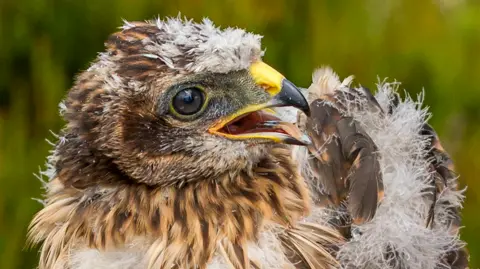
The story of Sorrel the hen harrier is an exceptional one.
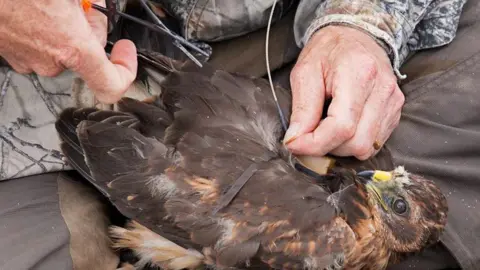
Ringed and satellite tagged on Langholm Moor in south Scotland a decade ago, simply by surviving and still being trackable she is a most unusual bird.
Natural England records show that the majority of her peers have either died, been killed or are categorised as "missing - fate unknown".
Sorrel, however, has travelled widely, fledged more than a dozen chicks and continues to provide precious data to help understand and protect a species facing a range of obstacles to its survival.
 Hawk and Owl Trust
Hen harriers, known for their acrobatic "skydancing" courtship displays, are categorised as red-listed in terms of conservation concern.
They are considered to be at high risk of extinction because of low breeding population levels following historic declines as a result of human persecution, according to the RSPB.
Hamish Smith is a licensed British Trust for Ornithology (BTO) ringer and trainer who works with the Hawk and Owl Trust (HOT) on hen harrier and peregrine falcon conservation projects.
He has followed Sorrel's progress over many years, helping to keep track of her movements and breeding history.
 Hawk and Owl Trust
"In a species that continues to face serious conservation pressures, every surviving breeding female is significant," he explained.
"Her story is notable because she has survived, travelled widely, returned to breed in multiple seasons, and successfully raised young.
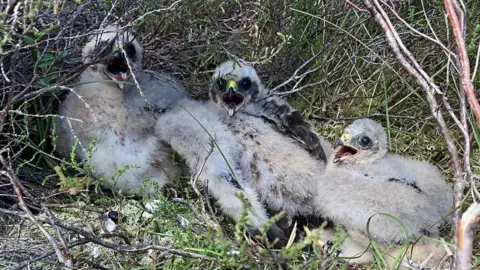
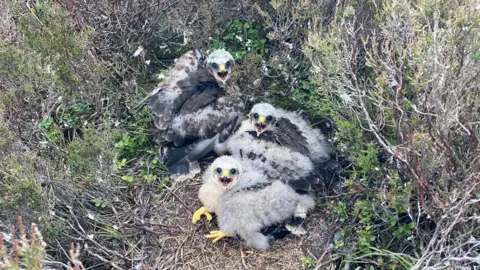
"Her latest brood has recently been ringed."
The trust said her story showed the value of careful, licensed, experienced conservation work and the importance of collaboration between conservationists, raptor workers, volunteers, land managers and local communities.
It is a journey which has taken her a long way since being tagged in the south of Scotland.
 Hawk and Owl Trust
"Hen harriers do not belong to one place alone," said Smith.
"Their lives depend on a connected network of safe habitats across a wide geographical area.
"Since 2016, Sorrel has travelled across a wide range of landscapes, including uplands, moorland, coastal areas, islands, forests and wintering grounds.
"Her movements have taken her across parts of southern Scotland, northern England, upland Scotland, island landscapes and, at one stage, across the Irish Sea."
Over the years she has used different areas for breeding, overwintering, prospecting and temporary stopovers.
She has returned to some regions repeatedly, while also exploring new areas in different seasons.
 Hawk and Owl Trust
"Without satellite monitoring, much of her story would have remained unseen - the distances travelled, the repeated seasonal patterns, the breeding attempts, the failed nests and the successful broods," Smith added.
Over the years she has fledged at least 14 of her chicks and provided precious information for those seeking to protect the species.
"Hen harriers are one of the UK's most iconic birds of prey, but they remain a species of high conservation concern," said Smith.
"Ongoing challenges include habitat pressures, nest failure, food availability, severe weather and illegal persecution.
"Long-term monitoring is valuable because it allows conservationists to understand patterns that would otherwise be missed.
"A single season may show where a bird breeds or winters, but many years of information can reveal much more about the importance of different landscapes at different times of year."
Her story is one which has spread its wings far and wide.
"Sorrel's journeys have also connected people, with her movements being tracked by conservationists, raptor workers, volunteers, land managers and local groups across different parts of Britain and Ireland," said Smith.
"This collaboration has helped improve understanding of how hen harriers use the landscape and where they may be most vulnerable."
In the process, Sorrel may also be giving other birds a better chance of surviving for as long as she has.
