Carly Simon reveals Parkinson's diagnosis

 Getty Images
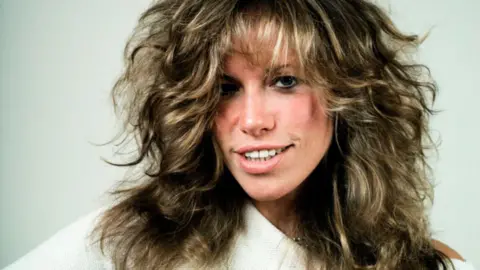
The singer-songwriter Carly Simon says she has been diagnosed with Parkinson's and is "learning how to live" with the "sometimes frightening" condition.
In a statement provided to the BBC, the 83-year-old described the "unpredictable" progress of the disease, saying: "Some days I'm so tired I can't get the day moving at all. On others, it gives me a little more room to move, think, work, and feel like myself.
"But I have not stopped living, and I have not stopped working," said the singer, best known for songs like You're So Vain, Why, and Coming Around Again.
Simon added that she had recently received surgery to remove a cancerous growth on her face that had "affected my appearance".
The surgery "made me more self-conscious about being seen in public," she added.
"I have always been more critical of my appearance than anyone else could possibly imagine (check out the irony of having written You're So Vain), and this gave my inner critic quite a lot of new material."
Parkinson's is a progressive disorder that affects the brain, nervous system, and muscle control.
It is the fastest growing neurological condition in the world, with about 153,000 people in the UK living with the condition.

Simon said her problems began with arthritis in both knees and one of her hips. However, her mobility failed to improve after three replacement surgeries.
"I had trouble standing up from low chairs and deep couches without someone offering me an arm," she said.
"Overstuffed furniture became my enemy. Once seated, I could feel as though I had been swallowed by the chair and might remain there permanently, like a guest who had badly overstayed her welcome.
"Eventually, there were periods when I could not walk without considerable help. My family and I knew that something more was going on. After an extensive evaluation at the Mayo Clinic, I was diagnosed with Parkinson's."
The musician has been receiving medication and treatment; but says the condition also comes with episodes of anxiety, depression, and apathy.
"The apathy is particularly strange," she observed.
"You can find yourself lying there like a starfish drying in the sun, arms pointing in all directions, while nothing inside is telling you to get up, read, watch, write, sing, call someone, or do much of anything at all.
"That has been one of the hardest things to explain. It is not simply sadness or laziness. It is as though the part of the brain that sends out invitations to participate in life has temporarily misplaced the guest list."
New album due in August
Simon said she had decided to speak about her diagnosis after she received letters, "kindly wondering about my relative silence, asking how I am and what I have been doing."
Despite her health condition, the musician recently announced a new album - Comes In Waves - which will be released in August 2026.
The first single, Howl, was released last month. It finds the singer consoling a friend who has just been through a break-up.
"Howl like the wind, roar like the river / Wail like the rain, cry, shout, and shiver," she advises, her tawny, contralto voice instantly recognisable.
A press release said the album would see Simon revisiting familiar themes such as "love, memory, family, self-reckoning, and forgiveness, while allowing space for contradiction, ambiguity, and emotional evolution."
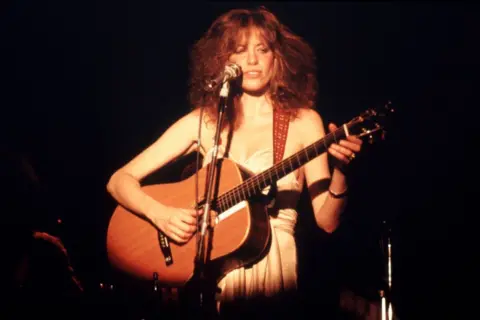
One of the most recognisable singer-songwriters of the 1970s, Simon was known for her emotionally honest, piano-led pop anthems, and intricate character studies.
Among her most beloved songs are the Bond theme Nobody Does It Better and Legend In Your Own Time, a withering portrait of an arrogant man.
The latter was something of a dry run for the scathing You're So Vain - written about actor Warren Beatty (and two other men) .
In 2003, she auctioned off the subjects' true identity for $50,000 (£38,000) - on the condition that the winner continued to keep the secret.
 Getty Images
In the statement confirming her Parkinson's diagnosis, Simon said she did not consider the condition "a gift or a blessing".
"It is neither," she wrote. "It is difficult, frustrating, and sometimes frightening. I am still learning how to live with it and how to accept it without feeling that I have surrendered something essential.
"I am still writing, singing, imagining, laughing, worrying, remembering, and occasionally getting trapped in an overstuffed chair.
She continued: "I am deeply grateful to my children, my family, my friends, my caregivers, and the medical professionals who have helped me through this. Their love and patience have carried me through days when my own reserves were not enough.
"These days I move more slowly, I lean on others more than I once did, and I have learned to accept that every day will look a little different.
"But I am still very much here."
