Saving lives: On board with an air ambulance crew

 BBC
BBCAs the Hampshire and Isle of Wight Air Ambulance service settles in to its new base at Southampton Airport, I have been thinking back to the memorable day I joined a crew on a shift out of its former airbase in Thruxton.
"Every day is totally different", says air ambulance pilot Chris Whittington.
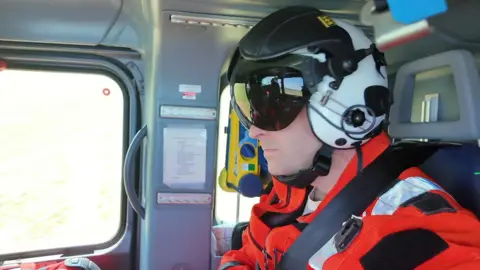
I'm sitting in a morning briefing with the team, eyeing the surprisingly heavy helmet and overalls I will be wearing on one of the hottest days of the year when I head out with them on shift shortly.
I have reported on news stories involving the emergency service many times over the years, always wondering what it would be like to be part of its crew.
When the opportunity to spend a full working day with them came up, I could not wait.
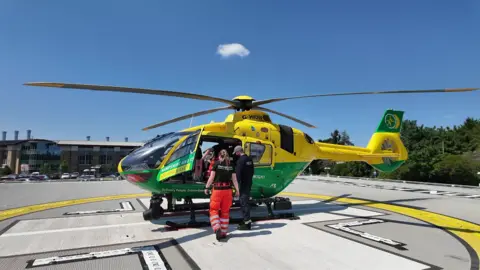
The service is a charity, relying entirely on donations to keep operating, and its move last week to a new £3.6m facility at Southampton Airport is expected to see journey times significantly shortened.
Each mission costs around £3,500 and its critical care teams are called out to an average of seven incidents a day.
When I joined the crew in the skies last summer, the service was operating out of its former airbase in Thruxton, near Andover.
First, I had to undertake a detailed training course, involving safety procedures and how to spot potential hazards as an extra pair of eyes when the helicopter lands.
Back in the briefing, pilot Chris outlines the weather conditions and other air traffic we must consider for the day.
"We could end up in Heathrow's airspace, which is slightly busier for me, or we could end up out in the middle of nowhere, where there's nobody on air traffic [control] to speak to and it's a relatively simple landing in a field," he says.
Our first call is to an incident in a residential Southampton street.
I put on my jacket and follow the crew down a flight of stairs to the hangar to get our helmets, which include headphones and microphones so we can communicate with each other over the noise of the spinning helicopter blades.
On the airfield, I wait away from the helicopter until Dr Chris Hill, the service's medical lead, says it is safe for me to approach and get on board.
My seat is at the rear of the aircraft, facing Dr Chris, with space alongside us for a patient to lie on a stretcher. Chris the pilot and paramedic Casey Pennington sit in the cockpit.
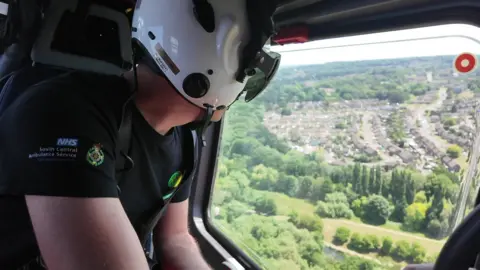
There is not much room - the top of my helmet touches the helicopter's ceiling - but, once we are airborne, the views of the countryside and the streets below are spectacular.
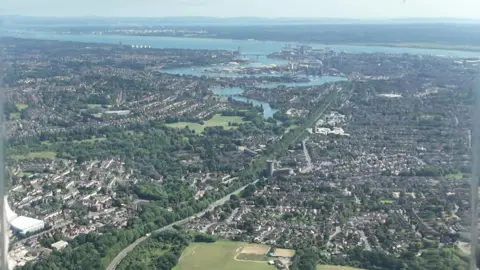
After a few minutes in the air, we land in a park identified as a safe open space close to the address we have been called to.
Chris the pilot stays on board, while Dr Chris and Casey put on their backpacks and head to the patient on foot.
"We tend to try and provide most of the advanced care that we administer outside of the aircraft", says Dr Chris.
"That's where we stabilise patients, typically, and then we use the aircraft itself as a principal transport vehicle."
In this case, the decision is taken for them to be transferred to hospital by road.
I travel with Dr Chris and Casey in an ambulance also at the scene.
Once the patient is handed over to the team at University Hospital Southampton, with an outline of their condition, it is back up to the helipad on top of the multi-storey car park to the waiting chopper.
On our way back to base, our headsets start to crackle as word comes in that we need to divert to another callout, this time in the countryside to a patient who has fallen from height.
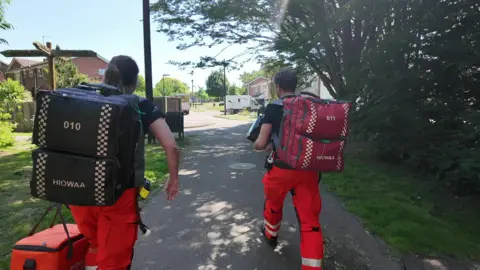
After landing in a field, Dr Chris and Casey are once again dispatched to provide care.
"I love doing what I do", says Casey. "I think we're in a really privileged position to go out and see patients that are quite sick, having a really bad day.
"We can go out and help them, make them feel a bit better and do something to maybe try and save their life."
Because of the nature of the patient's injuries, it is important to make the transfer to hospital as smooth as possible so, to avoid bumpy country roads, they will travel with us in the helicopter.
Several horses are rounded up and moved to a neighbouring field so our pilot can move the aircraft closer to the patient, reducing the distance the stretcher has to be carried.
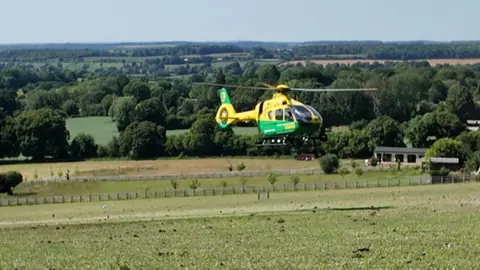
It is not long before we are back at University Hospital Southampton.
A team with a trolley is already waiting for us and the patient is wheeled to the emergency department.
After another detailed handover is completed, we take off once again and this time make it back to the Thruxton base.
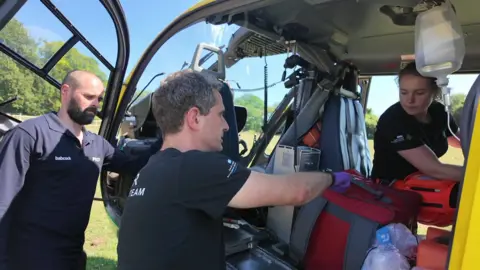
Most journey times for the service are now becoming shorter after its base moved to Southampton Airport.
Dr Chris says: "Placing ourselves in the middle of our population that we serve really will make a difference.
"We've already seen a step change in our response times and we hope that will then go forward to provide a greater and improved outcome for our patients when they unfortunately suffer one of the worst days of their lives."
My remarkable day comes to an end but it will live long in my memory.
Above all else, amid the fury of the spinning rotor blades, the dash to the cockpit and the scramble to get to patients when the call comes in, I was struck by the calm professionalism of the critical care team, no matter what.
The air ambulance high in the sky is a sight most of us are used to but, when I see it now, my admiration for the dedication of the incredible people on board has only deepened after the chance to see their work at first hand.
