Battery storage plans approved despite objection

 Getty Images
A plan for a large battery energy storage scheme near Thurso in Caithness has been given the go-ahead by the Scottish government, despite an objection from the bird charity RSPB.
The site is located on agricultural land at Phillips Mains Farm, about a mile (1.5 km) from the village of Mey, where the late Queen Mother had a favourite residence.
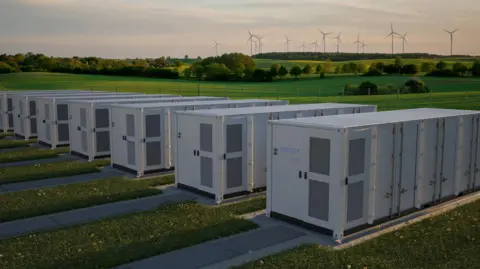
The Rigifa BESS comprises a battery energy storage system with a capacity of about 200 MW on a 45-hectare site.
The RSPB objected to the battery storage on the grounds that the development lies near the Caithness Lochs Special Protection Area (SPA), where geese and swans spend the winter.
'Essential infrastructure'
Scottish ministers said battery energy storage allows for renewable energy projects such as wind and solar farms to operate with more flexibility and resilience, meaning they don't have to be switched off when the electricity grid cannot cope with the amount of energy they are generating.
It said this was a "significant factor" in favour of the proposal.
The determination in favour of the plan said "on balance" the impacts of the proposed development were acceptable in the context of its benefits.

Historic Environment Scotland, which was one of the organisations consulted as part of the planning process, said the BESS had the potential to affect the Castle of Mey, the former residence of King Charles's grandmother.
However, it concluded it would not have an adverse impact on the listed buildings.
The one objection to the proposal was from the RSPB which said it was concerned about its impact on wintering populations of Greenland White-fronted Goose, Greylag Goose and Whooper Swan.
In particular, it said insufficient consideration had been given to the cumulative impacts of foraging habitat loss resulting from the development
 PA Media
How do battery energy storage systems work?
BESSs are being built across the UK to store renewable energy and improve the country's resilience.
They consist of metal containers storing huge numbers of lithium-ion batteries which can store energy generated by renewables when it cannot be taken on by the grid.
When demand is high, the batteries can then release the energy back into the system.
The move towards a net zero energy system will need increasing levels of energy storage but the BESS planning applications often prove controversial because of the visual and environmental impact.
There are concerns about the BESSs being a fire hazard due to the lithium-ion batteries, but the UK government said battery storage fires were rare in the country.
The application for the BESS near Mey came from David Bell Planning Ltd on behalf of Field Rigifa Ltd.
