'Contentious' flower beds could save council £750k

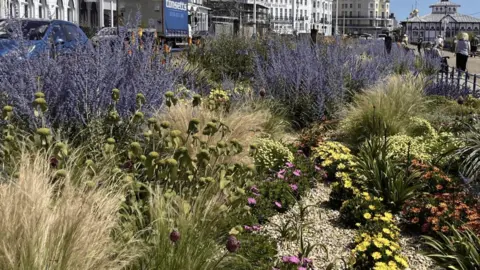 George Carden/BBC
"Contentious" flower beds in a seaside town could save the local authority about £750,000 across 10 years, a councillor has said.
In 2025, businesses said they were "disgusted" with Eastbourne Borough Council for changing the colourful seafront Carpet Gardens in a bid to reduce its carbon footprint.
Councillor Jim Murray said the new display with more hardy plants would save water and money, as flowers in previous years were imported from the Netherlands two or three times a year.
Murray, who admitted the change had been "very contentious", said due to increased travel prices it could have cost the council about £1m over 10 years, instead of the current estimate of £250,000.

When the change first happened, some people in the town said it made the display look "absolutely terrible" and like a "cat litter tray".
Murray said: "It was completely unsustainable going forward with climate change.... we need to do something more sustainability based."
The councillor said the previous Carpet Garden required "an awful lot of watering"
"[With] this scheme we've got the gravel on the top to stop the sun evaporating the water, and we don't have to water them quite so much like we used to," he added.
Murray said the display the previous year "was a bit of a shock", but added he "had faith that we would get to a point where we've got something as beautiful as we have now".
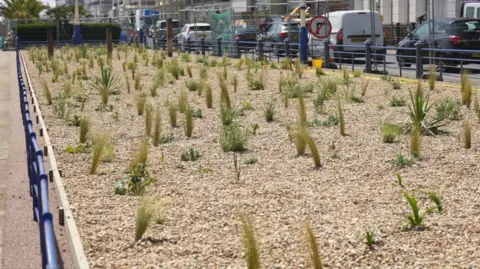
Speaking to BBC Radio Sussex, Eastbourne resident Peter Martin-Smith said the new display had "taken time".
"It obviously needed time and now, this year in particular with the additional planting, it's looking absolutely fabulous and I think we should consign the old Carpet Garden to history and enjoy the new," he added.
Karen Wells, who was visiting from Heathfield, said she hoped the council kept the new look amid a consultation on the change to the display.
"It's much better than the traditional carpet bedding which are not sustainable, garish, I think this is lovely.
"It's colourful all year round and it's better for the wildlife."
