How are people and wildlife faring in the heat?

 Richard Daniel/BBC
An amber heat health alert has been issued once more this summer for parts of eastern England as temperatures rise.
The alert is in place for 24 hours from 09:00 BST on Wednesday, and warns of significant impacts across health and social care services, including a rise in deaths, particularly among those aged 65 or over or with health conditions.
Temperatures in parts of the region are forecast to reach 34C (93F), so how are people and wildlife faring as the drought-like conditions continue?
Reservoir levels below average
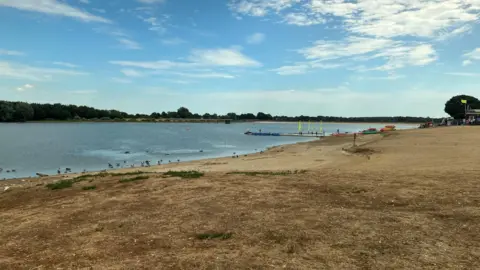
The banks of Alton Water reservoir, near Ipswich, are parched and dusty after weeks of hardly any rain.
It's therefore no surprise that the levels at the Anglian Water site are well below average - at about 75% of its capacity.
 Richard Daniel/BBC
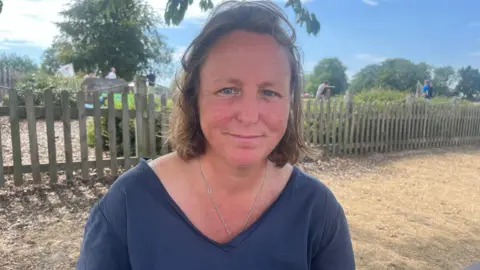
It is a matter which is on the mind of Jessica Southwell, who lives in the village of Birch, near Colchester in Essex, and falls under the Anglian Water hosepipe ban.
"I absolutely understand why I'm not using my hosepipe because of the water levels," she says.
"We are definitely doing all we can to help with everything by using the watering can.
"I think it's something we're going to have to get used to as the years go by because I don't think it's going to get any better sadly."
 Richard Daniel/BBC
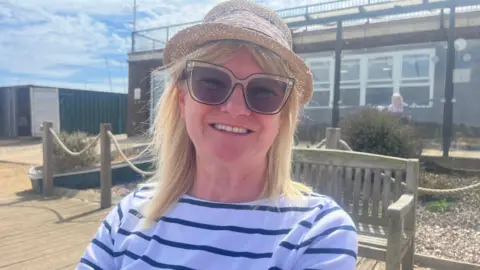
Lowestoft in Suffolk is not affected by the ban as it is served by Essex and Suffolk Water, which has not enforced the action.
It is home to Pauline Turner, but she says it feels unwise to be turning on her hosepipe and garden sprinklers to pump out water.
"It's common sense just not to be free with it if we haven't had it falling from the sky," she says.
"In the meantime, keep calm and carry on."
'I'm allowed to use a hosepipe because I'm 95'
 Richard Daniel/BBC
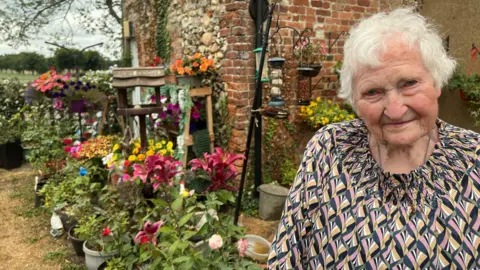
Maisie Pettitt is 95 years old and still proudly tends her garden and its blooms each day, at her home near Woodbridge in Suffolk.
Her area is subject to the current hosepipe ban, which has been brought in by almost all water companies supplying the region.
However, Anglian Water offers a number of exemptions. These include for matters of health and safety and where a hosepipe is needed for animal welfare.
Pettitt is one such householder who is permitted to use a hosepipe to water her garden, after she called the company to check her rights.
"The water board told me I was allowed to use a hosepipe because of my vulnerability and my age," she says.
"I was very grateful for that because I was so frightened I would fall over using my watering can."
Despite the exemption, Pettitt added she was being mindful of her water use.
"I'm very careful with it, and I have to be very careful that I don't trip over the pipe," she says.
'Extreme weather affects different birds in different ways'
 Richard Daniel/BBC
James Heywood is the Breeding Bird Survey national organiser, for the British Trust for Ornithology (BTO) charity, based in Thetford, Norfolk.
He says the repeated heatwaves have resulted in a mixed picture for East Anglia's bird population, which attracts people from across the country keen to spot the area's varied - and sometimes rare - species.
"An increase in temperature locally can actually have positive impacts for birds because insects, one of the main prey items for a lot of species - particularly when they're in nesting stage - become more visible," says Heywood.
"The parents can find them more easily, and so actually productivity can go up."
However, young birds - in the same way as humans - find it difficult to regulate their body temperature both in hot weather and unexpected cold snaps.
The bird expert says charity volunteers who have installed cameras in their bird boxes have recorded temperatures hitting 35C (95F) degrees, which is a problem in such small confined spaces.
He says birds that breed early in the season during hot spells can be caught out by sudden drops in temperature, while species, such as swifts, that typically nest later in summer can struggle in extreme conditions.
"You can visibly see the chicks panting - it's their way of regulating," says Heywood.
"It could be that not only the existence of these extreme weather events, but the timing of them will affect different birds in different ways."
He warns that for these reasons, people should site their nest boxes on north and east facing walls or anchor points.
Do you have a story suggestion? Contact us below.
Follow East of England news on X, Instagram and Facebook: BBC Beds, Herts & Bucks, BBC Cambridgeshire, BBC Essex, BBC Norfolk, BBC Northamptonshire or BBC Suffolk.
