New candy stores are popping up across NYC. Why?

 Getty Images
With US consumer confidence at historic lows, it's a tough time for retailers across the country. But in and around New York City one niche sector is expanding – candy stores.
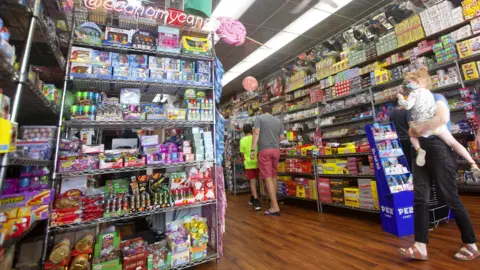
Mitchell Cohen, the third-generation owner of Economy Candy, on Manhattan's Lower East Side, has a theory – people will still buy candy (or sweets, as they are called in British English) – when economic times are difficult.
"The dollar isn't going as far these days," he says. "Inflation, uncertainty, all that, but there's always candy."
The business, the oldest sweet shop in New York, first opened its doors in 1937, towards the end of the Great Depression.
Initially it was a hat and shoe repair store, with candies sold from a cart out front as an extra earning stream.
But people couldn't afford to get things repaired, Cohen says. So his grandfather entirely pivoted to what was still selling – the affordable sweet treats. Eighty-nine years later, Economy Candy is still going strong.
 Economy Candy
While the most recent official data shows that US retail sales are still growing, up 4.9% in April from the same month last year, US consumer sentiment hit a new all-time low in May, according to one closely-watched report.
Echoing the thoughts of Mitchell Cohen, Kate Bolger says that as candy has a low price point "everyone can partake" despite people feeling the economic pinch.
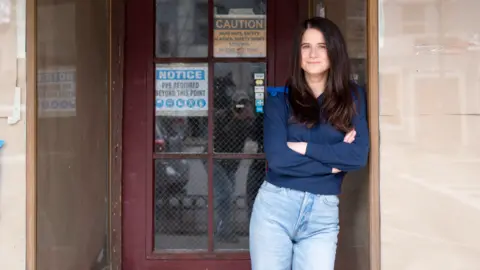
Next month she is due to open The Village Confectionery, a candy store in Sleepy Hollow, the Hudson Valley town 28 miles north of New York City that is best known as being the setting of the 19th Century horror short story The Legend of Sleepy Hollow.
Bolger, who previously worked as a movie producer, says that while consumers may be putting off making big, expensive purchases, they can still treat themselves to a piece of candy.
It is an extension of the so-called "lipstick effect" economic theory that was popularised in the early 2000s, whereby people who couldn't afford to buy something really expensive would buy a little luxury item instead.
 Andrew Porter
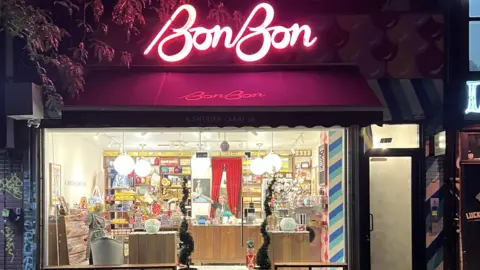
Back in New York City, an upmarket candy store company called BonBon now has five shops across Manhattan and Brooklyn, and another in the Hamptons on Long Island that opened last summer.
The business, founded in 2018 by three Swedish expats, imports its product range from Sweden. Swedish confectionery, which has strict rules regarding the use of all natural ingredients, has in recent years seen a big rise in global popularity thanks to social media.
BonBon co-founder Leo Schaltz says that a key company rule for its shops is to avoid main avenues. "You wouldn't want to be on Broadway," he says.
Instead the firm goes for side streets, where the rents are lower, and takes over small units. "You don't want to overpay for rent, and it's easier to make a space feel cozy when it's smaller," he says.
Schaltz adds that BonBon also focuses on "little, quirky details", such the staff wearing uniforms inspired by a Stockholm restaurant. This summer it is due to open a branch in Greenwich, Connecticut.
Meanwhile, Swedish sweet shop chain Candy King, opened its first US outlet in Manhattan last December.
 BonBon
In Brooklyn, Cat Cirino launched her sweet shop, Candor Candy's, in the Fort Greene neighbourhood in March. To boost revenues she also sells pantry items such as granola, rice, soft drinks and beef jerky, all from independent producers.
But when it comes to her core product, selling candy has a number of benefits, such as it having a long shelf life, and being able to sit at room temperature. And if the shop follows the pick-and-mix model then the customer does a lot of the work on his or her own.
But as Cohen points out, it is not all plain sailing. With many confectionary supplies coming from overseas, he says that his wholesale prices have risen. The increases come due to President Trump's numerous import tariffs on other countries, and higher global transport costs as a result of fuel prices rising due to the US-Israeli conflict with Iran.
Cohen notes that a Hershey chocolate bar that cost his shop about 62 cents pre-pandemic now comes to more than a dollar. For while Hershey's is a famous American brand, the cocoa beans it is made from come from overseas.
He adds that one of his UK suppliers simply stopped shipping to the US after losing too much money in customs.
Despite these issues, Cohen says he has absorbed most of the cost increases, and that his sales are up. In these tough economic times, he says "a little candy goes a long way".
