Opening of long-awaited US-Canada bridge delayed

 Getty Images
The long-awaited opening of a new bridge connecting the US and Canada has been delayed, according to the Canadian organisation in charge of construction.
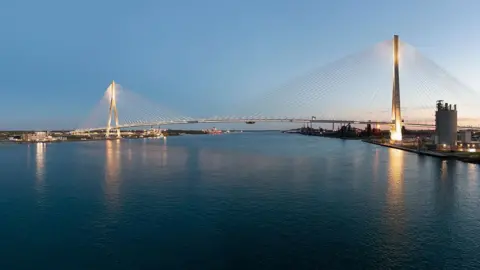
A ribbon-cutting ceremony had been scheduled for Friday to honour the new Gordie Howe International Bridge, named for the Canadian hockey legend who played for the Detroit Red Wings in the NHL.
"Canada and the United States have agreed to delay the opening of the bridge, taking the necessary time to resolve any outstanding issues," said Chuck Andary of the Windsor-Detroit Bridge Authority (WDBA).
Canadian Prime Minister Mark Carneysaid a delay of "a few weeks is time well spent" and referred to the issues as a series of "technical aspects".
Carney, who earlier this week conceded the bridge might not open at the scheduled time, asserted on Thursday that there is "no great drama" around the delay, which he said Canada agreed to at the request of the US.
The neighbouring countries would "take the necessary time" to resolve issues raised by the Trump administration, he said.
In a statement, Andary said the bridge would be a "vital economic link for Canada and the United States", and that the two sides were taking a "collaborative approach" to set an opening date.
The organsation did not explain the latest delays - and when the ribbon-cutting ceremony or the actual opening would take place.
Earlier this week, Carney said everyone was "working hard to make sure the bridge is open as soon as possible".
"If it takes a little longer, it'll take a little longer," he said.
Construction for the project - connecting the Canadian province of Ontario to the US state of Michigan - began in 2018, but has proven contentious for the countries for more than a decade.
The bridge faced several delays due to the Covid-19 pandemic as well as threats from US President Donald Trump to shut it down.
In February, Trump demanded that Canada "share authority" and ownership of the bridge, which was built by the Windsor-Detroit Bridge Authority, a Canadian federal Crown corporation wholly owned by the government but operating at arm's length.
Drew Dilkens, mayor of Windsor, the Canadian city where the bridge begins, said he was informed the ribbon-cutting ceremony and opening had been canceled but was not given a reason. He said he believed Trump was the reason behind the delay.
"I think that would be the only logical conclusion, that Donald Trump didn't want it to open, and therefore it shall not open," he told the BBC. "The bridge is fully built and ready to open."
The BBC has contacted the White House for comment.
The Moroun family - the American owners of the neighbouring Ambassador Bridge also connecting Detroit to Canada - has lobbied Trump to stop construction of the bridge. The family argued that it infringed on their exclusive ability to collect tolls. The Ambassador is one of the few privately owned crossings.
Dilkens said he understood the Moroun family's goals of protecting their business. But he said the bridge was designed in part for safety purposes, to have another crossing in case of a catastrophic incident on the Ambassador Bridge, as well as a response to increased trade between the two countries.
Dilkens, along with officials in Michigan, including Democratic Governor Gretchen Whitmer and Senator Elissa Slotkin, say the bridge will bring jobs and other economic benefits for the two countries.
The project was negotiated by former Michigan Governor Rick Snyder, a Republican, and is estimated to have cost $6.4bn CAD (£3.4bn).
The delay of the bridge opening comes after a year of tensions between Canada and the US during Trump's return to office. Last year, Trump launched a trade war with Canada and several other allies when he imposed new tariffs, while he has also angered the northen US neighbour by suggesting he wants to make Canada a "51st state".
This week, during trade talks, Trump said he was not sure he would renew the US-Mexico-Canada Agreement, the trade pact uniting the three North American economies for several decades.
The trade tensions have spilled over into unrelated areas. Last year, Canadian travel to the US plunged by 20%, costing the US economy more than $4bn, according to estimates by the US Travel Association.
Dilkens said he and many other Canadians have been protesting the Trump administration with their wallets, such as avoiding travel to the US. He was hopeful that opening the bridge would give a small boost to relations between two countries that have been allies for a century.
"We want to get back to normal," he said. "Having this opportunity to release a little steam out of the valve and allow people just to live their lives in a different way by being able to ride their bike or walk across the bridge I think will help - in some very small way - ease some of the tension that exists locally."
