How does wildfire smoke affect your health?

 BBC
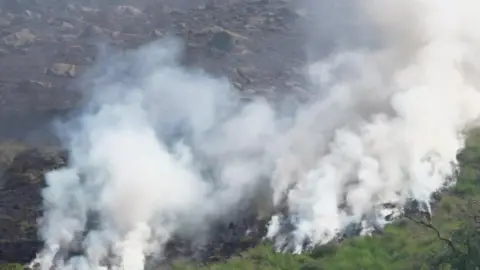
BBCParts of the north-west of England have been shrouded in smoke after a number of moorland fires broke out in the region.
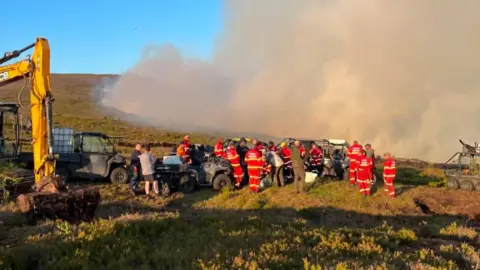
A fire, which broke out at Dove Stone Reservoir in Greenfield, Saddleworth, on Saturday, continues to burn and has since merged with another fire several miles away at Tintwistle Moor near Glossop, in Derbyshire.
In Lancashire, fire crews tackled a moorland fire on Burnley Road in Gisburn on Tuesday - just days earlier they had been called to a wildfire on Belgrave Road in Darwen.
With concerns growing over wildfire smoke, what do the experts say about how it can affect your health?
What is happening in the region?
Strong winds have carried smoke across parts of the region with parts of Greater Manchester particularly affected.
The Met Office said the wind direction and the heat was keeping the smoke low.
Alan Goodman, regional advisor at the Met Office, said: "There has been this continuous feed of smoke into the atmosphere and the winds have been helping it to travel a fair distance.
"We get what's called a temperature inversion which is where smoke and air will rise to a certain height but no higher than that that so it is effectively hanging around across the city [Manchester] and lower levels of the atmosphere for a lot longer."
Why are people concerned?
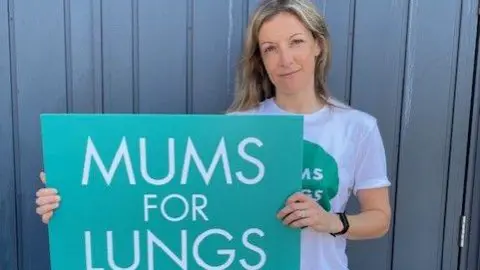
Liz Godfrey, 49, the Greater Manchester coordinator for clean air campaign group Mums for Lungs, said she had been "really concerned" over the air quality impact of the fires.
"We've been going outside and breathing in really thick, dirty, nasty air," she said.
"A lot of parents have contacted us feeling quite helpless, really unsure about what to do.
"They didn't know whether to take their kids to school, whether they should be opening windows or keeping them closed."
She said she would like to see more advice shared on the matter to ensure the public had all the information.
"I just feel at the moment, there's just very little health advice out there for everybody," she said.
 Liz Godfrey
What is the advice for the public?
All smoke is potentially harmful to your health, according to advice from the UK Health Security Agency (UKHSA):
Wildfire smoke is made up of various air pollutants, which will depend on what is being burnt and the nature of the fire.
But is likely to contain a complex mixture of fine particles, carbon monoxide, nitrogen oxides and volatile organic compounds, the UKHSA has said.
The fine particles are particularly concerning as they can penetrate deep into your lungs and even enter your bloodstream causing illness.
If a wildfire breaks out, the UKHSA has the following advice:
- Residents should avoid areas affected by smoke from the wildfire where possible
- If smoke is visible in your area, stay indoors with doors and windows closed, and follow updates and advice from local authorities and local media
- If you need to travel through smoky conditions, keep vehicle windows closed, switch air vents to recirculate, and turn off systems that draw air from outside
- Keep curtains closed to reduce heat from direct sunlight, use fans to circulate indoor air, wear lightweight clothing and drink plenty of fluids
- Where available, air-conditioning systems fitted with suitable filtration should be set to recirculation mode
 Micklehurst Cricket Club
How will short-term smoke exposure affect your health?
Dr Fatemeh Moheimani, who is a lecturer with a focus on respiratory diseases at Manchester Metropolitan University, said short-term exposure to wildfire smoke was unlikely to cause any significant health problems for most healthy people.
But she said that people with health conditions were more likely to be affected.
"Smoke can irritate the eyes, throat and airways, leading to coughing, sore throat or mild breathlessness," Moheimani said.
"People with asthma and other lung conditions are more likely to be affected.
"Young children and older adults may also be more sensitive to poor air quality and should take extra care if smoke levels are noticeable."
Moheimani also said it may be sensible to "reduce strenuous outdoor activity until conditions improve".
Read more stories from Cheshire, Lancashire, Greater Manchester and Merseyside on the BBC, watch BBC North West Tonight on BBC iPlayer and follow BBC North West on X.
