'My memories of foot-and-mouth disease are dystopian'

 PA Media
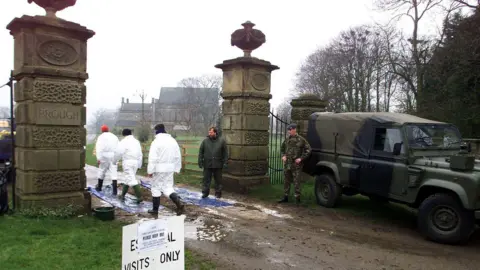
Twenty-five years on, farmer William Lambert is still reluctant to revisit his memories of the foot-and-mouth disease outbreak and the devastation it brought to his Yorkshire Dales home.
On 6 March 2001, a date Lambert can still recall, a case of foot-and-mouth was confirmed at his farm near Hawes.
It was the first of 133 cases of the highly contagious virus in North Yorkshire, making the county one of the worst-affected areas nationwide.
That day, a crestfallen Lambert told BBC Look North the news was "devastating", knowing full well the sheep and dairy cows he kept would have to be culled in line with government orders to control the spread of foot and mouth.
Nationally, millions of animals were killed, with the wider rural economy also dealt a devastating blow.
"We've done everything humanely possible to keep ourselves safe - we haven't been anywhere for 10 days," said Lambert, whose quiet corner of Wensleydale had become the centre of a national story, in the Look North interview at the time.
Lambert, whose family history is interwoven with farming "as far back as we can basically find", wasn't just thinking of his livelihood in trying to keep his livestock safe.
"When you are a stock farmer you do have an alignment with your stock, especially small Dales farms," he explains from the same farm 25 years later.
"Every cow had a name and we were home breeders, so every animal would go back generations.
"That was just wiped out in one day completely."
Lambert lost 117 cattle and 168 sheep.
The government had taken a ruthless approach to try and contain the disease, which was first discovered in February 2001.
Where it was found, animals on that farm and others within 3km (1.8 miles) had to be killed.
"From our point of view we need to get them dead as quickly as possible to close down what they represent, which is a virus factory," a spokesperson for the Ministry of Agriculture, Fisheries and Food (MAFF) said at the time.
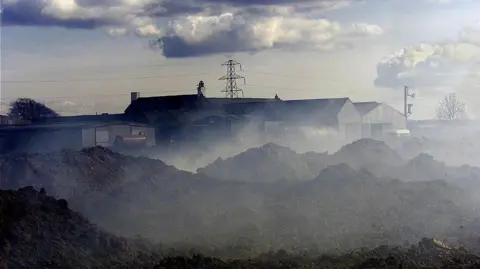
In total, more than six million animals were slaughtered and burned, with the image of piled-up burning carcasses an enduring memory of the time for many.
Exclusion zones around farms where cases had been confirmed were also commonplace.
In the Vale of York, in an effort to stop the virus from travelling to an intensive pig farming area, a 900-sq mile no-go-area centered on Thirsk was established, with a further buffer zone in place around that.
It was the stuff of Chernobyl, not the picture-postcard North Yorkshire countryside.
 Getty Images
Described as a "war zone" in one national media report, police and council trading standards officers patrolled the area 24/7, making sure animals were not moved on and off farms, and that all vehicles entering or leaving had been cleansed and disinfected.
The no-go area covered no fewer than 1,561 farms and lasted six weeks.
If this sounds dystopian, "it most certainly was," says Lambert, now 64.
"It was a very, very strange time," he adds.
"It was something we have never seen before, anywhere."
The National Farming Union's (NFU) regional director for the north, Adam Briggs, also recalls an "eerie time" for the industry.
In 2001, he was working as a farming accountant in Cumbria, the county with the highest number of outbreaks.
"We used to get lists every morning from Defra (Department for Environment Food and Rural Affairs) about which farms had gone down," he recalls.
"You had to identify any of your customers and offer them support."
What is foot-and-mouth disease?
- Foot-and-mouth is a viral disease which can affect cattle, sheep, pigs, and goats as well as wild and domestic cloven-hooved animals
- It causes fever, followed by blisters in the mouth and on the feet
- The virus can spread through the air and can travel very long distances given the right conditions
- Heat, sunlight and disinfectants help to destroy the virus. Cold and darkness tend to keep it alive
- It can also survive pasteurisation in milk. It can be spread on contaminated clothing, where it is able to survive for up to two weeks
- There are seven "types", external of the virus
- Type O is the most common and was responsible for the 2001 and 2007 outbreaks Each "type" requires a specific vaccine strain to provide immunity
Briggs says about 90% of his clients were affected by foot-and-mouth cases on their farms.
"The personal cost was immeasurable - people seeing their livelihoods literally go up in flames," he adds.
The farms who managed to avoid the disease "suffered just as much", he remembers.
"They couldn't sell their stock [but] they still had to feed their stock."
They too lost their livelihoods, Briggs adds, with many forced into so-called "welfare culls".
He likened the time to the coronavirus pandemic.
"From a farming perspective everything stopped, you couldn't trade anymore, the footpaths closed and you isolated yourself as much as you could.
"Then, when you found the disease, you go in as hard on it as you can."
Over in West Yorkshire, the outbreak was less severe, but sixth-generation farmer Andrew Parker from Thorncliffe Grange in Elmley still remembers the paranoia it caused.
"The biggest thing for us was monitoring how close it was coming," he recalls.
"The threat of getting it was the biggest worry - everything else seemed a little insignificant.
"I knew one or two farms that were directly affected and their herds were taken out, it was life-changing for them, quite literally.
"Some of them never went back in."
 PA Media
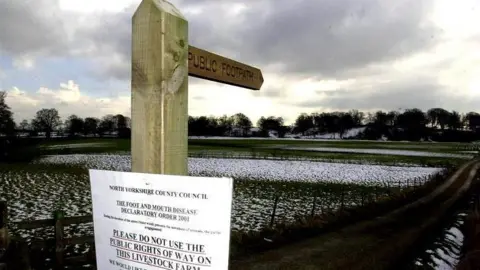
In many areas, footpaths, bridleways, canals and their towpaths were also forced to close, meaning the wider rural economy - often driven by visitors - also suffered.
Hotels, pubs and picturesque visitor destinations felt the pinch, with Lambert remembering the ever-popular Dales as "a barren landscape" in the absence of grazing animals and ramblers.
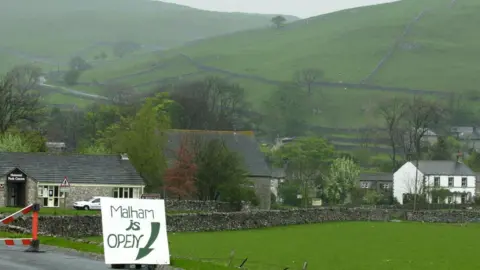
As cases of the disease continued to be identified until September, places like Burnsall and Malham - often overrun by visitors during summer months - turned into ghost towns.
A BBC report from spring 2001 said a lack of tourists was costing Yorkshire £80m a month.
In Malton, 100 workers were laid off at the town's bacon factory due to a lack of work.
Meanwhile, the long-running Great Yorkshire Show, only ever curtailed by world wars by that point, was also forced to cancel.
The 167th edition of the event takes place this week, with Briggs describing it as "the biggest show in the agricultural calendar".
The outbreak was declared over in January 2002, but Lambert, who never restocked sheep, instead focusing on dairy cows, says it changed farming forever.
"Every farm I know made changes," he reveals.
"Whether they changed the way they farm or the kinds of stock, or less stock.
"It was a turning point for a lot of businesses."
A smaller outbreak of foot and mouth occurred again in 2007, but the virus has not been found in Britain since.
However, it continues to be a problem in other countries around the world, including in Europe.
The disease was found in cattle and sheep in Cyprus in February, with farmers still well aware of its threat.
"It's a major risk," says Richard Wood, a second-generation farmer from Sowerby Bridge.
"People are complacent, they don't appreciate the risk."
Briggs says lessons need to be learned from the past.
"We need to have robust measures in place, both in our country and also to stop it from coming from abroad," he explains.
"The biggest threat is it coming in the back of a car. God forbid if we get it again."
Listen to highlights from North Yorkshire on BBC Sounds, catch up with the latest episode of Look North.
