World's oldest football in Miami for Scotland's game against Brazil

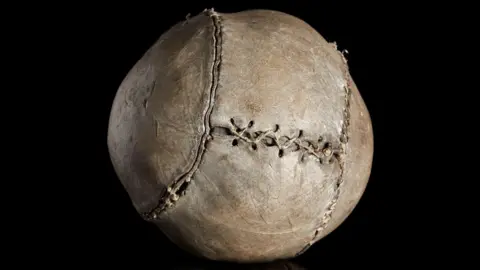 Stirling Smith Art Gallery & Museum
The world's oldest football has travelled from Stirling to Florida to make an appearance at Scotland's crunch World Cup match against Brazil.
The ball, which is believed to date from between 1540 and 1570 was discovered in the 1970s, lodged in the rafters behind the Queen's Chamber at Stirling Castle.
It will be displayed at the Coral Gables Museum in Florida until Saturday as well as being shown at the Scotland match on Wednesday.
The ball has been loaned to the museum by Stirling Smith Art Gallery and Museum, where it is the prize exhibit in a collection of more than 40,000 items.
The ball, which is recognised by Guinness World Records as the world's oldest, is roughly the size of a small melon.
It is made from thick leather panels containing a pig's bladder.
It has been dated to the era of James V and the young Mary, Queen of Scots, who lived in the chambers as a child.
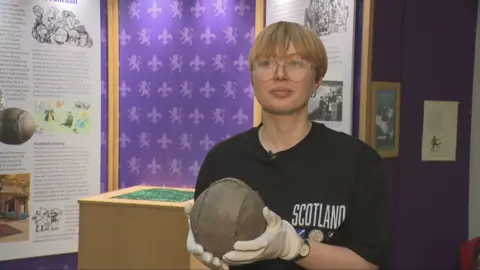
Stirling Smith curator Aiofe McKenna said: "Somebody in the 1540s must have kicked the ball quite high into the ceiling and it got stuck.
"The timeline aligns with Mary, Queen of Scots residing in the castle and of course it was discovered in the Queen's Chambers.
"So we couldn't say for certain, but we like to think that Mary played with this ball."
 Getty Images
Records show that football was popular in Scotland from the 15th Century.
McKenna said: "People still enjoyed playing it the same but it was quite a different game, it was very violent.
"But that doesn't mean it wasn't popular - it was very popular.
"Many of the Scottish monarchs actually tried to ban it because of all the chaos it was causing."
The ball is included in the Florida museum's exhibition Diplomacy and the Beautiful Game: From Scotland to Brazil to Haiti.
McKenna said: "It's really exciting that it will be there for the Scotland and Brazil match.
"People often come specifically to see the ball so football fans know it's here.
"But we think this will bring its history to a huge number of people who maybe do not know that the Smith held the football."
The Tartan Army has arrived in Miami for Scotland's final group game following a 1-0 win against Haiti and a 1-0 defeat to Morocco.
 Reuters