Inside London's only coalition council

 BBC
BBCLondon's only coalition council says it is "fixing Labour's mess" after the former administration criticised a series of U-turns and cancelled meetings since it took office.
The Green Party and the Liberal Democrats took control of Southwark Council in May after Labour lost overall control in the local elections.
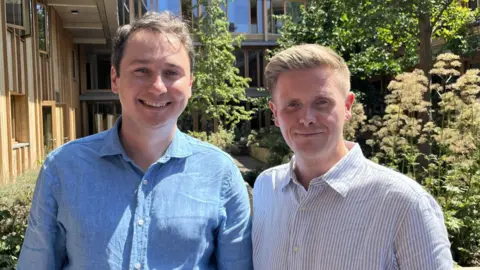
The council's new Green leader, James McAsh, and Liberal Democrat deputy leader, Victor Chamberlain, showed me around the Appleby Blue Almshouse in Bermondsey, a social housing development for older people that won last year's Stirling Prize for architecture.
With its pine-coloured decor and courtyard garden, it does not look like a typical social housing scheme.
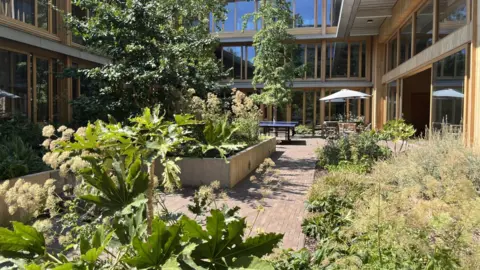
The development is run by the charity United St Saviour's, which subsidises housing costs. Southwark Council provided the land, enabling it to be built using developer contributions while Labour ran the authority.
'Accountable to the people'
The coalition says it wants to support more affordable housing developments like Appleby Blue, but has yet to set out detailed proposals.
Asked whether he was simply continuing Labour's approach, McAsh, who defected from Labour earlier this year, said: "We're certainly building on a lot of what Labour were doing in the past, but we're also moving away from some of the things that Labour are doing.
"One of the challenges that we face is this £102m funding gap that was left to us from the last administration and one of the clear differences from our administration to the one before is that we see ourselves as entirely accountable to the people of Southwark."
About 23,000 households are on Southwark's social housing waiting list.
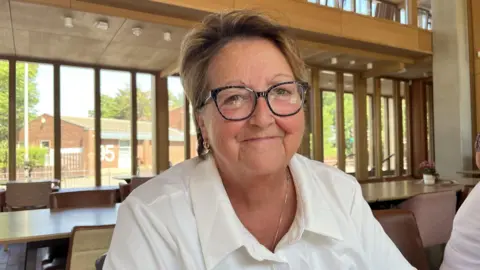
Appleby Blue resident Fran Goggins said moving into the development had freed up her former three-bedroom council house for another family.
She said the coalition council's pledge to make Southwark more affordable needed to be backed up with action.
They needed to "mean what they say and say what they mean, and stick to it," she said, "and if they're going to build places like this then they need to do it sooner, rather than later. Don't drag it out".
It has been almost three months since Labour lost control of a dozen London boroughs in the local elections.
While they lost four of them outright - including Hackney and Lewisham to the Green Party, and Westminster to the Conservatives – Southwark was among eight councils left in no overall control.
This means no party has enough seats to run the council with a majority.
While seven of those boroughs ended up being run by minority administrations of one political colour or other, one borough - Southwark - became London's only coalition council this year, when the Green Party and the Liberal Democrats joined forces to keep Labour out of power.
This is not the first time that Southwark's been run by a coalition.
Back in 2006 the Liberal Democrats joined forces with the Conservatives here to keep Labour out and there have been a handful of coalitions in other London boroughs over the years.
For example, after the previous London local elections in 2022, there was a coalition in Havering between the Residents Association and Labour, which only lasted two years.
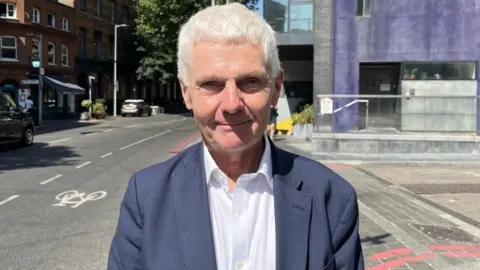
Tony Travers, a professor at the Department of Government at the London School of Economics, says there have been some "more successful ones before".
He said Camden had a Conservative-Liberal Democrat coalition in 2006, while the same parties joined forces in Lambeth between 2002 and 2006.
"So these things can be made to work," he added.
In Southwark, Labour were ousted in May's local election after 16 years in control despite remaining the largest party with 29 councillors.
The Green Party won 22 seats and the Lib Dems had 12, and used their combined majority to take control.
As the junior partners in the joint administration, the Liberal Democrats secured three executive posts on the leadership team, including that of the deputy council leader, a role filled by their group leader, Victor Chamberlain.
He said: "The more we started talking, the more we realised that we had a lot in common, that we shared similar values and aspirations for our borough, and actually we wanted to build a borough that is more affordable, that is safer and that is greener.
"I think we found it really very constructive to work as two parties that both bring great ideas to the table."
But the deputy leader of the opposition Labour group, Evelyn Akoto criticised the Green-Lib Dem coalition for either cancelling or postponing several council meetings and for saying they would close some local services before U-turning in the of face local opposition.
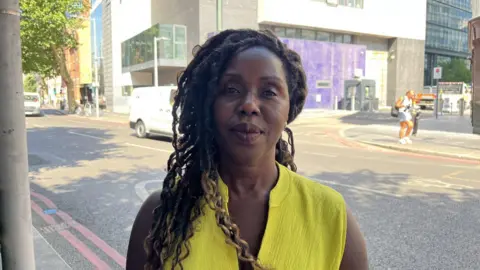
"It's been a chaotic few months," Akoto said.
"Apart from a number of meetings being cancelled, we've had two proposed cuts, one being the Nest which is a free mental health support for young people and a dementia service being cut, but it's been reversed because the Labour group, along with residents have pushed back.
"It's quite clear that they don't know what they're doing and actually this [coalition] was done in a rush."
But the Green's council leader, McAsh, said the meetings in question had been scheduled by Labour when they presumed they would still be in charge after the local elections.
On the proposed service cuts, he said: "For whatever reason, Labour did not renew their contract at the time it should have been renewed, and it lapsed two days after we formed an administration.
"At first, we thought it was too late for us to be able to resolve that problem, but actually we were able to save the service that Labour left to lapse."
I wouldn't describe that as a U-turn, I'd describe that as fixing Labour's mess," he added.
If the coalition holds, they will have just under four years to deliver, with the next set of local council elections due in London in 2030.
Listen to the best of BBC Radio London on Sounds and follow BBC London on Facebook, X and Instagram. Send your story ideas to hello.bbclondon@bbc.co.uk
