Celestial events to light up the spring night sky

A rare green fireball meteor shoots through the dawn sky over Florida during the Eta Aquariid meteor shower
- Published
Spring is a great time for stargazing with night skies still dark enough to spot celestial events.
Coming up we have a rare Blue Moon and not one but two meteor showers to look forward to.
If the skies are clear there could be plenty more to see.
Already this year stargazers have been treated to a lunar eclipse and a planetary parade as well as some dazzling Northern Lights displays.

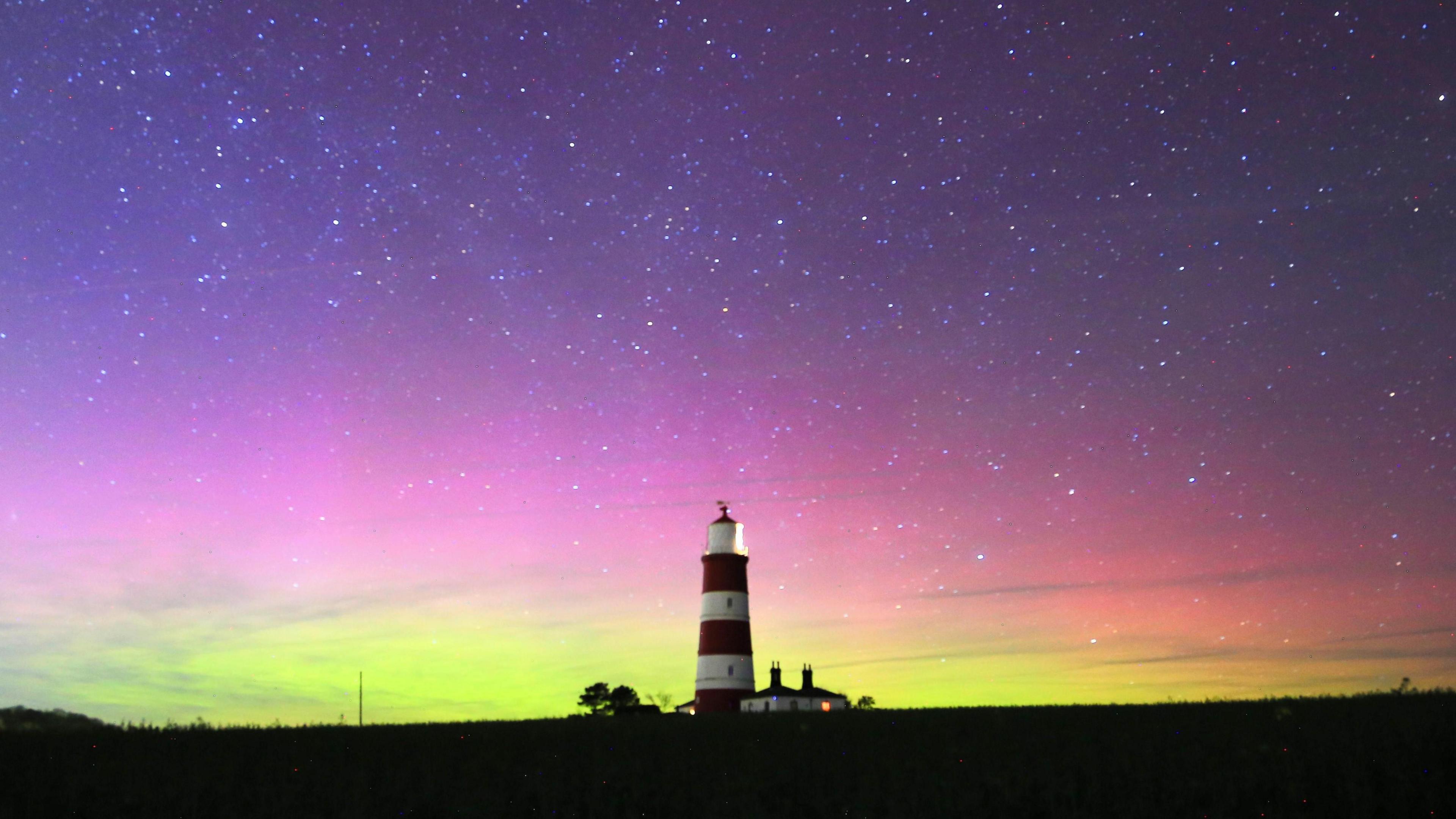
The Northern Lights put on a spectacular display over the North Sea at Weybourne
Lyrids meteor shower
The Lyrids meteor shower will light up our skies between 16-25 April.
These bright and fast meteors are associated with Comet Thatcher and they appear to radiate from the Lyra star constellation.
According to the Royal Museums Greenwich, it is the oldest recorded meteor shower still visible today.
At the peak of the meteor shower on 22 April there will be around 18 meteors per hour.
Eta Aquariids meteor shower
The Eta Aquariids meteor shower overlaps for a short while with the Lyrids.
They are active between 19 April and 28 May 2026 and peak between midnight and dawn on 6 May 2026.
With up to around 40 meteors per hour it is a stronger shower with stunning streaks of light which are debris from Halley's comet.
The best view of the Eta Aquariids is usually from the southern hemisphere, but they will be visible in the northern hemisphere as they appear low in the eastern sky just before dawn. To see them, look towards the Aquarius star constellation.
Two comets to flyby in April
The first comet to pass Earth is known as C/2026 A1 (MAPS), which reaches its peak brightness around the 2 - 6 April as it moves very close to the Sun.
It's best seen in the southern hemisphere where it will appear low in the sky and close to the Sun's glare, which makes it difficult to view safely.
In the northern hemisphere you could have a better chance of seeing the second comet, C/2025 R3 (PanSTARRS).
If visible it will be before dawn in the eastern sky near the constellation Pegasus, between 13 - 15 April. Positioned further from the Sun, it's easier and safer to spot.
Stunning sky gazing events to come in 2026
- Published27 May
Full Worm and Blood Moon shines in night sky
- Published4 March
Spring Triangle
As we move further into spring in the northern hemisphere, the Spring Triangle will also make a dazzling appearance in the night sky.
It consists of three bright stars from three different constellations: Arcturus, in the Boötes constellation, Spica, in Virgo, and Regulus, in Leo.
The Spring Triangle appears in the south-eastern sky around the time of the March equinox, and peaks in April.
A sure sign that spring has arrived.
May's full Moon

The full Flower Moon photographed in May 2024
April's full Moon, known as the Pink Moon took place on 2 April.
On 1 May we will see the Flower Moon which signifies the blooming of spring flowers and represents a time of abundance.
But in a rare occurrence, there will be two full Moons in May - on 31 May we will see the Blue Moon.
A 'Blue Moon' is the name given to a second full Moon in a calendar month.
We usually get 12 full Moons a year but this doesn't quite match up with the lunar orbit of the Earth.
The Moon makes one revolution every 27.3 days so roughly every two and half years we get an additional full Moon.
As it only happens every few years it is where the expression 'once in a blue Moon' comes from. The Moon will not look any different
If you want to take a photo of the Moon, make sure you turn off the flash and activate night mode on your camera.
Spring equinox and Northern Lights

The aurora is best viewed under clear skies, look to the north for a faint glow at first and if you can't see the colours, try through a camera lens or on your phone
The spring equinox marks the start of astronomical spring and took place this year on 20 March.
The equinox is when the Sun moves across Earth's equator and day and night are almost equal in length.
At this time of year there is a greater chance of seeing the Northern Lights due to something called the Russell-McPherron effect.
Despite being past a peak in the Sun's activity and heading towards its "solar minimum", activity will remain relatively high through 2026, meaning the chances of seeing more of these colourful waves of light are expected to remain strong.
It was spotted across the UK on 20 March with some impressive photographs taken by BBC Weather Watchers.
If you are planning on stargazing, be sure to check the BBC Weather forecast to find out where the clearest skies will be.
- Published21 March
- Published10 March