Summary

  • US President Donald Trump says an agreement has been reached for the "complete disarmament" of Hamas in Gaza - what we do, and don't, know

  • A senior Hamas official tells the BBC they have agreed to the plan and an official statement will follow

  • Israel has yet to comment - US officials say Trump will be "very disappointed" if Israel does not withdraw as part of the agreement

  • It remains too early to judge whether this agreement will stick - but it marks the first time ever that Hamas has said it would completely disarm, which has been the most significant obstacle for peace talks, writes the BBC's Rushdi Abualouf

  • Announcing the agreement late on Thursday, Trump said it was "a critical step towards Gaza finally being governed by a new Palestinian government"

  • The second phase of a US-brokered Gaza ceasefire plan - released last October - includes the disarmament of Hamas

  1. Analysis

    Why Trump's plan may not work in practicepublished at 08:41 BST

    Jeremy Bowen
    International editor

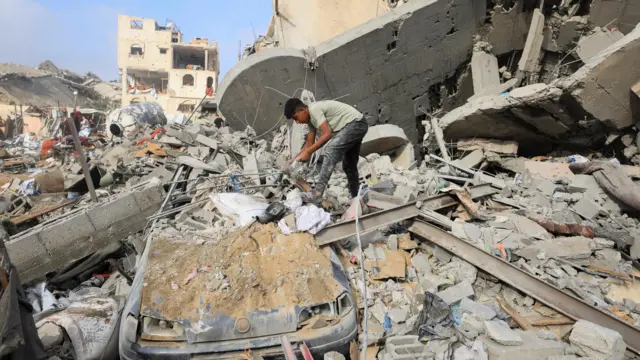
    A Palestinian boy inspects the site of Wednesday's Israeli strike on a house whose residents were pre-warned by the Israeli military to evacuate, in Gaza City, July 30, 2026.Image source, Reuters

    There are many reasons why this will not work.

    But there are many reasons why everybody should hope that it does find a way of working.

    More than two million people, Palestinians in Gaza, live in the most hellish conditions: intense disease, awful misery, and equally, Israelis have legitimate reasons for being concerned about Hamas because of what happened on 7 October.

    However, there are lots of conditionals in this.

    It depends on Israel also agreeing to withdraw from territory in Gaza, when actually what they've been doing is deepening their control of it.

    While there hasn't been an official response to this from the Israeli government, when there were earlier reports in the course of yesterday that there were breakthroughs being made in negotiations in Cairo, the Netanyahu office basically issued a statement from the prime ministerial office pouring cold water on the whole process.

    In Israel, they're having elections in October and the whole political spectrum is very much on the right - in other words, against concessions towards Palestinians.

    So there are loads of reasons why this might not work.

  2. Some Israeli politicians sceptical of Trump's plan, but Netanyahu yet to commentpublished at 08:13 BST

    Yolande Knell
    Middle East correspondent, in Jerusalem

    There’s been no official Israeli response to President Trump’s announcement. However, we are already seeing sceptical and dismissive reactions from members of the government.

    “Israel says it will not take any action until Hamas is disarmed with its weapons, tunnels and infrastructure and we all understand the complexity of this,” Moshe Sa’ada, from the Israeli PM’s Likud party told pubic broadcaster Kan News.

    "Hamas is already saying that it’s the other way around: that it expects Israel to withdraw and only afterwards it will disarm."

    Sa’ada says he still believed that ultimately there would "no other option" in Gaza "apart from military rule and end-to-end occupation."

    The far-right National Security Minister, Itamar Ben Gvir, lambasted the emerging deal before Trump’s social media post.

    "You only talk with Nazis through the crosshairs – and no other way," he wrote on X.

    "The only solution in Gaza to which Israel is willing to be a partner is encouraging emigration and destroying Hamas."

  3. What's included in Trump's Gaza peace plan?published at 07:39 BST

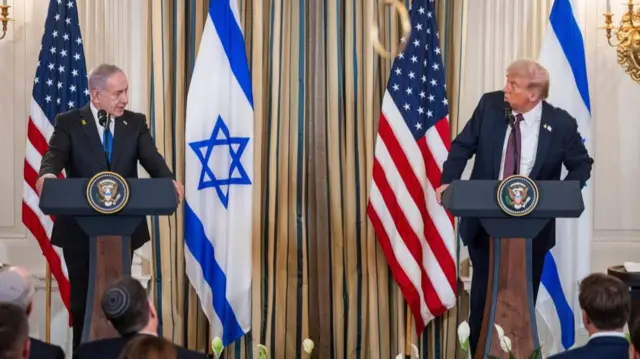
    US President Donald Trump (R) and Israeli Prime Minister Benjamin Netanyahu (L) speak at a press conference in the State Dining Room of the White House in Washington, DC, USA, 29 September 2025Image source, EPA/Shutterstock
    Image caption,

    US President Donald Trump and Israeli Prime Minister Benjamin Netanyahu agreed the peace deal in September 2025

    US President Donald Trump unveiled his 20-point Gaza peace plan at the White House on 29 September 2025 alongside Israeli Prime Minister Benjamin Netanyahu, who said Israel accepted the terms.

    On 3 October, Hamas said it agreed to return all 48 remaining hostages being held in Gaza in exchange for Palestinian prisoners in Israeli jails and Gaza detainees, and to the idea of handing over the governance of Gaza to Palestinian technocrats.

    But the group did not mention other elements, most notably the requirement that it disarm.

    Trump's plan, as provided by the White House at the time, said Gaza would be a "deradicalised terror-free zone that does not pose a threat to its neighbours".

    The plan also proposed a "Trump economic development plan to rebuild and energise Gaza", which it said would be created by "convening a panel of experts who have helped birth some of the thriving modern miracle cities in the Middle East".

    You can read Trump's plan in full here.

  4. What we do and don't know about disarmament planpublished at 07:11 BST

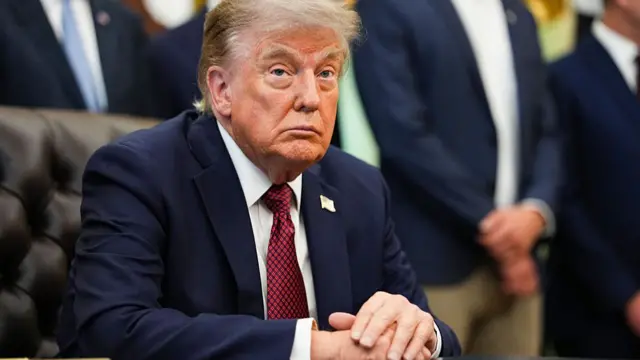
    President Donald Trump makes an announcement on American nuclear innovation in the Oval Office at the White House on July 24, 2026 in Washington, DC.Image source, Getty Images

    Overnight, US President Donald Trump announced an agreement had been reached for the "complete disarmament" of Hamas and other armed groups in Gaza and the withdrawal of Israeli troops.

    Here's what we know:

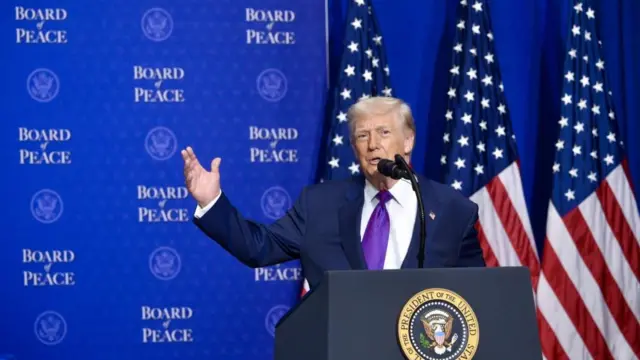
    • Trump said the agreement had been reached by his Board of Peace and described it as a "critical step towards Gaza finally being governed by a new Palestinian government"
    • The four-page roadmap of the plan, seen by the BBC, sets out phased disarmament of Hamas and gradual Israeli disarmament, with US officials saying each step of the process will be "verified"
    • A senior Hamas official has told the BBC that the group has agreed to the plan - but an official statement from the group is yet to be released
    • Trump will be "very disappointed" if Israel does not withdraw from Gaza, according to a US official

    And what we don't know:

    • Israel's stance on the agreement, or if they were involved in negotiations - we have not heard anything from Israeli officials since Trump's announcement
    • How an Israeli withdrawal would work, or whether it would include the buffer zone known as the Yellow Line
    • Who would ultimately take custody of the weapons Hamas would be giving up under the agreement
    • How the "verification" mechanism put forward by the US would operate in practice

    We'll bring you the latest on the agreement and answers to these questions as we get them.

  5. Analysis

    If Hamas disarmament plan holds, it could mark first credible step to ending Gaza warpublished at 06:34 BST

    Rushdi Abualouf
    Gaza correspondent, in Cairo

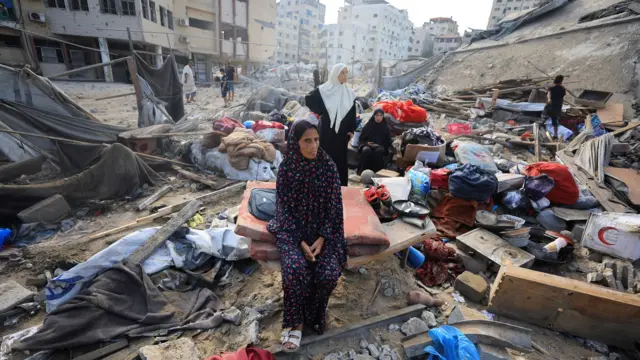
    A Palestinian woman sits amidst debris as people inspect the site of an Israeli strike on a house in Gaza City, 30 July 2026.Image source, Reuters

    After months of marathon talks, Hamas has, for the first time, accepted a framework of the Board of Peace's plan to completely disarm in Gaza.

    The plan provides for the inventorying and storage of its remaining heavy weapons under Palestinian supervision, potentially removing the most significant obstacle to advancing the Trump-backed peace initiative for Gaza.

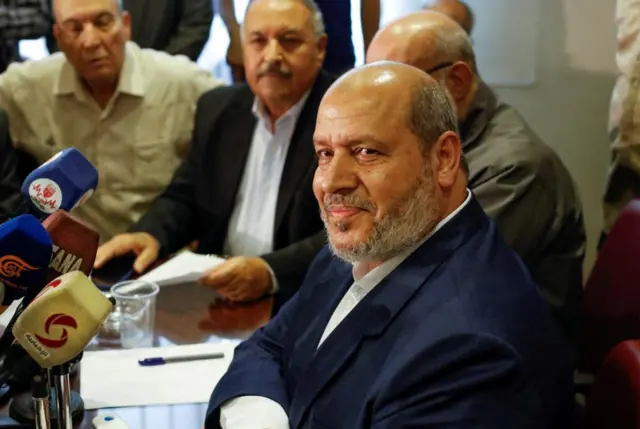
    The move comes soon after Hamas concluded leadership elections that brought Gaza-based leader Khalil al-Hayya to the head of the movement.

    Palestinian officials involved in the talks believe the new leadership was prepared to take what they describe as the most consequential political decision in Hamas's history, driven by the devastating humanitarian conditions facing more than two million Palestinians in Gaza.

    It remains too early to judge whether the agreement will be fully implemented or whether all parties will honour their commitments.

    But if it holds, it could mark the first credible step towards ending a war that has lasted for nearly three years and opening the way for a broader political process.

    Read the full analysis here.

  6. Analysis

    Hamas disarmament was a key sticking point as ceasefire stalledpublished at 06:04 BST

    Yolande Knell
    Middle East correspondent, in Jerusalem

    In recent months, the US-brokered Gaza ceasefire deal has stalled – with the disarmament of Hamas a key sticking point.

    But after recent intense talks between Hamas and regional mediators, President Trump wrote on social media that “a monumental step toward lasting peace and security” had been taken.

    Under a new proposal sent to Washington – and seen by the BBC – Hamas promises an inventory of weapons, military production sites and tunnels.

    Its arms are to be stored and kept under control of the new Palestinian administration; they cannot be transferred to Israel. The process is linked to “a phased Israeli withdrawal," according to the proposal.

    A separate plan is laid out on how Gaza’s new technocratic government should deal with Hamas public servants.

    There’s been no official response from Israel – which remains highly sceptical about Hamas’s willingness to disarm.

  7. If you're just joining us, here is what you need to knowpublished at 05:46 BST

    Here's what you need to know to catch up on this breaking story:

    • US President Donald Trump says the Board of Peace reached an agreement for the "complete disarmament" of Hamas and other armed groups in Gaza
    • Hamas has agreed to the plan, a senior Hamas official has told the BBC
    • Israeli soldiers will also withdraw from the Gaza Strip "as disarmament is completed", according to Trump
    • We are still waiting for an official response from Israel, which has not commented
    • There will be multiple phases to the disarmament process with progress to be independently monitored, US and Board of Peace officials said in a call with reporters
    • The deal was brokered with the help of meditators from Qatar, Egypt and Turkey
    • While some negotiators are hailing the agreement as a breakthrough, caution and scepticism remains on all sides
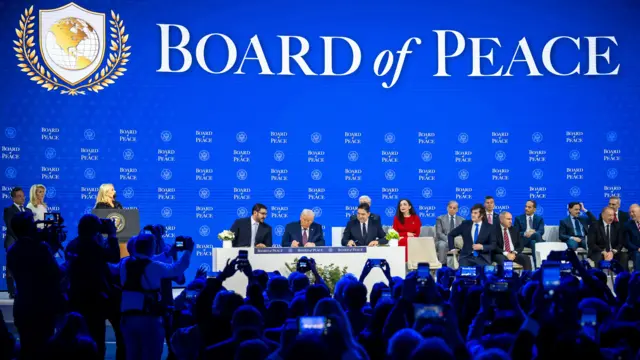
    US President Donald Trump (C) holds a signing ceremony for the 'Board of Peace' charter during the 56th annual meeting of the World Economic Forum (WEF), in Davos, Switzerland, 22 January 2026Image source, EPA
    Image caption,

    US President Donald Trump (C) holds a signing ceremony for the 'Board of Peace' in January 2026

  8. Cairo to hold meeting with mediators, state-linked news outlet sayspublished at 05:41 BST

    Cairo will host a meeting between the Gaza peace plan mediators "soon", state-linked Al-Qahera News reported early Friday. The mediators include Egypt, the US, Qatar and Turkey.

    The news outlet spoke to an "informed Egyptian source" who did not specify when the meeting would take place "to confirm the commitment of all parties concerned to implementing the terms of the agreement."

  9. How would disarmament be confirmed?published at 05:27 BST

    Speaking to reporters earlier today, a US and Board of Peace officials said an "implementation verification committee" will monitor progress on disarmament.

    The third-party committee will independently examine how conditions are progressing – noting difficulties of Hamas and Israel monitoring each other.

    The official acknowledges that it could take longer to ensure that Hamas has disarmed, saying that its army, tunnels and production facilities are more like those of a state than a militant group.

  10. How would Hamas disarmament work?published at 05:10 BST

    US and Board of Peace officials have given reporters a rough outline of how the disarmament process could work.

    In a phone call they said first, Hamas's police in Gaza will surrender their weapons to the transitional authorities.

    Then, there will be a "process of decommissioning" heavy weapons, which would including shutting down tunnels and depots as well as standing down the fighters who are operating these facilities.

    This would be a "very technical process" where one of the key questions would be how to store the collected weapons safely.

    Finally, all personal weapons in Gaza would have to be "dealt with" under Palestinian law.

    Officials said militias and clans would also have to decommission their weapons as part of this process.

  11. Israel has continued to launch strikes on Gaza since ceasefire agreement was signedpublished at 05:02 BST

    In the six months since Israel and Hamas were meant to begin phase two of the ceasefire deal, little progress has been made. At least 1,168 Palestinians have been killed in Israeli attacks since a ceasefire between Israel and Hamas took effect last October, according to the Hamas-run health ministry, whose figures are considered reliable by the UN.

    Four Israeli soldiers have been killed in Palestinian attacks in Gaza over the same period.

    Hamas led an attack on Israel on 7 October 2023, in which 1,200 people were killed and 251 were taken hostage.

    Israel responded by launching a massive military campaign in Gaza, during which more than 73,290 people have been killed, including 21,280 children, according to the territory's Hamas-run health ministry.

    In 2024, the International Criminal Court (ICC), issued arrest warrants over alleged war crimes for Israel's prime minister, Benjamin Netanyahu and former defence minister, Yoav Gallant, and as well as the military commander of Hamas, Mohammed Deif. Israel has said Deif was killed in an air strike.

    Prime Minister Netanyahu condemned the ICC's decision as "antisemitic", while Hamas said the warrants for Netanyahu and Gallant had set an "important historical precedent".

    A UN commission of inquiry said in September 2025 that Israel had committed genocide against Palestinians in Gaza. Israel's foreign ministry said it categorically rejected the report, denouncing it as "distorted and false".

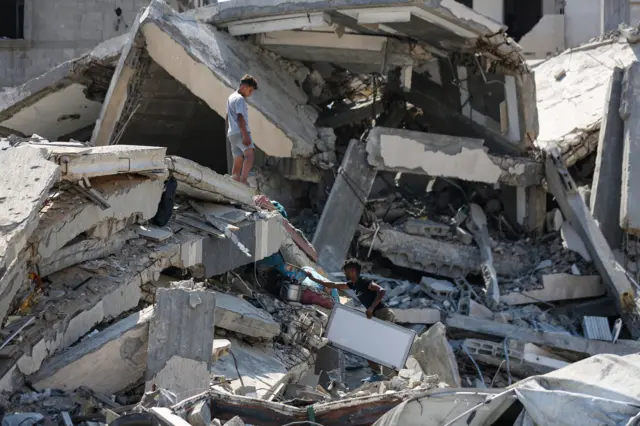
    Residents inspect damage after last night's airstrikes by Israel on residential buildings on July 30, 2026Image source, Getty Images
    Image caption,

    Residential buildings in Gaza crumbled after being pounded by strikes earlier on Thursday.

  12. Agreement comes after 'months of very difficult negotiations', Board of Peace official sayspublished at 04:40 BST

    We have heard from one of the most senior people involved in the region's diplomacy – the group's director-general and high representative for Gaza Nickolay Mladenov.

    In a post on X, he writes: "Today, agreement has been reached on the decommissioning of weapons and civilian transition in Gaza. It took months of very difficult negotiations to get here.

    "There were several points when I did not believe we would make it..." he continues. "What the agreement says matters. What happens next matters even more. Implementation and verification have to be real. Withdrawal must move in lockstep with decommissioning.

    Mladenov, a former Bulgarian foreign minister, has held multiple regional high-level roles in the United Nations – including as the UN's special coordinator for the Middle East Peace process.

    "Ahead of us is a Gaza rebuilt, governed by Palestinians and at peace with Israel an a political horizon to a meaningful resolution the Israeli Palestinian conflict. That is the work now."

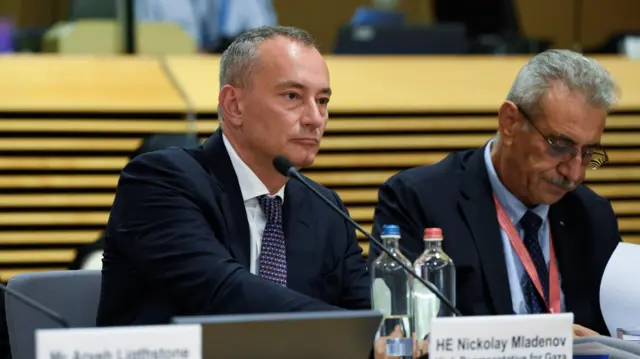
    UN Special Coordinator for the Middle East Peace Process, Nickolay Mladenov in JulyImage source, Reuters
    Image caption,

    Nickolay Mladenov, one of the most senior diplomats, commended mediator countries Turkey, Egypt and Qatar.

  13. Analysis

    How Israeli withdrawal would work remains unclearpublished at 04:15 BST

    Shaimaa Khalil
    North America correspondent

    There are many unanswered operational questions, too: exactly how an Israeli withdrawal would work, who are they handing over to, whether it would include the buffer zone known as the Yellow Line, who would ultimately take custody of Hamas's weapons, and how the verification mechanism would operate in practice are all issues that will determine whether this agreement moves beyond paper.

    Prime Minister Benjamin Netanyahu’s government raised these objections recently to Board of Peace envoy Tony Blair, without specifying its issues with the disarmament proposal, the Times of Israel reported, citing a statement from an Israeli official.

    “There will be no IDF withdrawal from the Yellow Line in the Gaza Strip before Hamas is disarmed and the Strip is fully demilitarized,” the Israeli official added.

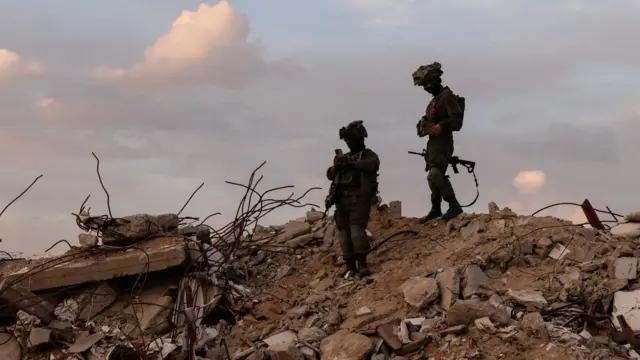
    Israeli soldiers stand on rubble in Rafah in the southern Gaza Strip, December 8, 2025.Image source, Reuters
    Image caption,

    Israeli soldiers, pictured in December, stand on rubble in Rafah.

  14. Analysis

    Major political questions remainpublished at 03:46 BST

    Shaimaa Khalil
    North America correspondent

    There are also major political questions. Israel has not yet publicly commented on the agreement. While the White House insists this builds on a framework Israel has already accepted, Prime Minister Benjamin Netanyahu has so far shown little appetite for a permanent withdrawal from Gaza, facing pressure from far-right coalition partners who have long opposed such a move.

    When asked by reporters whether the US is convinced Israel will agree to the terms of the agreement, a US and Board of Peace Official said, "We're very confident they will adhere to it. If they don't, obviously, President Trump would be very, very disappointed."

  15. Analysis

    Plenty of opportunity for process to collapsepublished at 03:25 BST

    Shaimaa Khalil
    North America correspondent

    No one will be surprised by the scepticism with which this announcement is being met. The fact that the BBC has now independently confirmed, through a senior Hamas official, that the group has agreed to this roadmap is significant. But two things stood out from a briefing with US and Board of Peace officials.

    The first is that this is a phased process. US officials repeatedly stressed that every stage is conditional, independently verified and based on what they called "zero trust". No side moves forward until the other has fulfilled its commitments. If previous ceasefires are any guide, that leaves plenty of opportunities for the process to stall or collapse.

    We've seen that before. President Trump's ceasefire agreement last October initially brought Israeli hostages home and allowed more aid into Gaza. But the truce later broke down, the bombing of Gaza resumed, the aid stopped, and both Israel and Hamas accused each other of violating the deal.

    The second point is the sheer complexity of what is being proposed. This is not simply about Hamas handing over rifles. The roadmap envisages dismantling what US officials described as Hamas's wider military infrastructure: tunnels, heavy weapons, production facilities and weapons depots. Smaller armed groups would be disarmed first, with Hamas's military capabilities addressed later because officials acknowledge that will be a far longer and more technically demanding process.

  16. Analysis

    Announcement met with little enthusiasm in Gazapublished at 03:13 BST

    Rushdi Abualouf
    Gaza correspondent, in Cairo

    In Gaza, the announcement has been met with little public enthusiasm.

    After years of failed ceasefires and collapsed agreements, many Palestinians have grown deeply sceptical of new political breakthroughs. Some residents shared their views online saying they are less interested in the details of negotiations than in whether this deal will actually end the war, allow displaced families to return home and bring lasting relief.

    For many, confidence in both Hamas and Israel remains low, with previous agreements having repeatedly broken down before delivering meaningful improvements on the ground.

  17. Board of Peace calls agreement ‘historic breakthrough’published at 03:03 BST

    We’re hearing from the Board of Peace, which has released a statement on social media.

    The agreement, the board says, concludes months of “intensive, good faith negotiations to advance President Donald J. Trump's vision for establishing new governance, security, humanitarian relief, reconstruction, and economic recovery in Gaza”.

    The board says the agreement “holds the promise of delivering significant benefits to the people of Gaza”.

    “The Roadmap represents a historic breakthrough. For the first time, Hamas officially has committed to an actionable plan for relinquishing all its weapons, which will be followed by Israeli withdrawal from Gaza.”

    The statement concludes by saying the board’s focus is now on implementation.

    US President Donald Trump speaks during the Board of Peace meeting at the Donald J. Trump U.S. Institute of Peace in Washington, USA, 19 February 2026Image source, EPA/Shutterstock
  18. Analysis

    Talks were 'long and extremely difficult'published at 02:51 BST

    Rushdi Abualouf
    Gaza correspondent, in Cairo

    A senior Hamas official and member of the movement’s negotiating team told the BBC that the talks were “long and extremely difficult”, with Hamas insisting on the wording “inventorying and storing weapons” under Palestinian oversight rather than handing them over to Israel.

    It remains too early to judge whether the agreement will be fully implemented or whether all parties will honour their commitments. But if it holds, it could mark the first credible step towards ending a war that has lasted for nearly three years and opening the way for a broader political process.

  19. What is in the Gaza peace plan?published at 02:48 BST

    Trump unveiled the 20-point peace plan in October. It called for a ceasefire in the conflict between Israel and Hamas and for a return of Israeli hostages seized in the 7 October 2023 attacks on Israel.

    Another key provision is the disarmament of Hamas along with the full withdrawal of Israeli forces from Gaza.

    The Board of Peace also was created as part of the plan.

    Read more of our coverage of the Gaza peace plan here.

  20. Analysis

    Disarmament potentially removes most significant obstacle to peace planpublished at 02:32 BST

    Rushdi Abualouf
    Gaza correspondent, in Cairo

    After months of marathon talks, Hamas has, for the first time, accepted a framework of the Board of Peace’s plan to completely disarm in Gaza.

    The plan provides for the inventorying and storage of its remaining heavy weapons under Palestinian supervision, potentially removing the most significant obstacle to advancing the Trump-backed peace initiative for Gaza. The move comes soon after Hamas concluded leadership elections that brought Gaza-based leader Khalil al-Hayya to the head of the movement.

    Palestinian officials involved in the talks believe the new leadership was prepared to take what he described as the most consequential political decision in Hamas’s history, driven by the devastating humanitarian conditions facing more than two million Palestinians in Gaza.

    Khalil al-Hayya attends a news conference in Damascus, Syria October 19, 2022.Image source, Reuters
    Image caption,

    Khalil al-Hayya