Branching out on your seasonal knowledge
As the weeks and months pass by, so many things continue to change around us, like the seasons. When it comes to spring, summer, autumn and winter, we all have a personal favourite - and it's often nature that offers signs a season is changing.
Take autumn, for example. The days are shorter, the temperature is lower, and the leaves on our trees begin to change colour and fall. But why exactly do our leaves do this?
Well, if you've ever wondered what the answer is, don't worry - BBC Bitesize has got you covered. You can find out more fascinating facts below.

What do leaves do?
They're all around and often not hard to find - but we're going to start from the beginning with a brief explanation of what leaves actually do.
One of the most important organs of a plant, leaves produce food for the plant through a process called photosynthesis. During this process, leaves use chlorophyll and light energy to convert carbon dioxide and water into oxygen and glucose. And it's the glucose that acts as a source of food for the plant.
Depending on the plant, leaves vary in size, shape and colour. But all are adapted to carry out photosynthesis.
Why do leaves fall off trees?

Simply, trees actively shed their leaves because there’s no use for them anymore - and doing this also ensures the tree’s long-term survival. It’s a way of protecting the trees, and making sure they survive the winter and beyond.
Leaves die during the winter months and if those dead leaves stayed on the trees, and new, working ones didn’t grow in their place, the trees would have no way of processing food for themselves. If it didn’t do it every year, the water in the cells of the leaves would also freeze, and this would rupture them, as water expands as it turns to ice.
By the time summer rolled around, the tree would have no working leaves, so no means to create food, and it would die pretty quickly. Also, by the time summer ends, most leaves have either been eaten by bugs or have decayed to some extent, so this gives them a chance to start fresh. To turn over a new leaf, if you will.
Why do leaves change colour?
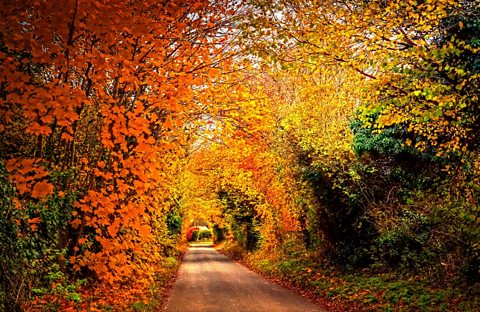
When leaves are green, they are working as organs for the tree. The green colour comes from a part of the cell called chlorophyll, which processes sunlight into sugars that the tree can ‘eat’.
As the weather gets colder, the days get darker, and there is less sunlight for them to munch on, the rest of the tree starts to absorb these useful parts of the leaves. It then stores them for winter in its roots. As the tree does this, the green chlorophyll is removed, which reveals hidden colours in the leaves.
The first colours to appear are yellow, then they turn clear too, revealing the gorgeous red-brown that dominates most of the autumnal months.
Here's a quick run down of why leaves change colour.
The green colour comes from a part of the cell called chlorophyll, which processes sunlight into sugars that the tree can ‘eat’.
As the weather gets colder, and the days get darker, the rest of the tree starts to absorb these useful parts of the leaves.
It then stores them for winter in its roots, removing the green chlorophyll. This reveals hidden pigments in the leaves.
Why does autumn get called 'fall'?
The UK typically refers to the third season of the year as autumn. The word itself is said to derive from the Latin word 'autumnus' and centuries ago, the English adopted the word autumn from the French word 'automne.'
You may have heard other countries, particularly America, refer to the autumn season as 'fall' instead. But why is this?
Well, while 'fall' is widely considered to be American, it in fact originated in England in the 16th century, or even earlier, became more widely used in the 18th century. BBC Radio 4 previously said: "Fall was originally short for "fall of the year" or "fall of the leaf," but it had largely become the snappier, one-word version by the 17th century - long before American English had been established. So while the term is now widely used across the pond, it is not actually American in origin."
Why do some trees keep their leaves?
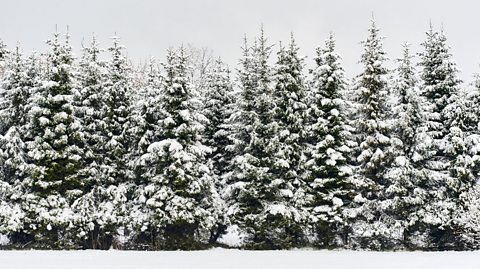
Some trees are what are known as ‘evergreens.’ As the name suggests, that means their leaves are green all the time and they don’t fall off.
The reason for this is trees such as firs have a thick, waxy coating called a resin that protects their leaves. This means they don’t freeze and rupture like other trees’ leaves would when they get cold, so they don’t need all of them to fall off and regrow in time for summer.
Some do fall off sporadically throughout the year though, and some trees called semi-evergreens only shed all their leaves when it’s cold enough. If the winter months are mild, they stay green.
Why do Christmas trees lose their needles?
Real Christmas trees have long been staples in households across the world during the festive season. But if you've ever had one, you'll know the pain of regularly cleaning up the needles that have fallen to the floor.
This happens because the tree has been cut down and can no longer take up water. As the tree loses water, the leaves, or needles, become unable to create food anymore, so they fall off.
So, leaves always fall. There’s no getting around it.
When do leaves come back on trees?

Autumn and winter are typically colder and darker months - but as spring returns, leaves start to emerge from their buds. This is because springtime brings longer hours of daylight and warmer temperatures.
The first leaves usually start to appear in the months of March and April. However, there are contributing factors such as weather and climate that can influence this, as well as the nature of the different tree species themselves.
This article was published in November 2018 and updated in July 2026
