Summary

  • A US missile attack on an oil tanker near Oman on Wednesday killed three Indian sailors, the Indian government confirms

  • The US said its aircraft hit the tanker's engine room as it transited the Gulf of Oman

  • It said the crew of the M/T Settebello "repeatedly failed to comply with directions from American forces"

  • Meanwhile, the US and Iran have exchanged attacks for the second day in a row

  • The US hit military, surveillance and radar sites in southern Iran

  • Tehran responded with a round of strikes on US military sites in the region, including bases in Bahrain and Kuwait

  1. US hits Iranian vessel in Gulf of Oman - reportpublished at 11:45 BST

    The US struck an Iranian cargo vessel carrying "essential goods" in the Gulf of Oman this morning, according the governor of Sirik, who was quoted by Iran's semi-official state news agency Mehr news.

    Five crew members were rescued after a projectile hit the vessel, which was reportedly struck as it departed from the city of Khasab, Oman, towards the Iranian city of Sirik.

    The US has not commented on the reported strike.

  2. Settebello is eighth ship 'disabled' by US forces during Hormuz blockadepublished at 11:33 BST

    The M/T Settebello was the eighth ship to be disabled by US forces since the start of its blockade of Iran's Gulf Coast, according to US Central Command (Centcom).

    The US initiated its blockade of Iranian ports in the Strait of Hormuz on 13 April, and has been intercepting or turning back vessels travelling to or from Iran's coast.

    Map titled “US blockade of Iran’s Gulf coast” showing Iran’s southern coastline along the Persian Gulf, Strait of Hormuz and Gulf of Oman highlighted in red to indicate a blockade. Iranian territorial waters are shaded, with a caption stating “US blockade will affect all ships travelling to or from Iran’s Gulf coast” Ports and major jetties are marked with purple dots, including Kharg Island and Bandar Abbas. Surrounding seas are labelled, including the Arabian Sea, and a distance scale, source credit, and BBC logo are visible.

    Centcom says 134 ships have been redirected after complying with US forces, while eight non-compliant vessels - including the Palau-flagged Settebello - have been "disabled". The tanker was struck by US forces on Wednesday, resulting in the deaths of three Indian sailors.

    It adds that US forces have allowed 42 humanitarian ships to pass through the waterway since the blockade began.

    Meanwhile, Donald Trump also claimed on Wednesday that the US military had helped 200 commercial ships pass through the strait as part of a "secret mission".

    Iran, however, insists the shipping channel is "completely closed".

  3. India summons senior US diplomat after oil tanker attackpublished at 11:14 BST

    BBC Hindi

    India has summoned a senior American diplomat after three Indian sailors were killed in a US strike on an oil tanker near Oman.

    India’s Ministry of Foreign Affairs summoned Jason Meeks, the US Embassy’s deputy chief of mission in New Delhi, to lodge a "strong protest".

    The three Indian sailors who were killed in the strike on the Palau-flagged Settebello on Wednesday have been identified as deck cadet Aditya Sharma, engine fitter Shivanand Chaurasia and chief engineer Patnala Suresh.

    Earlier today, India's shipping minister described their deaths an "irreparable loss" and said he was "deeply saddened" to learn about the "tragic incident".

    He added that their bodies would be returned to India at the earliest opportunity.

    Yesterday, US Central Command said it had disabled an oil tanker as it transited the Gulf of Oman, accusing it of violating its blockade of Iranian ports in the Strait of Hormuz.

    Clip of US military video showing attack on tankerImage source, CENTCOM
    Image caption,

    The US military released footage of its attack on the Settebello. It said "the crew repeatedly failed to comply with directions from American forces"

  4. What is the Strait of Hormuz?published at 10:54 BST

    Sandwiched between Iran, Oman and the United Arab Emirates, the Strait of Hormuz is one of the most vital shipping lanes in the world.

    Around 20% of the world's oil and liquefied natural gas usually passes through the tight waterway but it was effectively cut off by Iran after the US and Israel launched wide-ranging strikes on 28 February.

    The closing of the strait has sent oil prices soaring globally.

    The US established a blockade of Iranian ports in early April after a ceasefire was agreed.

    US President Donald Trump has said the blockade will remain "in full force and effect until an agreement is reached, certified, and signed".

    This Flourish post cannot be displayed in your browser. Please enable Javascript or try a different browser.

  5. 'Everything was alright when we last spoke', says father of killed sailorpublished at 10:41 BST

    A man stands in front of a camera and microphone. He is upset and crying into his scarf, while trying to speak to the microphoneImage source, Reuters

    The father of a sailor killed in the US attack on oil tanker Settebello says he last spoke to his son on Tuesday, and "everything was alright".

    Ramji Chaurasiya tells Reuters that his son had left home eight or nine months ago.

    Chaurasiya says he was informed that a bomb had been dropped on the ship and that several crew members were missing.

    When asked what information he had received, the father breaks down in tears.

  6. Open or closed? Iran and US disagree over activity in the Strait of Hormuzpublished at 10:30 BST

    Debate is continuing between Iran and the US over the closure of the Strait of Hormuz.

    On Wednesday, Iranian state media reported the busy shipping channel was "completely closed to all type of vessel".

    On Thursday morning, Iran's waterway authority says again the strait is closed, state media reports, following a new wave of US strikes yesterday.

    However, overnight US Central Command denied its closure, writing: "Commercial ships are continuing to transit in and out of the Strait of Hormuz tonight."

    The Strait of Hormuz remains at centre of negotiations, with both the US and Iran attempting to exert control over its future.

    Iran has been blocking the waterway since the beginning of the war leaving thousands of sailors stranded, with the US imposing a blockade on Iranian ports in retaliation.

    Iran has created the Persian Gulf Strait Authority, which it says will allow the Iranian army to oversee vessels moving through after the war.

    But the US insists Iran will not be allowed to control the strait after the war - Donald Trump claimed on Wednesday that the US military had helped 200 commercial ships pass through the waterway as part of a "secret mission".

    A BBC graphic outlining an area in the Strait of Hormuz over which Iran claims to have control
  7. Iranian foreign ministry says US attacks leave ceasefire 'practically meaningless'published at 10:11 BST

    Iran’s foreign ministry has said the latest US strikes leave the ceasefire between the countries “practically meaningless”.

    In a statement, the ministry strongly condemns the “illegal and criminal attacks” carried out by the US, claiming they violate the UN Charter and fundamental rules of international law.

    It adds that US leaders will be responsible for the consequences of the escalation.

    It comes after US Central Command said it completed a wave of “self-defense strikes” targeting military, surveillance and radar sites in southern Iran on Wednesday.

    Iran also carried out strikes, targeting US military assets across the region in Bahrain, Kuwait and Jordan.

  8. Death of three Indian sailors a 'tragic incident' - India's shipping ministerpublished at 10:03 BST

    Announcing the death of three Indian sailors after the US struck an oil tanker, India’s Shipping Minister Sarbananda Sonowal says it was “deeply unfortunate to learn of the tragic incident”.

    In a post on X, he adds that it's a "profound loss".

    The Palau-flagged Settebello came under attack on Wednesday after the US military accused it of violating an American blockade by "attempting to transport oil from Iran". There were 24 Indian crewmen on board - 21 were rescued.

    The US Central Command said it fired munitions into the ship’s engine room after crew “repeatedly failed to comply” with American forces.

    Manoj Yadav, general secretary of the Forward Seamen's Union of India, told The Economic Times newspaper that he "refused to believe" that the US lacked information regarding the nationalities of the people on board those ships. He said detaining the ships instead was a “viable alternative”.

    This is the second vessel with Indian crew that has come under attack this week. On Monday, US forces hit Marivex, also a Palau-flagged oil tanker with an Indian crew, in the Gulf of Oman after it failed to comply with US instructions, Centcom said.

    All 24 crew were rescued by the Omani military, Indian authorities said.

  9. Three Indian sailors killed in US strike near Oman, as US and Iran exchange firepublished at 09:53 BST

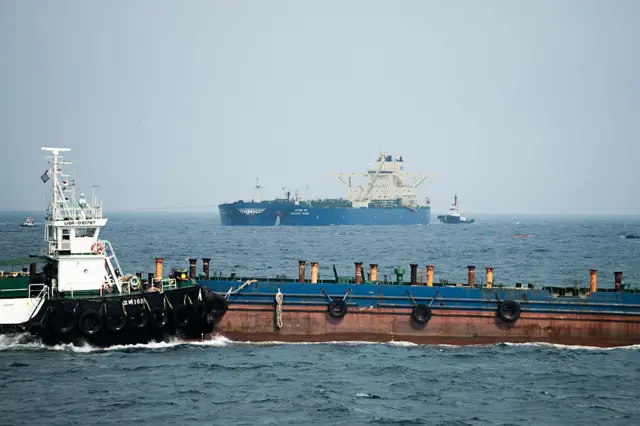
    Ships and tankers remain stranded in the Strait of Hormuz off the coast of Musandam, OmanImage source, Reuters
    Image caption,

    Ships and tankers remain stranded in the Strait of Hormuz off the coast of Musandam, Oman

    Three Indian sailors were killed after a US strike on the Palau-flagged Settebello, New Delhi’s Shipping Minister Sarbananda Sonowal has announced, describing it as "deeply unfortunate".

    On Wednesday, US Central Command said it had disabled the oil tanker, accusing it of violating the ongoing blockade of the shipping channel the Strait of Hormuz.

    India's government had initially said three Indian sailors were missing and 21 Indian crew members had been rescued.

    Meanwhile, the Indian embassy in Oman said it was investigating a separate incident involving a vessel off the Shinas port in Oman, which took place in the early hours of Thursday morning.

    It's the latest in a series of strikes on vessels operating around the coast of Oman this week – on Monday the US said it disabled a different oil tanker, another Palau-flagged vessel, the Marivex.

    The ceasefire between the US and Iran is under increasing strain after the two sides exchanged fire for a second consecutive day on Wednesday, with both sides targeting military sites.

    Despite the escalation of strikes, three Iranian sources told Reuters this morning that diplomatic efforts had intensified, with negotiations centring around the release of frozen Iranian funds.

    We'll bring you the latest developments on this story throughout the day.