Summary

  • More than 1,200 homes have been evacuated within 400m (1,300ft) of a World War Two bomb found in Plymouth

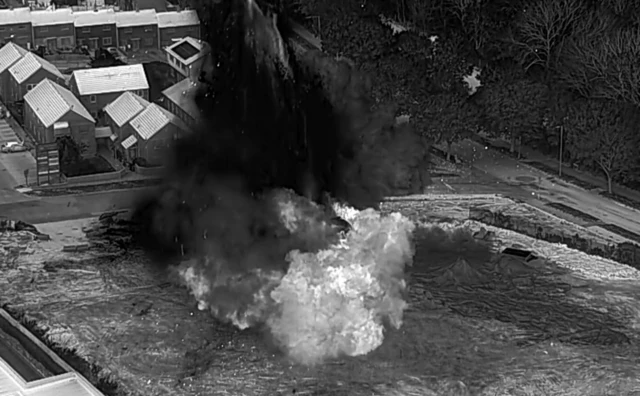
  • Bomb disposal experts plan to detonate the bomb where it is on Friday

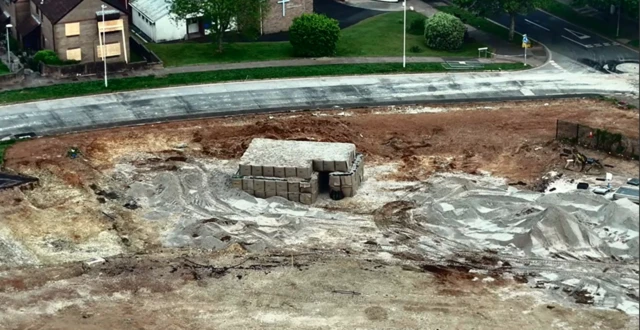
  • In the meantime the Army will place sand in containers around the bomb to try to protect nearby buildings from the detonation

  • Plymouth City Council said the original 200m (650ft) cordon, centred on Flamborough Road, was extended on Wednesday following advice from bomb disposal experts

  • Devon and Cornwall Police said there were no plans to extend the cordon further but the council said it could not guarantee plans would not change

  • The council said it was supporting the work of the Royal Navy by supplying "large quantities" of sand, and specialist X-ray equipment had arrived on site

  • Southway Youth and Community Centre in Hendwell Close has been set up as an evacuation centre, where council staff are available to provide information

  • Councillor Sally Haydon, cabinet member for community safety, has urged residents to "take note" of advice and vacate their homes

  • Listen to BBC Radio Devon for all latest updates from Southway as explosive experts deal with a suspected World War Two device

  • Tune in to BBC Spotlight at 18:30 for more coverage

  1. Thousands of people spend another night away from homepublished at 19:59 BST 30 April

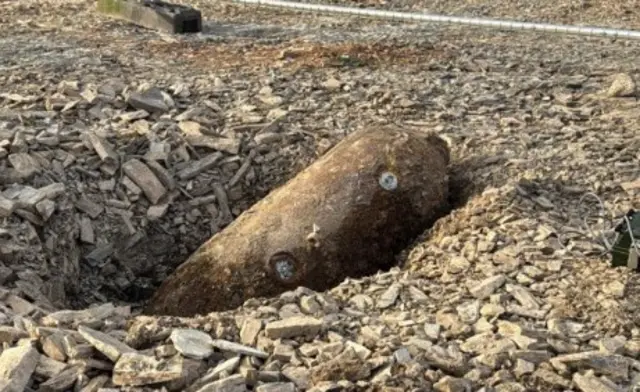
    Bomb in SouthwayImage source, Royal Navy

    We're ending today's coverage, but here's a recap of what's happened...

    • More than 1,200 homes have been evacuated within 400m (1,300ft) of a World War Two bomb found in Plymouth on Wednesday
    • Bomb disposal experts from the Royal Navy and Army plan to detonate the bomb where it is on Friday
    • Sand will be placed in containers around the bomb to try to protect nearby buildings from the detonation
    • Devon and Cornwall Police said there were no plans to extend the cordon further but the council said it could not guarantee plans would not change
    • Southway Youth and Community Centre has opened its doors as an evacuation hub - more than 50 residents helped and 25 households moved into temporary accommodation.

    We'll be back with more coverage on Friday.

  2. World War Two bomb a legacy of Plymouth Blitzpublished at 19:37 BST 30 April

    Destroyed houses with a truck and police office in the foregroundImage source, Mirrorpix via Getty Images
    Image caption,

    Bomb damage to Plymouth following a Luftwaffe raid in April 1941

    Plymouth was among the major British cities targeted by the German air force - the Luftwaffe - during World War Two.

    It was targeted because of its importance as a major naval port and much of the pre-war city was destroyed.

    Some 1,178 civilians were killed in the Plymouth Blitz, beginning in March 1941 and continuing until 1944 with more than 50 Luftwaffe air raids on the city.

    Earlier this year two bombs were discovered on the same day in Devon - one was dredged up in Exmouth Marina and the other was found on a building site in the Millbay area of Plymouth.

    Both were found to be safe for transport and were detonated at sea.

    Two years ago a 500kg German World War Two bomb was found in a garden in the Keyham area of Plymouth.

    More than 10,000 people were evacuated - thought to be the largest peacetime evacuation - while the bomb was removed and destroyed.

  3. Have you been affected by the discovery of the WW2 bomb?published at 19:25 BST 30 April

    Were you one of the residents asked to evacuate or has the discovery affected you in other ways.

    We're interested in hearing your experiences - you can get in contact via this webpage.

  4. Plymouth bomb: Thousands evacuated as experts plan controlled detonationpublished at 18:56 BST 30 April

    A police cordon with a police officer and a car in the background.
    Image caption,

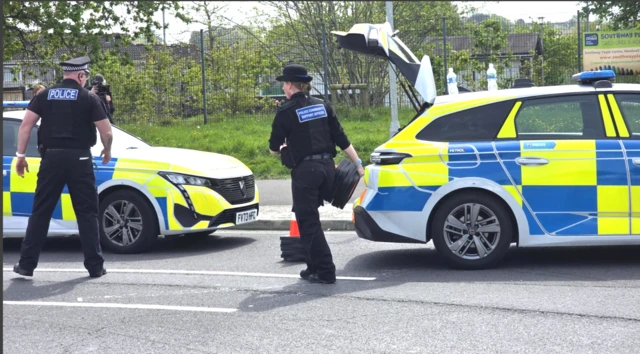
    Police cordons remain around Southway in Plymouth

    Thousands of people forced from their homes in Plymouth are facing another night away as experts prepare to detonate a World War Two bomb that cannot be moved.

    Plymouth City Council said a 400m (1,300ft) safety cordon remained in place after military specialists confirmed the 250kg German SC250 device was too dangerous to relocate.

    “Royal Navy and Army unexploded ordnance specialists have now completed a rigorous and detailed assessment of the device,” a council spokesman said.“They have advised that it is not possible to safely remove it.

    “The only safe option is to make the device safe in situ, which will involve a controlled detonation. This is planned to take place on Friday, once all safety measures are fully in place.”

    A police officer viewed from behind with blurred images of people
    Image caption,

    Southway Youth and Community Centre has opened its doors as an evacuation hub

    Specialists are building what the council described as a sand mitigation structure, designed to contain the blast and reduce the impact on nearby homes and streets.

    “You will not be able to see the detonation and people are asked to stay well away from the area,” the spokesman said. “A no-fly zone is also in place – drones are not permitted.”

    Residents living inside the cordon have been told they will not be able to return until the device has been made safe., external

    For those affected, Southway Youth and Community Centre has opened its doors as an evacuation hub. More than 50 residents have already been helped, with 25 households moved into temporary accommodation.

    The disruption is also hitting families with young children. Oakwood Primary School, Little Acorns Pre-School and Beechwood Primary School will remain closed on Friday as safety operations continue.

  5. Plymouth detonation timing unclear as experts monitor unstable fusepublished at 18:37 BST 30 April

    Jonathan Morris
    BBC News Online

    The image shows an outdoor media briefing, with television cameras, microphones and journalists gathered on a grassy verge beside a path. In front of them, uniformed officials and a person in a green jacket appear to be speaking to the press, with trees and buildings visible in the background.
    Image caption,

    Col Nick Handy spoke to reporters, alongside police and Plymouth City Council

    Bomb disposal teams said the final stages of dealing with the World War Two bomb in Plymouth would depend on conditions on the ground, as dozens of military specialists worked around the unstable device.

    The bomb, found on a building site in the Southway area on Wednesday, is due to be blown up in situ on Friday.

    Explosive ordnance expert Col Nick Handy said crews were operating “very carefully” around the bomb containing about 130kg of explosives, with uncertainty over one of its fuses posing the greatest risk.

    “If we move it, we could restart a timer,” he told a press briefing, adding that one specialist had been assigned to “listen to the fuse constantly” to ensure it did not begin ticking.

    He said there was no fixed timeframe for the detonation, but it would be at "some time" on Friday.

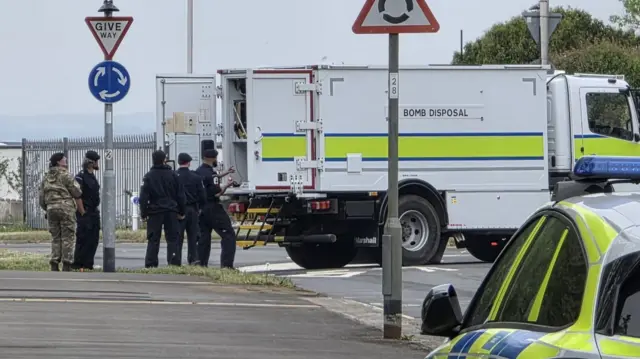
    He said about 35 military personnel from Army and Royal Navy units have been involved working to diagnose the device, build mitigation and render it safe while protecting the public.

  6. I'm not moving: Pensioner stays put as Plymouth bomb cordon enforcedpublished at 18:19 BST 30 April

    Emma Hallett
    BBC News, reporting from Southway

    A bearded man wearing a blue top talks to two men in red unifoirms carrying rucksacks with houses behind them.
    Image caption,

    Terrance Waters said he was not worried about what might happen

    Terrance Watters, 80, lives yards from the current cordon and had a letter alerting him the area was being evacuated last night, but he said for now he has decided to stay where he is. "Obviously, people were knocking on the door, but I didn't hear it," he said."When I came down at six o'clock this morning, I found a letter."

    Asked if he was worried about what might happen, he said: "Not really. I'm too old to worry about it now."What's the point in moving? You know? I mean, the community centre can only house so many people."Until a policeman comes knock on my door, I'm not moving."

  7. Sand barriers to be built to protect church and shops ahead of blastpublished at 18:05 BST 30 April

    Jonathan Morris
    BBC News Online

    A modern single storey church with a tree and grass around it.Image source, Google
    Image caption,

    Measures will be taken to protect the Holy Spirit church in Southway from the blast

    Bomb disposal teams are moving to protect nearby buildings, including a church and local shops, as preparations continue to deal with the World War Two bomb found in Plymouth.

    The 250kg bomb will be blown up in situ on Friday, said explosive ordnance expert Col Nick Handy.

    He told a press conference that although mitigation measures would reduce the impact, the device contained about 130kg of explosives and would cause damage when it detonated.

    About 450 tonnes of sand are being packed into large containers to form a protective structure around the device, with additional mitigation placed in front of nearby shops and a church to reduce blast and fragmentation.

    “When that thing goes bang, for want of a better expression, there will be damage,” he said

    Col Handy said the mitigation had been “signed and tested against this munition” and should mean only limited damage at the edges of the cordon.

    He confirmed extra protection was being placed “in front of the shopping area and in front of the church” to reduce blast and fragmentation, and teams would work through the night to keep people safe.

  8. Coming up on BBC Spotlightpublished at 18:02 BST 30 April

    On Spotlight at 18:30 on BBC One and on iPlayer we'll be crossing to our reporters who've spent the day in the area around Southway where the WWII bomb was found on Wednesday afternoon.

    Find out what residents think about the evacuation process - and what that means for people with pets.

    Watch what the police and military had to say at a press briefing a short time ago.

    And we'll look back at some of the other bombs uncovered in our part of the world.

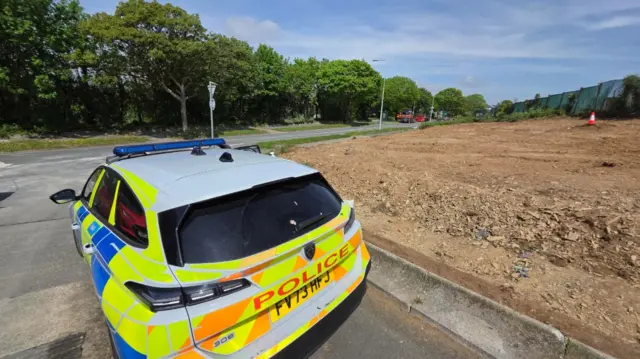
    Police car at the scene
  9. Why Plymouth’s WW2 bomb could not be moved, expert explainspublished at 17:49 BST 30 April

    Jonathan Morris
    BBC News Online

    Colonel Nick Handy
    Image caption,

    Col Nick Handy said it was not safe to move the bomb

    Explosive ordnance expert Col Nick Handy said soldiers had worked to identify the device found in Plymouth as quickly as possible, confirming that it was a 250kg German air‑dropped bomb from World War Two on Wednesday evening.

    The focus then shifted to its fuses. Col Handy said these had to be fully understood before any decision could be made about moving it. Although the bomb had been in the ground for decades, he said disturbance during construction work could not be ruled out.

    Specialist X‑ray equipment was used to examine the fuses, but one could not be clearly identified. “Unfortunately, we cannot get a definitive X‑ray of the second fuse, and therefore it’s not safe to move that item,” he said.

    Because of that uncertainty, the decision was taken to deal with the bomb where it was found. Col Handy said teams would “work tirelessly through the night” to build mitigation designed to limit blast and fragmentation and protect nearby buildings.

  10. World War Two bomb found in Plymouth to be detonated on Fridaypublished at 17:32 BST 30 April

    Jonathan Morris
    BBC News Online

    A WW2 bomb in gravel.Image source, Royal Navy
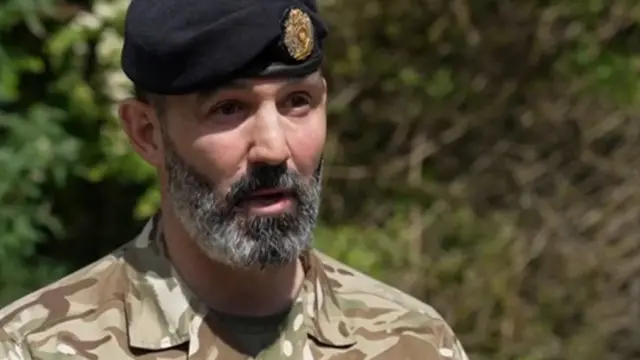
    Image caption,

    The bomb was found in Southway, Plymouth

    A World War Two bomb found on a building site in Plymouth is going to be blown up where it lies on Friday, experts have said.

    Explosive ordnance specialist Col Nick Handy said damage would be mitigated by a "structure" around the 250kg bomb that was found in the Southway area of the city.

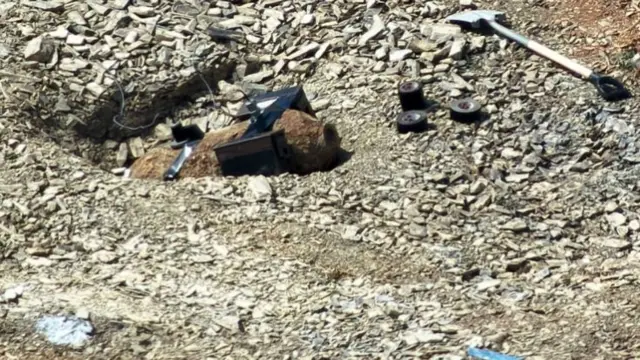
    An X-ray of the bomb and an examination of its fuse had led to the decision to detonate the bomb in situ, he said.

    The detonation would be "some time" on Friday, Handy added.

    "This is 130kg of explosive and when it goes bang there will be damage," he said.

    All residents within 400m (1,300ft) of the bomb have been asked to leave their properties.

  11. Press briefing under way from police, council and militarypublished at 17:15 BST 30 April

    A joint press briefing by Plymouth City Council, Devon and Cornwall Police, and a member of the military is under way at Crownhill Police Station.

    It comes after an unexploded ordnance was found on Wednesday in Flamborough Road, Plymouth.

    The police force said no new updates were expected, with the aim of the call "to provide reassurance and context for the communities about the activity that is going on".

  12. Volunteers help evacuate people living near bomb sitepublished at 17:14 BST 30 April

    Volunteers have been helping evacuate people from their homes after an unexploded World War Two bomb was found in the Southway area of Plymouth.

    The device was found at a building site in the city.

    More than 1,200 homes have been evacuated after a 400m (1,300ft) cordon was put in place.

    East Cornwall Search and Rescue are among the groups helping evacuate people from the area.

  13. WWII bombing raids saw hundreds of explosives fall on Plymouthpublished at 16:55 BST 30 April

    In the 59 bombing raids that flattened Plymouth during World War II more than 1,000 high explosives fell on the city.

    The first three fell one afternoon in July 1940 on the residential area of Swilly now known as North Prospect.

    During the Plymouth blitz attacks, about 1,200 civilians were killed and thousands were injured.

    Numerous unexploded bombs have since been discovered and detonated.

  14. What we know so far about the bomb found in Plymouthpublished at 16:20 BST 30 April

    Police cordon
    • A suspected unexploded World War Two bomb was discovered at a building site in the Southway area of Plymouth.
    • Royal Navy bomb disposal experts later confirmed the device was a German SC250, weighing about 250kg.
    • More than 1,200 homes have been evacuated after a 400m (1,300ft) cordon was put in place to allow specialists to work safely.
    • Plymouth City Council said the exclusion zone had to be fully cleared on expert advice and warned residents not to return home.
    • Specialist enhanced X‑ray equipment have been brought in to help experts carry out a detailed assessment of the bomb.
    • The council said it was supplying more than 400 tonnes of sand to help build a mitigation structure around the device.
    • Devon and Cornwall Police said there were no current plans to extend the cordon, but the council said this could not be guaranteed.
    • An evacuation centre has been set up at Southway Youth and Community Centre, where residents are being offered support and allowed to bring pets.
  15. Most evacuated households staying with family and friends, council sayspublished at 16:02 BST 30 April

    Plymouth City Council says it cannot give a rough estimate of how many people have been placed in temporary accommodation "as a number of agencies are activity dealing with this".

    It says most households that were asked to evacuate were finding their own accommodation and staying with family and friends.

    "Plymouth Community Homes and other relevant housing associations are supporting their tenants and the council is supporting any other residents who need somewhere to stay," it adds.

    "We are actively finding temporary accommodation for a number of households today."

  16. Police cordon draws questions as Southway Drive shut after wartime bomb findpublished at 15:41 BST 30 April

    Emma Hallett
    BBC News, reporting from Southway

    Police cars, people in hi vis at cordon
    Image caption,

    A police cordon at Southway

    The cordon on Southway Drive is being manned by two police community support officers from Devon and Cornwall Police. It has been busy all morning with lots of people driving past and stopping to ask what is happening.

    By now, most locals have heard about the road closures that are in place, but there are still a few people unaware of the disruption currently being caused by the discovery of the World War Two ordnance.

    Some of those who have stopped to speak to officers have been trying to get information about how long the roads are likely to be closed, at this time though, things are still uncertain.

    Others are people who live within the cordon trying to get access to their homes to retrieve more belongings or medication, that were left behind in the rush to leave.

  17. What to do if you evacuated your home without your medicationpublished at 15:20 BST 30 April

    Jonathan Morris
    BBC South West

    A hand reaches out to medicines at a pharmacy.Image source, PA Media

    So, what do you do if you've been evacuated and left something important at home like medication?

    Plymouth City Council says it is aware some residents who had to leave are asking if they can pop back to collect essential items.

    But it says the "clear advice" from the Royal Navy is that no-one can go back into the cordon, not even for a short visit.

    Southway GP surgery is currently open as usual, however it is "continually assessing" the situation. The two Well Pharmacies in the area are temporarily closed due to the incident.

    If you need to collect medication but your usual pharmacy is closed, your prescription will be returned to the system. This will allow another pharmacy to dispense your medication.

    You can use the NHS Find a Pharmacy online search tool, external to find another local pharmacy in your area.

    If you are running low on medication and unable to access your medicines through your usual pharmacy, you can:

    • Contact NHS 111 – they can arrange for another pharmacy to dispense the medication under the Pharmacy First Scheme.
    • Contact your GP Practice – as a last resort, the GP can issue a new prescription, which can then be collected from an alternative pharmacy.

    More information about what to do when your pharmacy is closed is available here, external.

  18. Cordon size explainedpublished at 15:10 BST 30 April

    Police cordon, blurred, with the word "police" on it with a police car in the backgroun in focus.

    It is the radius of the circular cordon that is 400m (1,300ft).

    "It is drawn 400m out from the location of the device," Plymouth City Council says.

  19. Woman describes 'stress' of being evacuated from homepublished at 15:10 BST 30 April

    Leanne, who was evacuated from her home, has described the experience as "different" and "very, very stressful, especially when myself and other people have mental health problems".

    She stayed with a friend overnight and has been unable to return home for a toothbrush or clean clothes because her house is within the exclusion zone.

    Leanne says the council is now paying for her to stay in a hotel.

  20. 'Twist of irony' as husband retires on day family is evacuatedpublished at 14:35 BST 30 April

    Lisa Clark, who spent last night in a hotel with her son, says her husband is retiring today and wants to go on a "jolly".

    “In a sort of funny twist of irony, today - after 22 years of service - it is my husband’s last official day in the Royal Navy," she says.

    “So he is feeling like celebrating so he wants to go away for the weekend.

    “So it looks like my husband’s good spirits combined with our bomb scare are resulting in a little jolly for the weekend, so I’m laughing really.”