Summary

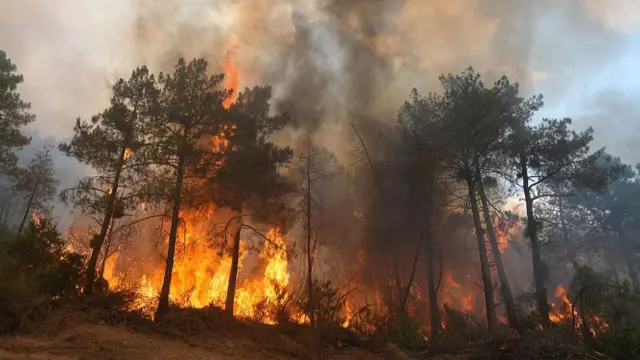
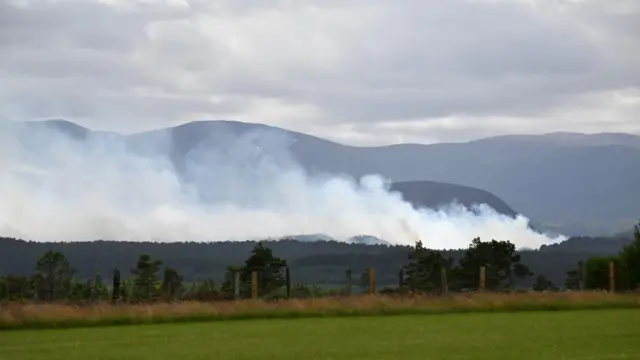
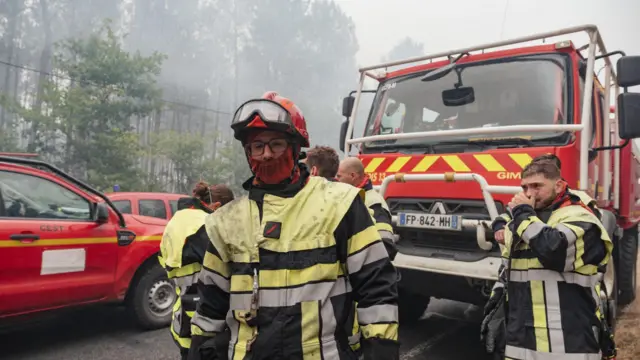
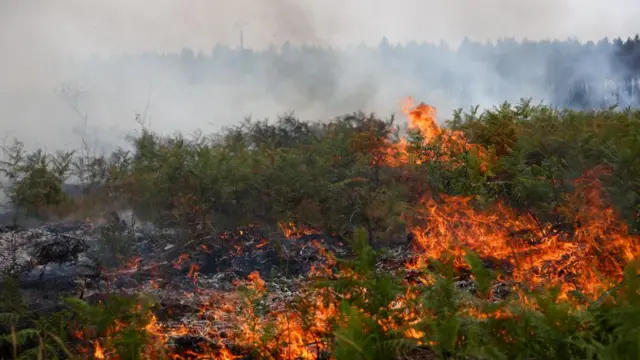
  • Firefighters are struggling to contain wildfires raging across France and Spain

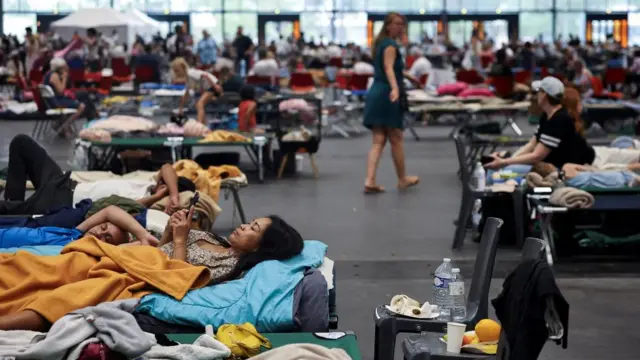
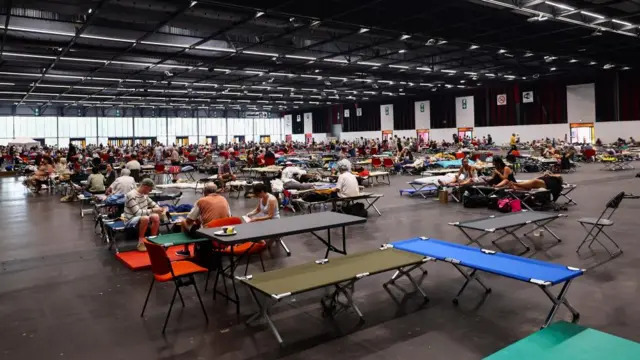
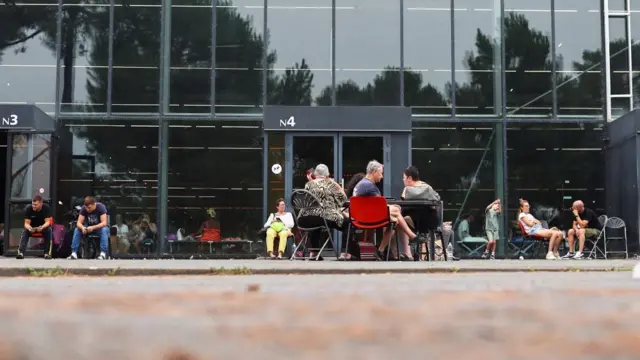
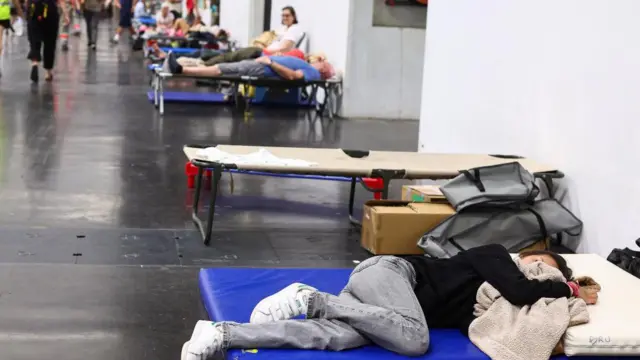
  • An evacuation alert for residents in the south-west of France takes the number of people displaced to more than 220,000

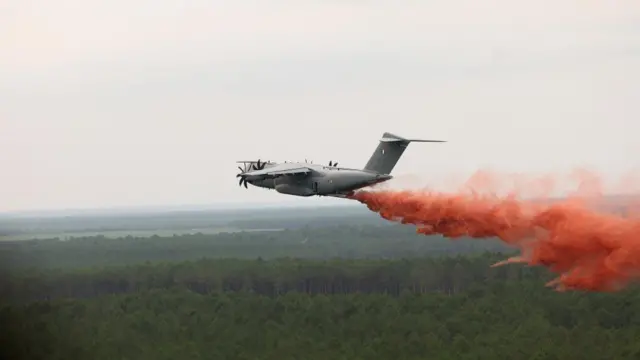
  • The French military has been mobilised to assist in battling the blaze, which has changed direction and is moving east towards Bordeaux

  • In Spain, about 25,000 were told to evacuate as a local official says that containing wildfires near Madrid is "beyond the capacity" of firefighters

  • The Spanish government has declared a national emergency, with Madrid's regional president Isabel Díaz Ayuso saying this is "the worst fire in the history of the region"

  1. An exceptionally hot summer has created perfect conditions for firepublished at 09:30 BST

    Ben Rich
    Lead Weather Presenter

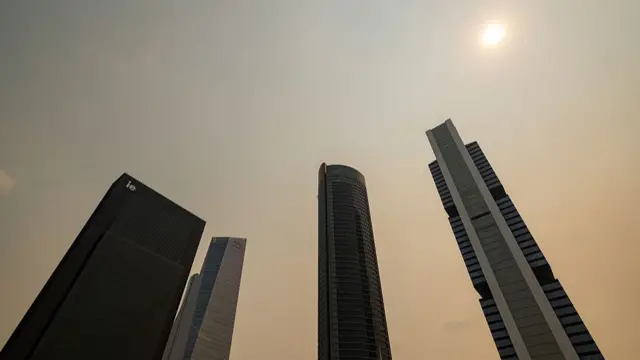
    The sun shines dimly through a cloud of smoke that hangs over some trees.Image source, EPA/Shutterstock

    The weather, on its own, rarely causes wildfires.

    A fire needs a source of ignition. Rarely, this can be a bolt of lightning, but more often it’s caused by human activity – perhaps a discarded cigarette, a spark from a barbecue, fallen power lines or sometimes even arson.

    But the weather can bring the perfect conditions for a fire to take hold and spread, and this is exactly what has happened this time.

    It has been an exceptionally hot summer so far in western Europe with back-to-back heatwaves. Indeed, June was the hottest on record for western Europe, according to data from the EU’s climate change service, Copernicus.

    It was also very dry with below-average precipitation across large swathes of France and Spain.

    This means the vegetation is tinder dry and highly prone to ignition with high temperatures, dry air and gusty winds readily able to fan the flames.

    What’s worse, an unusually wet winter allowed vegetation to grow widely and rapidly which, when dried by the summer heat, has meant abundant fuel for the fires.

    Climate change is increasing the risk of summer heatwaves across Europe – which is the fastest-warming continent on earth, with temperatures rising more than 0.5C each decade since the 1990s.

  2. Madrid wildfires shut down Nasa facilitypublished at 09:15 BST

    Nasa says the fires have "passed through" its Madrid Deep Space Communications Complex.

    "Any potential damage will be assessed when it is safe to do so," the US space agency said, adding its staff had been "safely evacuated".

    The facility is located in Robledo de Chavela, around 37 miles (65km) west of central Madrid.

    It is one of three sites in the deep space network which allow Nasa to communicate with spacecraft. The other two are in California and Canberra - those sites have taken over mission operations.

    Smoke from a nearby fire drifts across the horizon of a hill with dense trees and a Nasa antennaImage source, Europa Press via Getty Images
  3. Fire rages near Bordeaux as four nearby towns evacuatepublished at 09:05 BST

    Thousands of people have been evacuated near Bordeaux in the south-west of France as a huge fire blazes.

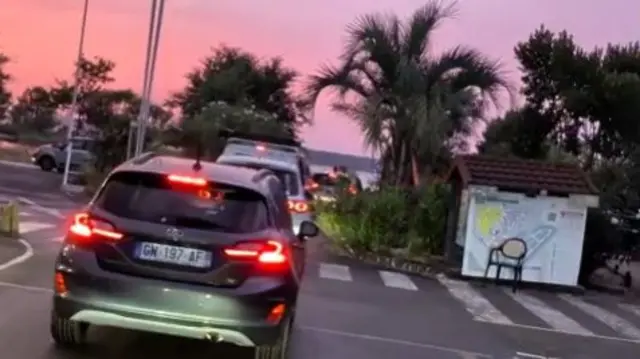
    Photos that have come through overnight show huge walls of smoke rising above the trees and people queuing in their vehicles to leave the area.

    A handout photo made available by the French Landes Prefecture shows a forest burning in Biscarrosse, southern France, 25 July 2026.Image source, EPA
    Image caption,

    Bright orange flames light up the sky in Biscarrosse, south-west of Bordeaux

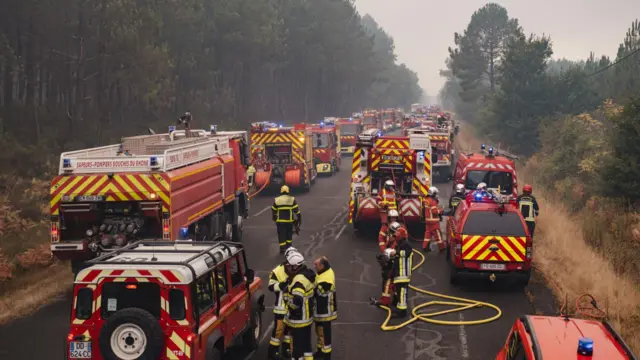
    A handout photo made available by the French Landes Prefecture shows firefighters at the scene of a forest fire in Biscarrosse, southern France, 25 July 2026.Image source, EPA
    Image caption,

    Firefighters are pictured at the scene

    A handout photo made available by the French Landes Prefecture shows firefighters at the scene of a forest fire in Biscarrosse, southern France, 25 July 2026.Image source, EPA
    Image caption,

    Emergency vehicles are seen at the site of the fire in Landes

    A traffic jam of vehicles evacuating Saint-Aubain-de-Medoc as a wildfire burns nearby amid worsening drought conditions following a heatwave and water shortages across much of France, July 25, 2026.Image source, Reuters
    Image caption,

    A traffic jam of vehicles forms as people leave Saint-Aubin-de-Médoc - one of four towns evacuated near Bordeaux

  4. Wind sending acrid-smelling smoke towards Bordeauxpublished at 08:52 BST

    Hugh Schofield
    Paris Correspondent

    At around 03:00 local time (02:00 BST) the prefect for the Gironde department ordered the evacuation of seven towns in the western suburbs of Bordeaux.

    They include part of the suburb of Merignac, the site of the city’s airport. These places are on the possible trajectory of the wildfire. It’s still 40 or 50km (25-31 miles) away, but the wind is blowing the smoke towards Bordeaux and people there are reporting an acrid smell in the air.

    Extra reinforcements from the army are being drafted in today, who’ll be used to back up fire fighters with tasks such as clearing brush and creating firebreaks.

    Another fire is still raging to the south, in the Landes department, and across the country there are about 30 fires underway – a situation which the government says is totally unprecedented.

  5. Ash falling from sky 'like shaved charcoal' in southern France, says Scottish touristpublished at 08:46 BST

    People enjoy the beach in Lacanau as a wildfire burns in a forest area near the Bassin d'Arcachon in the Gironde department amid worsening drought conditions following a heatwave and water shortages across much of France, July 23, 2026Image source, Reuters

    Scottish tourist Robin Jamieson has described seeing a "huge dark plume of smoke billowing out to sea" from the beach in Lacanau yesterday morning, around 10km north of the fire in southern France.

    By the afternoon, a cloud had "blackened out the whole sky" and ash was falling from the air "like shaved charcoal", he tells Radio 4's Today programme.

    He describes an "acrid smell" this morning, saying there was a little bit of rain overnight, but that thunderstorms "didn't materialise".

    He's planning to stay put for the moment awaiting any evacuation instructions, he says.

  6. EU has sent aircraft to France and Spain after emergency mechanism triggered, says crisis commissionerpublished at 08:41 BST

    Hadja Lahbib, EU Commissioner for Crisis Management speaks to BBC Breakfast wearing white shirt with outdoor scene behind her

    The EU has responded immediately after France and Spain triggered an emergency mechanism due to dramatic wildfires, according to Hadja Lahbib, EU Commissioner for crisis management.

    Both countries have triggered the Union Civil Protection Mechanism (UCPM), which allows for cooperation between member states when disasters occur.

    Lahbib tells BBC Breakfast that the EU has sent aircraft and helicopters to both countries to help tackle the fires.

    It has also activated satellites and used mapping to help authorities understand the magnitude of the situation, she says, while an expert has been sent to France to help with coordination on the ground.

    Lahbib says the challenge is that the crises are happening "simultaneously" and in areas with "a lot of tourists", adding that the wildfire season has "started earlier in the year", with fires burning for a "longer period" and in a "broader area".

    "For the first time in history, we have a commissioner responsible for preparedness, which is more about anticipating risk than reacting to those risks," she adds.

  7. More than 220,000 evacuated as wildfires continue to rage in France and Spainpublished at 08:26 BST

    A handout photo made available by the French Landes Prefecture shows a forest burning in Biscarrosse, southern France, 25 July 2026.Image source, EPA
    Image caption,

    A wildfire seen burning in Biscarrosse, south-west of Bordeaux

    More than 220,000 people have been evacuated in France and Spain as wildfires continue to rage in areas near Bordeaux and Madrid.

    French authorities ordered the evacuation of almost 60,000 people near Bordeaux in the early hours of Saturday "as a precaution".

    Other areas in south-west France have also faced evacuations in the Gironde and Landes regions.

    French President Emmanuel Macron has mobilised the military to assist the response.

    Meanwhile, a fire near Madrid is "beyond the capacity" of firefighters to contain, Spanish officials have warned, after three fires west of the capital merged into a single blaze.

    Spain's government has declared a national emergency, with 25,000 people told to evacuate and almost 40,000 told to stay indoors.

    We're expecting Spain's Prime Minister Pedro Sánchez to visit the emergency coordination centre in Madrid early on Saturday.

    Stick with us for the latest updates.

  8. More than 140,000 evacuated as massive wildfires rage in France and Spainpublished at 22:48 BST 24 July

    Flames and smoke are illuminated on a distant hillside against a black sky.Image source, Getty Images
    Image caption,

    A wildfire rages in Puerto de la Cruz Verde, 80 kilometres west of Madrid, on Friday night

    More than 140,000 people have been evacuated in France and Spain as firefighters struggle to contain large wildfires that have been burning for several days.

    The Spanish government has declared a national emergency as blazes burn just a few dozen kilometres west of the capital, Madrid.

    There, local official Carlos Novillo warns that containing the outbreaks is "beyond the capacity" of firefighters, so "defensive measures are being taken".

    Madrid's regional president Isabel Díaz Ayuso says it is "the worst fire in the history of the region".

    Meanwhile in France's Gironde region, an "XXL fire" has sparked the evacuation of multiple municipalities, with at least 110,000 people forced to leave - a number of them escaping the Cap Ferret peninsula by boat. More than 23,000 have also evacuated the neighbouring Landes region.

    France's Interior Minister Laurent Nuñez says the wildfires in his country have left firefighters exhausted and needing to be reinforced by military resources to "combat this completely unprecedented situation".

    "We have never seen a convective fire of this magnitude," Nuñez tells French broadcaster TF1, explaining that around 50 firefighters have been injured today.

    Residents in affected areas are being urged to stay informed and follow instructions from authorities.

    We're wrapping up our live coverage now, but our teams will continue to bring you the latest in our story.

  9. Gironde resident preparing to evacuate for the third time in 48 hourspublished at 22:29 BST 24 July

    Tara Mewawalla
    Live reporter

    Smoke emanating from burning trees and vegetation in the forest in Le Porge, southwestern FranceImage source, AFP via Getty Images
    Image caption,

    Yassmina says "half-burned tree bark and pine needles" began falling from the sky as fires raged near Le Porge, in the Gironde region

    I've been in touch with Yassmina de Freitas, 19, who lives in Le Porge, in the Gironde region.

    She has been evacuated twice since she noticed smoke and the smell of burning around her house at lunchtime on Wednesday.

    By the afternoon, "half-burned tree bark and pine needles" were falling from the sky which was "very dark" and the smoke was getting "thicker and thicker".

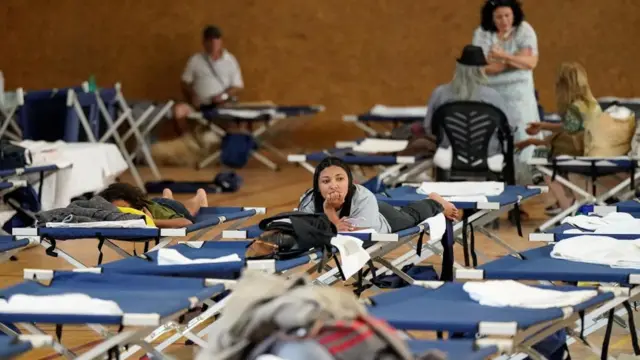
    At around 20:00 local time (19:00 BST), her family was evacuated by law enforcement and taken to a gymnasium in neighbouring town Cap Ferret.

    They had to leave two of their cats and four chickens behind as they could not be found in the flurry to leave.

    She was then evacuated again around 05:00 local time (04:00 BST) this morning and had to travel to Bordeaux and she is preparing to be evacuated for a third time.

    “Ash is falling from the sky,” Yassmina says. “And the air has become unbreathable because of the smoke being carried by the winds.”

    She has been told by her neighbours that their house in Le Porge has burned down.

  10. Analysis

    Brussels ambitious wildfire response hasn't been enough to contain firespublished at 22:22 BST 24 July

    Nick Beake
    Europe Correspondent

    I was at briefing in Brussels last month when European Commission officials spoke of their concern that wildfire season had started earlier this year.

    They said the omens were not good.

    Since then we’ve had the devastating fires in southeast Spain, in which seven Britons were among the dead.

    And now both Spanish and French officials talk of an unprecedented struggle to contain these current blazes.

    Commission officials had told reporters that a fleet of nearly 30 planes and helicopters, as well as 800 firefighters, had been pre-positioned across Europe.

    They called it their most ambitious wildfire response yet. It hasn’t been enough to contain fires that are being described grimly as historic.

    Every effort will be needed it in the days and weeks to come, judging by the ferocity of the wildfires so far this summer.

    In the short-term, rainfall, lower temperatures and gentler winds are what’s really needed.

  11. Analysis

    The scale of these Spain and France wildfires is strikingpublished at 22:16 BST 24 July

    Justin Rowlatt
    Climate editor

    July is the heart of the Mediterranean wildfire season, so the fires in Spain and southern France are not in themselves unusually early. What is striking is the scale already reached.

    Spain has burned far more land than at the same point last year, while France says significant fire activity began several weeks earlier than usual and the area burned is already well above normal.

    Europe is the fastest-warming continent, heating at more than twice the global average, and that rapid warming is making its summers hotter and, particularly in the south, drier.

    Those conditions leave soil, trees and other vegetation with less moisture, creating the fuel in which wildfires can take hold. A spark is still needed - most often from human activity, usually accidental but sometimes deliberate, or from lightning.

    Once a fire starts, extreme heat, dry vegetation and strong winds can help it spread faster, burn more intensely and become much harder to control.

    How forests and landscapes are managed also matters: Accumulated vegetation and abandoned land can provide more fuel for fires.

    But the European Environment Agency has said “climate change has increased forest fire risk across Europe”, with the greatest danger expected in southern Europe.

  12. Scattered showers forecast for Spain but picture far from straightforwardpublished at 22:05 BST 24 July

    Ben Rich
    Lead Weather Presenter

    A Spanish flag (three horizontal stripes: red, yellow, and red, with the yellow stripe twice as wide as each red stripe. It also includes the national coat of arms shifted slightly toward the hoist side) partially burned with dark smoke clouding the skyImage source, EPA

    The weekend forecast provides a little hope for the situation around Madrid with the fire danger predicted to drop a little – but the picture is far from straightforward.

    Temperatures on Saturday will be lower than recently, peaking at around 29C (84F). The humidity may rise a little as well, meaning slightly more moisture in the atmosphere.

    Scattered showers and thunderstorms will affect parts of northern Spain and authorities will be hoping that some of these move across the Madrid area. Local forecasts suggest about a 25% chance of rain which, of course, means a 75% chance that it will remain dry.

    The winds could also continue to fan the flames, strengthening through the day with gusts potentially touching 45km/h (28mph) during the afternoon and into the evening.

    By Sunday the winds will be lighter although it is, unfortunately, expected to remain dry.

    And there will undoubtedly be concerns about the forecast for next week, with computer weather models suggesting temperatures could climb again, perhaps touching 40C (104F) – with the threat of further gusty winds at times and very little, if any, rain in the forecast.

  13. 'Nearly 60,000' people affected by Spain wildfires, says interior ministerpublished at 21:54 BST 24 July

    Interior minister Fernando Grande-Marlaska in a denim shirt with the two top buttons opened as he speaks to the pressImage source, Getty Images

    Spanish Interior Minister Fernando Grande-Marlaska has been speaking to national media this evening to provide an update on the wildfires.

    He tells Cadena Ser's Hora 25 programme that "nearly 60,000 people" are being affected by the fires, with at least 30,000 evacuated and more than 20,000 in lockdown.

    "It's a difficult and complex situation but conditions may improve in the coming hours," Grande-Marlaska says.

    "The first priority is to save lives and ensure people's safety."

    Since the start of the fires, more than 140,000 people have been forced to leave their homes in Spain and France, 110,000 in the Gironde region alone.

  14. Former firefighter battles flames: 'We managed to save four houses'published at 21:42 BST 24 July

    A shirtless man in his forties hoses down vegetation in front of houses in what appears to be a semi-rural area. There is visible fire damage to some plants, and the house next door appears to have been destroyed, but the house directly behind the man does not appear to have been damaged.Image source, Reuters

    Amid the wildfires, some residents are hunkering down with hoses to try and save their homes.

    Ludovic Pollet, a resident of Cap Ferret in France - an area near Bordeaux where tens of thousands have been evacuated - describes a desperate wait for firefighters last night.

    "We didn't see a single truck all night, except for one, but it arrived very late," Pollet tells Reuters, who is a former firefighter himself.

    "I really had to push hard to get it. With those four firemen, plus my son and me, we managed to save four houses."

  15. Patchy rain falls in parts of France's Gironde region, with more possible over weekendpublished at 21:23 BST 24 July

    Ben Rich
    Lead Weather Presenter

    Much-needed rain is currently falling in parts of the Gironde region of France with scattered showers and thunderstorms moving in from the west.

    This rain is quite patchy in nature but authorities will be hoping that it becomes more widespread overnight and during tomorrow.

    As well as that, easterly winds which have been bringing very dry air from the interior of France are being replaced by west or north-westerly winds which will instead feed moist and humid air across the region, from the Atlantic.

    However, these winds will still be strong and rather gusty – perhaps touching 50km/h (31mph) or more – so despite the change to a more favourable direction, they could continue to fan the flames.

    Further spells of rain are possible, but not guaranteed, over the weekend. However it looks likely to turn largely dry once again next week, and temperatures will climb.

    Winds will be rather variable but will occasionally blow from the dry interior, so forecasters will be watching the conditions very closely as they unfold.

  16. 'At first we dismissed it but then everyone was packing in a panic'published at 21:12 BST 24 July

    Firefighters in black uniform and yellow hard hats tackle a large fire among trees and bushesImage source, Reuters
    Image caption,

    Hundreds of firefighters have been deployed to help tackle the wildfire in the Gironde region

    Olivia Jarratt, 44, was evacuated from the Truc Vert campsite in Lège-Cap-Ferret with her husband and two children in the early hours of Friday morning.

    Her daughter was woken with sirens and the family left their tent, camping gear and bikes behind as they made the drive to Bordeaux.

    "At first, we dismissed it, and thought she was having a nightmare, but we realised it was all going on, and everyone was packing in a panic. There's only one road off the peninsula, so people were trying to be as quick as possible.

    "There was a loudspeaker with the sirens, but obviously that was in French, and with everything, we couldn't understand what was happening."

  17. British holidaymakers saw 'several fires in the distance' whilst evacuatingpublished at 20:59 BST 24 July

    Headmaster David Morton, 53, from Gloucester in southwest England, had been on holiday with his wife and sons when they received an emergency alert via text overnight on Thursday instructing them to evacuate.

    The family were staying in a house in Petit Piquey, in the Cap Ferret peninsula, and were woken up at 03:00 local time (02:00 BST) by an alert on the property's landline.

    "Everyone was driving with their lights on, driving very slowly – there was lots of fire service people, ambulances, police on the other side of the road controlling things and we could see several fires in the distance as we drove," he has told the BBC.

    "It's different from seeing it on the television… seeing it blazing out of control despite hundreds and hundreds of firemen and women helping."

    One of David Morton's sons takes a selfie of the familyImage source, David Morton
  18. France has had a terrible year for forest fires but worst could be yet to comepublished at 20:44 BST 24 July

    Hugh Schofield
    Paris Correspondent

    The outlook for these fires in France is not optimistic.

    The winds are shifting and unpredictable, and months of heat and drought have created alarmingly dangerous conditions.

    It's already been a terrible year for forest fires, but in France, these are the most severe yet.

    The great fear is that the worst is yet to come.

    There’s no prospect of rain, and next week more high temperatures are forecast.

  19. Wildfires are 'the worst-case scenario' says French mayorpublished at 20:35 BST 24 July

    The Mayor of Lège-Cap Ferret Philippe de Gonneville puts as he speaks to reporters. He is wearing a blue shirt and has a mask in his shirt's pocketImage source, Reuters

    The mayor of one of the hardest hit areas of France has described how the wildfires are "the worst-case scenario" and authorities are dealing with a "massive, unprecedented fire".

    The Mayor of Lège-Cap Ferret Philippe de Gonneville tells reporters how the region has "faced extreme weather conditions for the last month and a half" without rain and with temperatures above average.

    "It is unheard of," he says. "Neither we nor the firefighters have ever seen anything like it."

    The mayor says two fire breaks have been created to prevent the fire from spreading down towards Cap Ferret and "the defensive lines appear to be holding".

    The entire Cap Ferret peninsula was evacuated "using both land and sea routes" after the fire spread, he explains.

  20. 'We are doing everything we can to prevent fires merging' - Spain's interior ministerpublished at 20:21 BST 24 July

    A firefighter standing next to a line of fire burning through a field in Spain with smoke flowing into the skyImage source, AFP via Getty Images
    Image caption,

    A firefighter battling a wildfire in Cebreros area, near Avila

    Spanish Interior Minister Fernando Grande-Marlaska has told Spain's public broadcaster RTVE that authorities are doing "everything we can" to prevent the Ávila fire merging with the fires in Madrid.

    Grande-Marlaska says the situation is "complex" and authorities will "carry out all necessary evacuations and containment measures".

    He adds that saving lives is the top priority.

    Local emergency services said this afternoon that two fires to the west of Madrid had merged. The regional government's emergency management chief said that the fire is "beyond the capacity" of firefighters "to extinguish it".