Summary

  • The death toll from Venezuela's earthquakes is now 1,430, with 3,238 injured, according to lawmaker Jorge Rodríguez

  • He describes the incident as "the most disastrous event this republic has suffered in the last 123 years"

  • Rescuers are racing to pull out survivors as the 72-hour window nears its end

  • A newborn baby is among those rescued from the rubble - watch the emotional moment

  • However, tensions are also growing over the pace and co-ordination of the government's response, writes our correspondent Will Grant

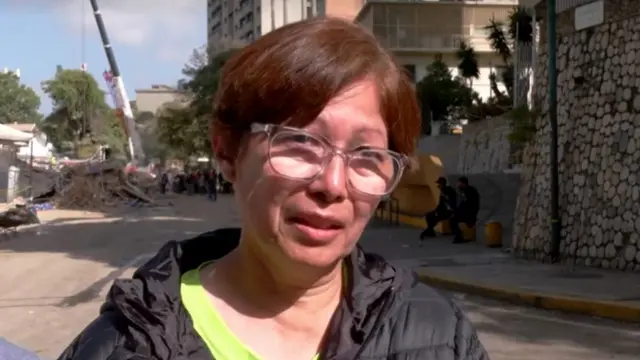
  • The quakes, with magnitudes of 7.2 and 7.5, hit less than a minute apart while most were home for a national holiday - how locals are describing the scenes

  1. Death toll rises in Venezuela, as window for survival narrowspublished at 22:40 BST 27 June

    Katie Williams
    Live reporter

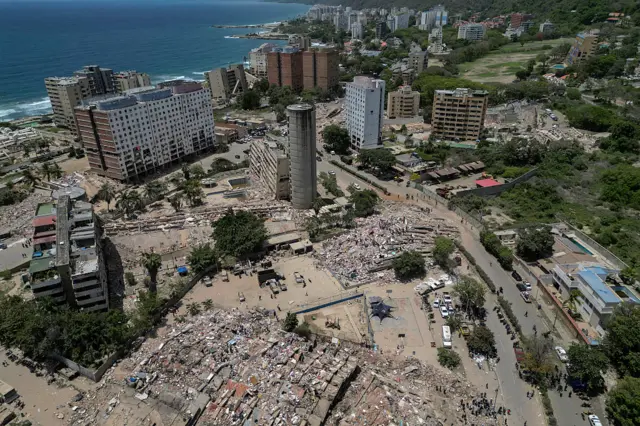
    This aerial view shows rescuers and volunteers working amid the rubble of collapsed buildings in Caraballeda, La Guaira state, VenezuelaImage source, AFP via Getty Images

    Nearly 72 hours have passed since twin earthquakes shook Venezuela in what top lawmaker Jorge Rodríguez has called "the most disastrous event" the country has suffered in the last 123 years.

    The death toll has risen to 1,430, with 3,238 injured, Rodríguez says.

    With homes flattened, 3,142 families are reported to be in shelters.

    Rescue teams and locals are searching through the rubble - one international rescuer tells us Venezuelan equipment is "decades behind international standards".

    There’s growing frustration at the pace of the government response, says our correspondent in La Guaira.

    Amid the devastation, there have been some moments of joy, including when a newborn baby was freed earlier.

    But tens of thousands could still be missing - the exact figure is unclear - and photos of loved ones have been posted on hospital walls.

    As for tomorrow, search and rescue will continue. Many Venezuelans cling to hope that their loved ones are still waiting to be found. One Caracas resident, whose son is missing, asks: "Please don’t stop searching."

    We’re now bringing our live coverage to a close - you can read more in our story.
  2. Woman clings to hope her son and family are still alivepublished at 22:26 BST 27 June

    Vanessa Silva
    Reporting from La Guaira, Venezuela

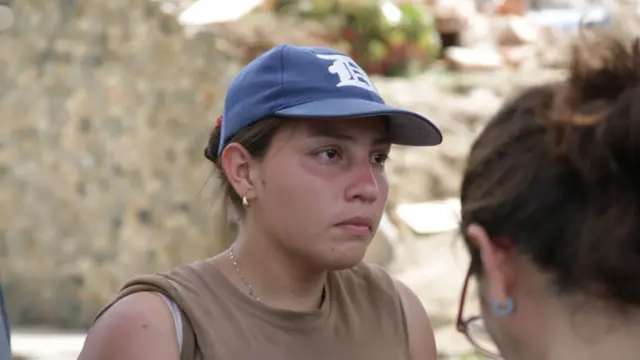
    Andreina Valerio, in a blue baseball cap, stands in front of rubble
    Image caption,

    Andreina Valerio says she heard her almost two-year-old son crying beneath the rubble

    Families have been searching for relatives in the rubble with their bare hands, outside dozens of collapsed buildings in La Guaira.

    Those I spoke to were sleep-deprived, their voices hoarse from screaming for survivors. One woman was still holding on to hope that her son would be saved.

    I met Andreina Valerio outside a crumbling building. She told me she was worried about her almost two-year-old son, Santiago, and her partner, Ramsés Mendoza, who were still trapped inside along with all of Mendoza's family.

    On the day of the earthquakes, Andreina came back from work to look for her child at her in-laws' house. She found the building in ruins.

    That night she heard a voice coming from the ruins - a woman crying for help. On Friday, she went back again and heard a baby crying.

    She told me she has faith that the voice belongs to her son, and that he and her family are alive.

  3. Rescue equipment 'decades behind international standards', says rescuerpublished at 22:17 BST 27 June

    Bruno Boelpaep
    Reporting from Cúcuta, Colombia

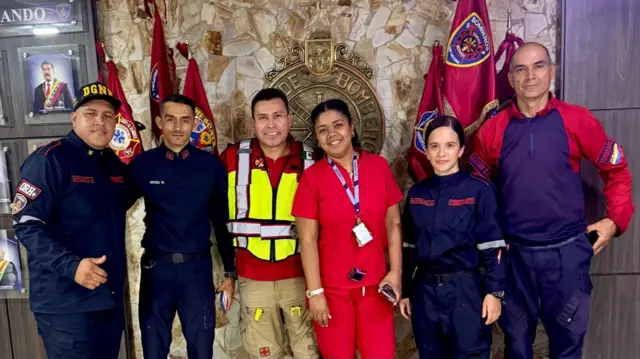
    Daniel Velázquez Martínez pictured with colleaguesImage source, Daniel Velázquez Martínez
    Image caption,

    Daniel Velázquez Martínez, pictured third from left

    Daniel Velázquez Martínez is a Mexican fireman, architect and disaster assessment specialist.

    We met him as he was about to cross the border into Venezuela and he’s since reached the disaster zone in La Guaira.

    He says the situation is "extremely challenging" with the country’s rescue equipment "decades behind international standards".

    Local teams are doing everything they can with what they have.

    A strong international team is working away too, but the logistics are difficult, including getting aid and equipment to the disaster zone, he adds.

    It is clear Venezuela was not prepared for an event like this, he says.

  4. Photos of missing left at hospital as Venezuelans cling to hopepublished at 22:08 BST 27 June

    Vanessa Silva
    Reporting from Caracas, Venezuela

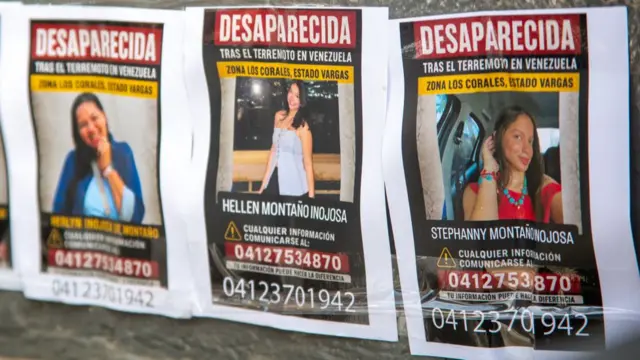
    Photographs of missing at hospital in CaracasImage source, Rhonny Zamora

    Outside the Vargas Hospital in Caracas, there’s a list of injured people who’ve been taken to this medical centre.

    According to Luis Rodríguez, head of surgery, they have "kept strict records of the admitted patients. That’s the list you see posted on the wall", he tells the BBC.

    Alongside these lists, families have also left photographs of their loved ones, hoping they’ll be found alive somewhere.

    I spoke with a man who was searching for a 14-year-old boy.

    The family had dispersed, but while at the hospital, they received news that the body had possibly been found. Given the conditions, they hadn’t yet been able to identify it with certainty.

    "Until we are 100% sure, we have a glimmer of hope," he said.

    According to Rodríguez, this hospital has admitted more than 600 of the more than 3,000 injured reported since the earthquakes that shook the country.

    He says the injured are mainly from La Guaira state, the most affected area. The main injuries are crush injuries and fractures, but they’ve also treated people with anxiety attacks.

    He says this hospital has resources and isn’t overwhelmed like other hospitals in La Guaira and Caracas.

    Media caption,

    Panic attacks and fractures - Venezuela hospital treats earthquake victims

  5. More foreign nationals reportedly killed in quakespublished at 21:55 BST 27 June

    We have also been tracking the number of foreign nationals reported to have been killed in Venezuela's earthquakes. Here are the latest updates:

    • The Portuguese death toll - local media now report that 41 nationals and people of Portuguese descent have died, citing an update released by the Ministry of Foreign Affairs this afternoon
    • The Spanish death toll - earlier reported as five - has risen to six, with 133 missing, according to the government-owned news agency EFE
    • One Chilean national has also been reported dead by the country's Ministry of Foreign Affairs
    • Three Italian-Venezuelans have been killed, according to Italian media, citing Foreign Minister Antonio Tajani

    These are in addition to earlier reports that seven Chinese nationals and two Brazilians have been killed.

  6. 'I'll get there no matter how,' says man heading to La Guaira with foodpublished at 21:43 BST 27 June

    Dan Johnson
    Reporting from Cúcuta, Colombia

    Roger Manrique and his brother-in-law Domingo Barrios
    Image caption,

    Roger Manrique and his brother-in-law, Domingo Barrios

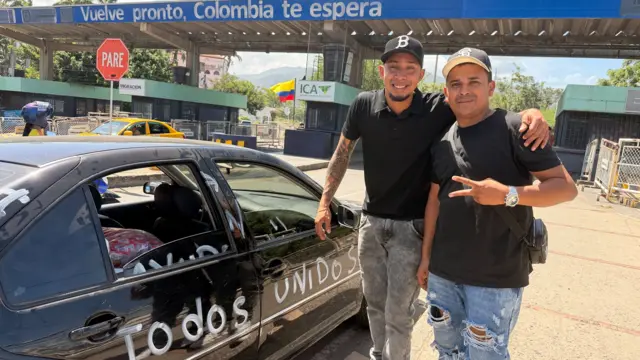
    Crossing the border into Venezuela, we met Roger Manrique, driving a car packed full of food and supplies, with the words "Humanitarian aid, for you Venezuela, standing together" scrawled on it.

    Roger is Venezuelan but lives in Colombia’s capital, Bogotá. His family is from La Guaira, the worst-hit area. His father and brothers survived, but he’s heard several of his cousins were killed.

    "A lot of people are dead," he says. "It’s really hard. My surviving relatives are waiting for me to deliver this food. I’ll get there no matter how."

    Roger left Bogotá on Friday with his brother-in-law, Domingo Barrios, and still faces a drive of more than 15 hours - if he can reach La Guaira at all. It’s reported that roads are blocked and the military is stopping civilians from entering the region.

  7. Growing frustration at pace of government responsepublished at 21:27 BST 27 June

    Will Grant
    Reporting from La Guaira, Venezuela

    Firefighters and volunteers work amidst the rubble of a collapsed building after earthquakes hit the country, in La GuairaImage source, Reuters

    The situation in the coastal town of La Guaira is dire.

    This is where the majority of the estimated 50,000 missing are believed to be, an unknown number of them buried beneath the rubble.

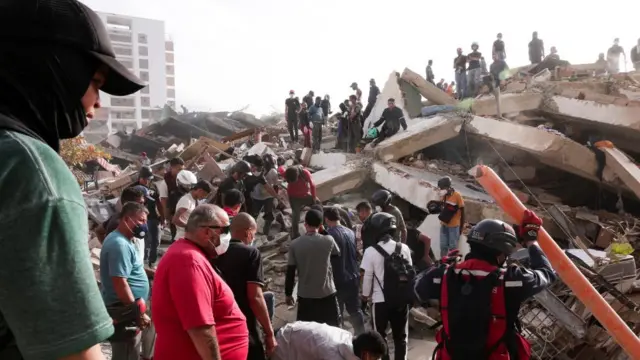
    In the collapsed building in front of me, three bodies were just pulled from the concrete and twisted rebar, and rescuers believe they have located a fourth.

    Nearby, in another flattened apartment block, there was better news - with two people pulled out alive.

    But tensions here are growing at the pace and co-ordination of the government’s response.

    While the scale of this tragedy would present a challenge for any country, many residents have complained about what they see as a hesitant and mismanaged reaction.

    They say it has been the people themselves who have pulled together in this emergency.

    International support is now on site in La Guaira, with rescue teams from Mexico, Brazil and elsewhere working around the clock.

  8. All the figures lawmaker Jorge Rodríguez told us earlierpublished at 21:19 BST 27 June

    JORGE RODRIGUEZImage source, Reuters

    As we reported earlier, Venezuela's top lawmaker Jorge Rodríguez has given an update on the latest death toll.

    He’s shared more detail about the earthquake. Here’s a summary of what he said earlier:

    • Rodríguez says 1,430 of "our brothers and sisters" have died and that 3,238 injured people have received care
    • He adds that 3,142 affected families are being cared for in shelters
    • Hospitals have given direct medical care in more than 5,000 cases
    • In disaster areas, more than 7,500 triage assessments and over 12,000 medical consultations were carried out
    • More than 73,700 families have received direct assistance and 7.2 million kg of food has been distributed in the disaster zones, particularly in the hardest-hit La Guaira state
    • Twenty-one international delegations have been deployed to help rescue efforts, totalling 2,242 rescue workers and 96 canine units
    • More than 30,000 people, including military and police officers, rescue workers, medical and paramedic staff, support workers, psychologists and other specialised workers, are assisting
  9. US Geological Survey estimate suggests death toll could be higherpublished at 20:48 BST 27 June

    Esme Stallard
    Senior climate and science reporter

    As we've reported, Venezuelan officials say the latest death toll is 1,430, with 3,238 injured.

    However, after the earthquake, the US Geological Survey's (USGS) estimate of potential fatalities in the region is most likely between 10,000 and 100,000.

    This is not an exact figure of the number of people that may have died - it could be higher or lower.

    The USGS issues this figure to help emergency responders, government agencies and the media understand how potentially significant this event is and deploy resources effectively.

    The organisation uses something called the PAGER system to calculate this figure.

    It looks at many factors including the size of the earthquake, how far below the surface the earthquake started, the amount of ground shaking and the population in the area that could have been exposed. And then, based off of previous earthquakes with similar characteristics it gives us a figure.

    But many other factors play into the potential injuries and deaths, including the quality of the buildings and the time of day.

    If people are sleeping when earthquakes occur, it increases the likelihood of not being able to evacuate.

    The figure will get updated as more information comes through. But this event has been given a red alert - of which there are usually only 1-2 a year.

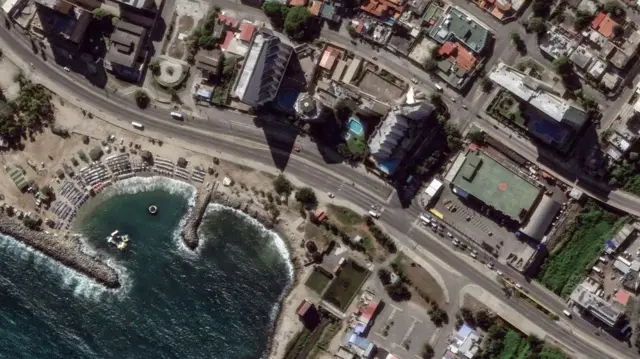
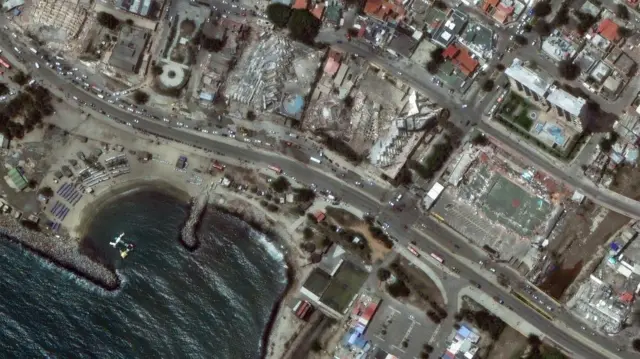
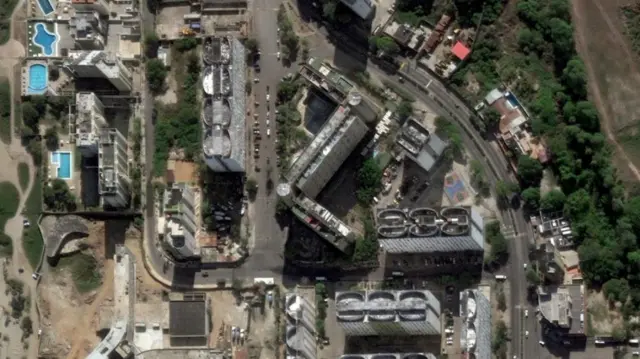
  10. High-rise buildings flattened in before-and-after shotspublished at 20:24 BST 27 June

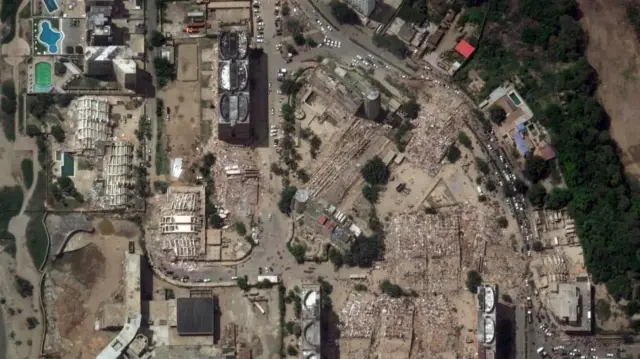
    A series of before-and-after images show the destruction in Caraballeda, a town in the state of La Guaira.

    Several high-rise buildings have been completely reduced to rubble.

    La Guaira is the area that has been worst affected by the twin earthquakes on Wednesday evening.

    A satellite image shows structures in Caraballeda, Venezuela, before the earthquakes that hit the countryImage source, Reuters
    Image caption,

    Before: an aerial shot shows structures intact

    A satellite image shows collapsed structures in Caraballeda, Venezuela, following the earthquakes that hit the countryImage source, Reuters
    Image caption,

    After: widespread destruction with buildings reduced to rubble

    A satellite image shows high-rises in Caraballeda, Venezuela, before the earthquakes that hit the countryImage source, Reuters
    Image caption,

    Before: high-rise buildings stand tall

    A satellite image shows flattened high-rises in Caraballeda, Venezuela, following earthquakes that hit the countryImage source, Reuters
    Image caption,

    After: several buildings completely flattened

  11. Venezuela issuing us with temporary accreditation to visit La Guairapublished at 20:00 BST 27 June

    Will Grant
    Reporting on the way to La Guaira, Venezuela

    Amid the devastation, Venezuela briefly waived its normally strict visa rules and let the international media in.

    Now, after the event, the authorities are issuing us with temporary accreditations and are controlling press access to the worst-hit area of La Guaira.

    We have all been loaded on to state buses and are on our way to the coast to witness the rescue teams in action and see the destruction. It’s not clear if we will have free rein to move around and film.

    But after the initial impact and confusion of the twin earthquakes, this feels like the government’s attempt to impose some order on the chaos.

    Critics say that should hardly be the priority in a tragedy of these dimensions.

  12. 'Survivability reduces' with every hour that passes, rescuer sayspublished at 19:51 BST 27 June

    Katie Williams
    Live reporter

    Josh Macabuag pictured at work previously wearing hard hatImage source, Josh Macabuag

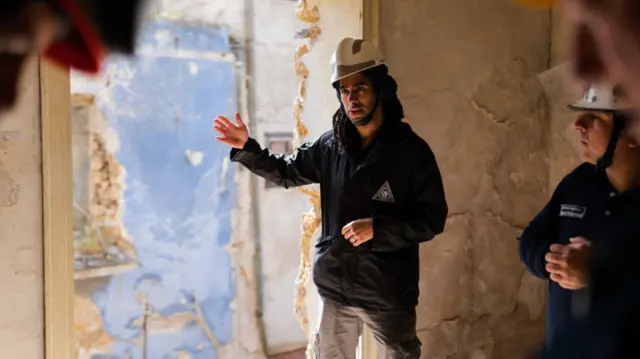
    I’ve just spoken to Josh Macabuag, an engineer at UK-based charity Search and Rescue Assistance in Disasters (Saraid).

    Saraid is working to assist rescue efforts in Venezuela.

    While many have been talking about a 72-hour "golden window" for rescues, he says there is "no hard cut-off" but, essentially, "time is of the essence".

    With every hour, "survivability reduces" with survival rates falling in a "continuous curve".

    Macabuag, who has on-the-ground experience in the aftermath of the 2023 Turkey-Syria earthquake, says the last person his team saved was "well over 100 hours later", although these sort of "miracle" rescues are "rare".

  13. Venezuelan man visibly moved as he thanks rescuers at airportpublished at 19:34 BST 27 June

    Orla Guerin
    Reporting from Valencia, Venezuela

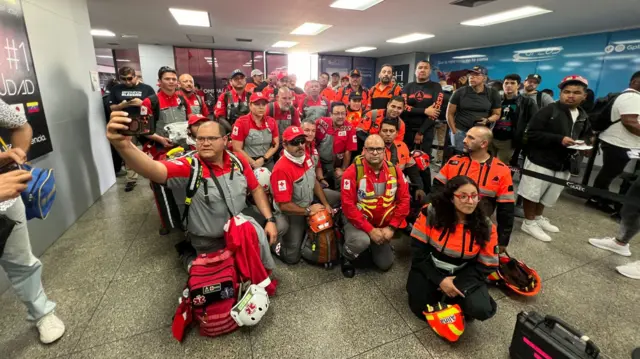
    Rescuers pictured at the airport

    More international search and rescue teams have arrived in Venezuela to help with efforts to find survivors from Wednesday’s twin earthquakes, as the crucial 72-hour window draws to a close.

    Experts say after this period the chances of finding anyone alive fall sharply.

    The arrivals area in Valencia airport - about a two-and-a-half-hour drive from Caracas - was bustling with dozens of rescue workers moving fast to collect bulky baggage and equipment.

    A sniffer dog was in among the throng of teams from Ecuador, Chile and Mexico, who flew in from Panama City.

    Before landing, one passenger - a Venezuelan himself - thanked all the rescue teams on board for coming to help his people and his nation, his voice breaking as he spoke.

    On landing, the rescuers were thanked by airport staff standing on the blistering hot tarmac. There were cheers and more thanks from local people in the arrival area.

    For families waiting desperately beside piles of rubble three days on, well-equipped international teams may be their best chance of recovering loved ones.

  14. Rescuers flying into Venezuela greeted with heroes' welcomepublished at 19:19 BST 27 June

    Alice Cuddy
    Reporting from Valencia, Venezuela

    There was a lot of anticipation on my flight into Venezuela today. It was filled with rescuers coming to help the search efforts here.

    Among them was a team of more than 30 from Panama, including firefighters and medics, plus two rescue dogs.

    One woman told me she’s responded to natural disasters around the world, including the 2023 earthquake in Turkey. She said she was eager to get moving as quickly as possible.

    The groups crowded around the luggage carriers, picking up heavy rescue equipment.

    When they left the airport, they were greeted with a hero’s welcome - crowds cheering, and some holding up signs.

    "Welcome to Venezuela! Thank you so much," one said.

  15. 'Please don’t stop searching,' says Caracas residentpublished at 19:04 BST 27 June

    Yamile SantanaImage source, Reuters
    Image caption,

    Yamile Santana's son and his partner are still missing after building collapse

    As it approaches 72 hours since the earthquakes hit Venezuela, rescuers are working to pull out as many survivors as possible.

    Hector Mendez, from a Mexican search and rescue team, tells the Reuters news agency he has been working in Chacao, Miranda state, non-stop since last night.

    He says he has recovered the body of a woman, with her dog in her arms.

    "The dog came out alive, but the woman unfortunately died," he says. "We are working now, as you can see, to try to recover the body of the woman’s son."

    "This is something terrible," he says.

    Meanwhile, Yamile Santana, a resident of Caracas whose son and his partner are missing after a building collapse, says she still has hope her loved ones will come out alive.

    But she says there does not seem to be enough machinery and equipment to clear the rubble.

    "I ask - please - to send people who are capable of helping us, and that they don’t stop searching.

    "Because they told me today that they want to stop searching, and that’s not right, because we still hope our loved ones come out alive. Please don’t stop searching."

  16. Earthquakes 'the most disastrous event Venezuela has suffered' - Rodriguezpublished at 18:51 BST 27 June

    We can now bring you more from top lawmaker Jorge Rodríguez's speech.

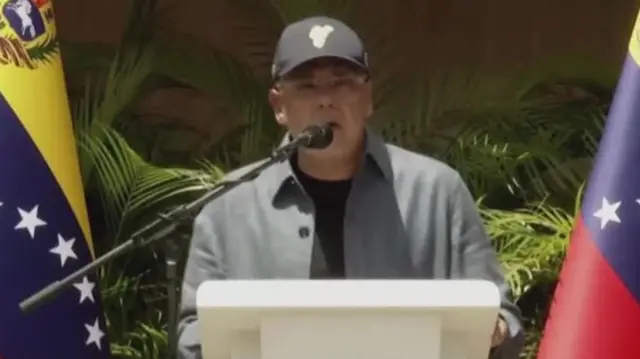
    The lawmaker says the earthquakes are "the most disastrous event this republic has suffered in the last 123 years".

    As well as providing updated death and injury tolls, he says 3,142 families are currently in shelters.

    There have been 430 subsequent aftershocks following the two earthquakes on Wednesday, he adds.

    Rodríguez calls on people to stay at home and avoid travelling to La Guaira state - the worst-hit area which he says suffered "tremendous devastation".

  17. Death toll hits 1,430 - officials saypublished at 18:20 BST 27 June
    Breaking

    The death toll has risen to 1,430, with 3,238 injured, according to top lawmaker Jorge Rodríguez, speaking on state TV now.

    We will bring you more from his speech soon.

  18. Recap: Venezuela still under rubble, as search for survivors intensifiespublished at 18:13 BST 27 June

    Freya Scott-Turner
    Live reporter

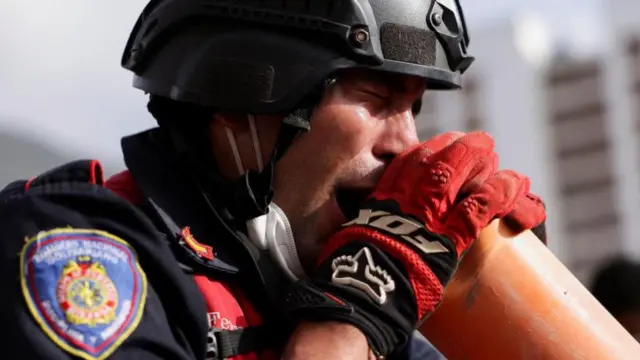
    A firefighter wearing a helmet and protective gloves shouts into an orange tubeImage source, Reuters
    Image caption,

    A firefighter shouts through a tube to people trapped under rubble of a building in La Guaira

    It has been more than 60 hours since Venezuela was struck by twin earthquakes, and the race to find survivors is more urgent than ever.

    Here is what has been happening so far.

    The search continues: Acting President Delcy Rodríguez said in an overnight briefing that she still had "faith and hope" survivors would be rescued.

    In La Guaira: Rodríguez said 60% of electricity services had been restored in the worst-affected state.

    No update on the death toll: The acting president did not give an update on the death toll. The most recent official figure came on Friday - confirming 920 deaths and more than 3,300 injuries.

    Global response: Countries around the world continue to send rescue missions to Venezuela. The UN's co-ordination system shows at least 20 international rescue teams have been deployed, with 32 others mobilising.

    Number of missing unclear: UN aid chief Tom Fletcher told AFP it could be more than 50,000. A website, external - which lets Venezuelans self-report their missing loved ones - has received reports of about 68,000 people missing at the time of writing. About 13,000 are reportedly located - but because the website relies on people actively reporting people as missing and found, the true figure is uncertain.

  19. In La Guaira, a man with a drone becomes an unlikely beacon of hopepublished at 17:43 BST 27 June

    Nicole Kolster
    Contributor to BBC Mundo, in La Guaira

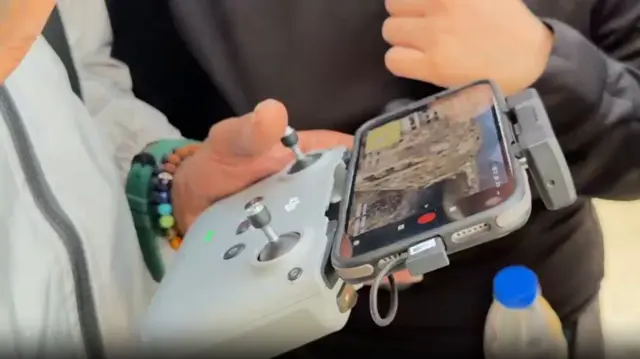
    A man controls a drone as people watch

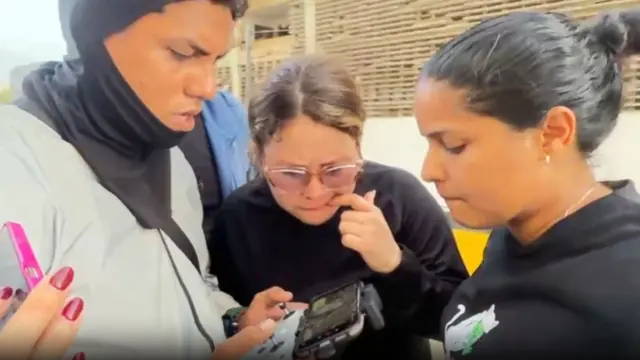
    In La Guaira, a local man with a drone has become an unlikely source of hope. For two days he has been flying his drone over the destruction. He is a volunteer, and families come to him desperate for news or a sighting of their loved ones they cannot reach.

    We all gather around the screen; seeing the scale of the destruction and devastation from above is shocking. Among the rubble in the top corner of a high-rise building, we see a motionless body, a woman. She is still unidentified.

    “This is the only confirmed fatality I’ve seen on my drone,” he tells a young woman who is searching for her relative. She stands opposite nervously biting her nails as she directs the man flying the drone.

    “What other angle do you want to see?” he asks her.

    The search is cut short by what feels like an aftershock. Panic sets in, and people begin to run.

    A man controls a drone as people watch
  20. Next few hours will be critical in rescue operationpublished at 17:15 BST 27 June

    Dan Johnson
    Reporting from Cúcuta, Colombia

    Media caption,

    Venezuela earthquake: 'Next few hours will be critical' for rescuers

    The situation in Venezuela is desperate.

    There is a sense that the next few hours will be critical for saving anyone who is still trapped. People with search and rescue experience talk about a 72-hour window.

    About 2,000 search and rescue officials are heading into Venezuela from right across world - but getting people to the right area with the right equipment is a complex task.

    Despite being in a risk zone, Venezuelan authorities were ill-prepared for this sort of disaster - both in terms of building standards and the emergency response.

    Political instability and corruption have contributed to an underfunded health system and search and rescue service.

    There is widespread poverty, communications are difficult, and infrastructure is poor, meaning getting around the country is complex.

    There are reports of tens of thousands missing - whether this translates into deaths will take time to see.

    We will also have to see how open and transparent Venezuelan authorities are in terms of recording and reporting this information.

    At the moment, the death toll still stands at less than 1,000 - the fear is that the total will climb significantly.