Air defense sirens sounding in Bahrainpublished at 01:40 BST
Alarm sirens have been activated in Bahrain, its Ministry of Interior said via X.
It urged citizens and residents to remain calm and head to their nearest safe location.
The US says it is striking Iran after Donald Trump earlier threatened to "hit them hard" tonight
Trump says the strikes are "in retribution for yesterday's bombing of ships by Iran", and that "if it happens again, it will get much worse"
Iranian media is reporting explosions heard in areas along the country's southern coast and that strikes have hit Iranian-controlled islands in the Gulf
It follows US strikes on Tuesday, which US Central Command said were in response to attacks on three commercial vessels transiting the strait - Iran said it responded with retaliatory attacks on US military sites in Bahrain and Kuwait in the early hours of Wednesday
Responding to Trump's comments earlier, Iran's foreign minister said: "We do not answer vulgarity with vulgarity, but with action: fearlessly and with great valour"
Alarm sirens have been activated in Bahrain, its Ministry of Interior said via X.
It urged citizens and residents to remain calm and head to their nearest safe location.
The southeastern Iranian port city Chabahar has been hit for the first time during the conflict.
Photo and video of a damaged maritime traffic control tower circulating online has been verified and reviewed by BBC Verify and BBC Persian.
Iran's semi-official news agency Tasnim says that the sounds of about ten explosions have been heard in Chabahar and Konarak and power has also been cut off in parts of the city of Chabahar.
Tasnim also reports that US fighter jets bombed the IRGC Navy's Imam Ali base in Chabahar.
Trump has told journalists aboard Air Force One that the conflict with Iran is not a "war."
"It's really not a war so much. It's a de-nuking of Iran. De-nuclearisation of Iran," he said.
"So this is all about taking nuclear weapons, not allowing Iran to have nuclear weapons. And everybody should like that."
He later repeated his claim that he has ended eight wars during his time as president.
When asked if the US is returning to full-scale military scale conflict in Iran, Trump said: "I don’t know, but we would win it very quickly".
The president reiterated his claim that the US has already "won militarily" in Iran, adding that the Middle Eastern nation had "very little left" and wanted to make a deal "so badly".
"They called a little while ago, they want to make a deal so badly - I just don’t know if they’re worthy of making a deal," Trump told reporters.
"I don’t know that they’re going to honour the deal, that’s the problem," he said.
Trump has just been speaking on Air Force One, where he told journalists about today's strikes on Iran.
"We just hit them very hard, and I say we hit them 20 to 1," he said, adding that every time "they hit us, we’re going to hit them 20".

 Peter Bowes
North America correspondent
Hours after US President Donald Trump threatened to hit Iran hard for the second night this week, US Central Command confirmed that further strikes were indeed under way.
Iranian media reported that explosions were heard along the country's southern coast. In a social media post the US said the goal was to "further degrade" Tehran's ability to "threaten freedom of navigation in the Strait of Hormuz." The statement added that America was holding Iran accountable for recent unjustified aggression against commercial shipping navigating the international waterway.
That same justification was given for Tuesday night's exchanges of fire - the biggest breach of the ceasefire since Iran and the US struck an interim agreement in June.
President Trump hasn't formally pulled the US out of the negotiating process - but the chances of reaching a long-term agreement look slimmer than ever.
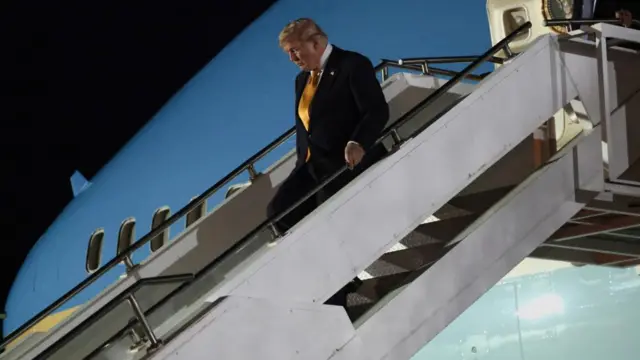 Image source, Reuters
Donald Trump deplanes from the older Air Force One in the UK
A short while ago, President Donald Trump arrived at Mildenhall Air Force Base in the UK, on his way back to Washington from the Nato summit in Turkey.
He didn't make any public remarks about the US resuming airstrikes in Iran. He spoke with some US service members and switched aircraft from the old Air Force One presidential jet to the newly commissioned jet donated by Qatar last year.
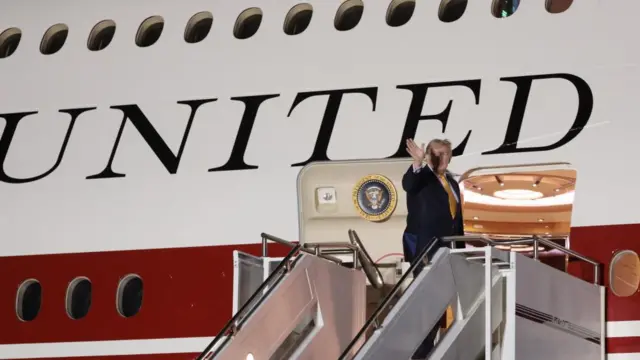 Image source, Reuters
Donald Trump boards the newer Air Force One model in the UK
The latest round of strikes come after the US said it had struck "over 80 targets" in strikes aimed at Iran on Tuesday in response to attacks on commercial ships in the Strait of Hormuz.
The Iranian military said coastal bases and civilian facilities were struck in the provinces of Hormozgan and Mahshar, and later added that eight Iranian soldiers stationed in Bandar Abbas and Bushehr had been killed.
Iran's Islamic Revolutionary Guard Corps said it had responded with retaliatory attacks on US military sites in Bahrain and Kuwait in the early hours of Wednesday morning.
Bahrain's military said it had thwarted a number of Iranian attacks overnight, while Kuwait's defence ministry said no injuries were reported after it intercepted two ballistic missiles and 13 drones overnight.
Donald Trump says the US strikes are "in retribution for yesterday’s bombing of ships by Iran".
The US president adds in a post on Truth Social: "If it happens again, it will get much worse."
His post includes an image of another post on social media that appears to be reporting strikes in Chabahar in southern Iran, which have not been verified by the BBC.
The ongoing strikes on Iran will be greater in number than those carried out on Tuesday, Reuters reports, citing a US official speaking on condition of anonymity.
Axios also reports cites an unnamed US official as saying the latest strikes are wider in scope than Tuesday's.
US Central Command said it hit over 80 targets in its strikes on Tuesday, including Iranian air defence systems, command and control networks, coastal radar sites, anti-ship missile capabilities, and more than 60 Islamic Revolutionary Guard Corps small boats.
A reporter on Iranian state television says that the disputed Abu Musa Island in the Gulf has been hit with two projectiles.
Under a clip posted on Telegram, Fars, the semi-official government news agency, says that eight explosions were heard tonight east of Bandar Abbas, a port city on the country's south coast.
It reports that two projectiles struck Abu Musa Island, two struck Sirik Island, and two explosions were also heard elsewhere on the south coast.
For context: Iran controls the three islands of Abu Musa, Greater Tunb and Lesser Tunb in the Gulf, but they are also claimed by the UAE. This has been the subject of a longstanding dispute between the two countries.
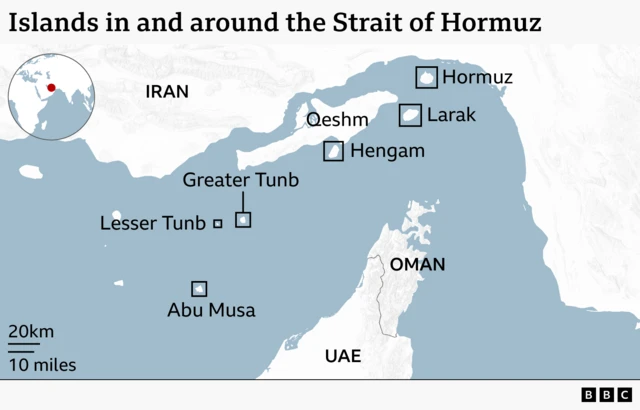
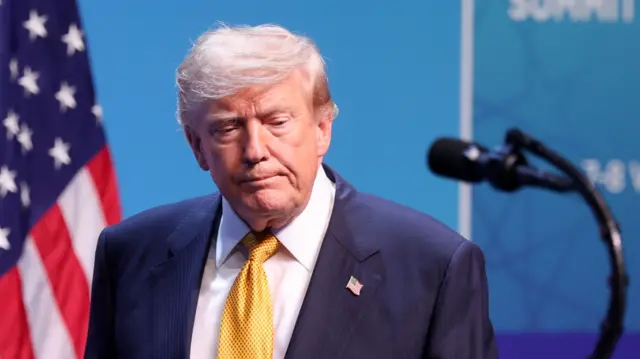 Image source, EPA/Shutterstock
Trump said earlier today that the US would "probably" strike Iran "very hard" again tonight.
"We hit them very hard last night, very, very hard," Trump said, adding the US would "probably hit them hard again tonight".
Trump added: "I gave them a little warning, we're gonna hit them hard again tonight."
Earlier in the day, when asked whether the ceasefire is over and the memorandum of understanding the two countries agreed last month was also over, Trump said: "To me, I think it's over.
"I don't want to deal with them anymore, they're scum. You know what scum is? They're scum. They're sick people."
Asked if talks would resume, Trump said: "I don't care, they can talk. But I think they're wasting their time. They're a bunch of lying guys."
Iranian media have reported explosions being heard at several locations across the south of the country.
State-run outlets report several explosions being heard in the areas of Konarak and Chabahar, with IRNA saying power has been cut off in parts of the latter.
IRIB adds that air defence systems have been activated in Bandar Abbas and that several explosions have been reported in the area.
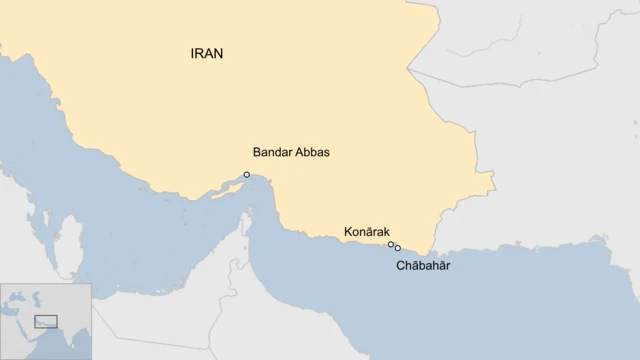
US Central Command says it is carrying out further strikes on Iran.
It says on social media: "At the direction of the Commander in Chief, U.S. Central Command forces have started conducting additional strikes against Iran to further degrade their ability to threaten freedom of navigation in the Strait of Hormuz.
"The United States is holding Iran accountable for recent unjustified aggression against commercial shipping and civilian crews freely navigating a vital international waterway."
 Nick Johnson
Reporting from Washington DC
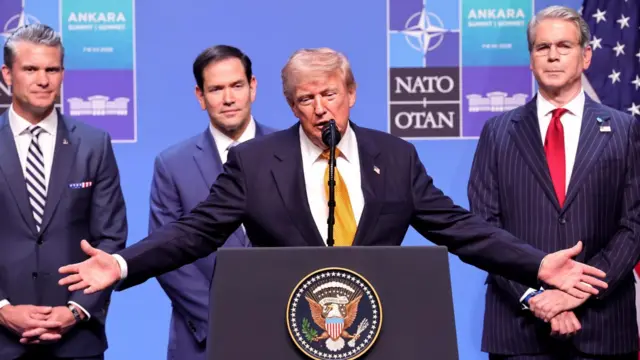 Image source, EPA
Speaking from the Nato summit in Turkey, President Trump made it clear his patience with Iran was running thin.
Shortly after describing the leadership in Tehran as “scum” - he said the US would "probably" strike Iran “very hard” again tonight.
On Tuesday, the US attacked sites in Iran which it claims were used to launch strikes upon commercial vessels in the Strait of Hormuz. Tehran replied by targeting US interests in Bahrain and Kuwait.
But, we’ve been here before.
Only last week, ceasefire talks resumed following another tit-for-tat exchange of fire between Iran and the US. And despite the president’s rhetoric, it’s not clear if the ceasefire has yet run its course.
The duration and intensity of any subsequent US strikes on Iran should provide a clearer picture.
While Donald Trump did not rule out a continuation of the ongoing peace talks, this latest exchange of words and bombs is yet another test of a ceasefire which looks increasingly fragile.
We're ending our live coverage now. You can read more in our news story.

By Joshua Cheetham
The US says it carried out its latest round of strikes in response to attacks on three commercial vessels which it has blamed on Iran.
But these aren’t the only ships to come under attack recently in the Strait of Hormuz.
In total, at least five vessels have been targeted since the US and Iran signed a deal to end the war on 17 June.
The first, on 25 June, was a Singaporean-flagged container ship called Ever Lovely.
The others were three oil tankers and an LPG carrier, tied to owners in Saudi Arabia, Qatar, Greece and South Korea.
All were hit near the coast of Oman, along shipping routes that the UN’s International Maritime Organization, the US and its regional allies have said ships should use to transit the strait.
Iran has previously warned ships to only use a corridor further to the north of the strait which has been approved by Tehran.
By Thomas Copeland
As a reminder, Tuesday's US strikes on Iran followed attacks by Iran on three tankers in the Strait of Hormuz.
Iran has been trying to assert control over the Strait of Hormuz and has demanded that ships take a government-approved route.
Since a deal to end the war with the US was signed on 17 June, Iran has been blamed for five strikes on ships using other routes instead.
This includes a route recommended by the US through Omani waters and also an International Maritime Organization lane through the middle of the strait.
The numbers of ships carrying cargo, oil or gas through these non-Iranian routes steadily grew to a peak of 38 on 24 June, according to data from maritime intelligence firm Kpler.
Then Iran attacked two ships and traffic through the non-Iranian routes slumped.
But these transits have continued at a lower level, despite Iran’s threats, averaging about 13 a day between 30 June and 7 July.
We’ll be keeping a close eye on the data to see what impact yesterday’s three ship attacks will have.
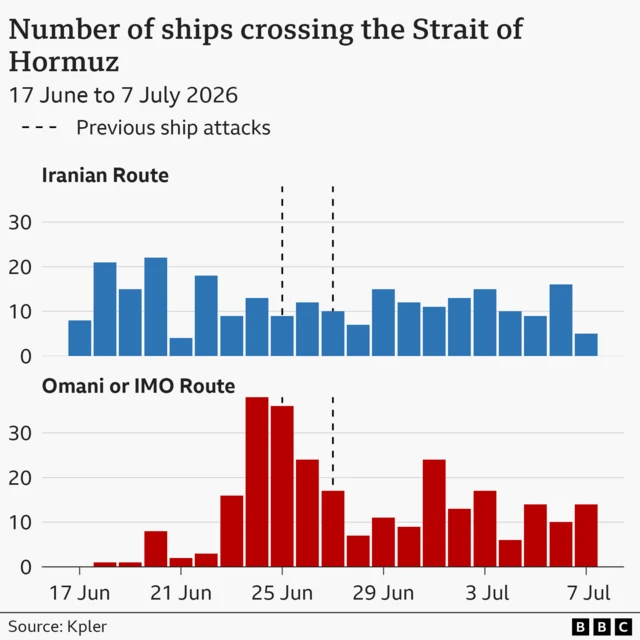
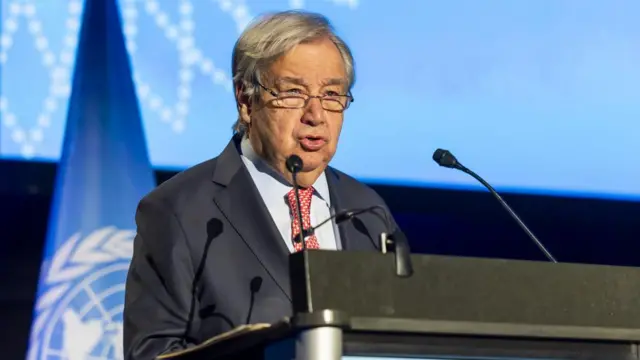 Image source, EPA/Shutterstock
The UN secretary-general has urged Iran and the US to "urgently resume negotiations".
Antonio Guterres says in a statement that a return to full-scale hostilities between the two countries would have "catastrophic consequences" - on the people of the region, international peace and security, as well as the global economy.
He calls on all parties to take immediate steps to de-escalate.
Iran's foreign ministry has also just released a statement accusing the US of violations of the memorandum of understanding (MOU) - an agreement between Iran and the US to work towards ending the conflict.
The ministry highlights what it describes as "repeated illegal attacks against Iran, along with the decision last night by the US Treasury to revoke the license to sell Iranian oil" among the violations.
The US is responsible for the "dangerous consequences" of this escalation, it warns.
