|  | The origins of the Dartmoor Rescue Group date back to 1968, when a small group of local moorland enthusiasts in the Tavistock area started to help out the police during search and rescue operations on Dartmoor.
In due course, a recognised official team was formed.
Currently, the group consists of four sections, based in Ashburton, Okehampton, Tavistock and Plymouth.
Each one is capable of functioning independently, although generally, two sections respond on callouts - leaving two as a back-up in case of an extended operation.
The group is a registered charity and survives financially on fundraising events run by the members and on donations.
No charge is made for the rescue operations, and it's hoped it can remain that way.
 | | The moors can look very friendly and inviting when the sun is out but they can be dangerous at night or in bad weather |
All members provide their own personal equipment.
The larger items such as vehicles and stretchers are purchased with group funds - sometimes with the assistance of the Mountain Rescue Council, which is the national umbrella organisation.
Membership is open to people who are over 18, who are required to complete a training and probationary period. During this time, they have to establish their skills in all-weather navigation and search techniques, first aid and casualty handling, radio operating, local knowledge and team compatibility.
Acceptance onto the callout list may then follow.
Training and practice in all rescue skills continues weekly all year round.
The group is activated only by a 999 call to the Police who assess the situation and, where necessary, alert the appropriate section search controller by telephone or pager.
Currently, each of the sections has around 50 members. No duty roster exists but all members, if available, respond at any time of the day or night to take part in search and rescue operations.
 | | The weather can change very quickly on Dartmoor |
The search teams will generally consist of up to eight people with a Team Leader and individuals nominated as Radio Operator, Navigator and First Aider - although all members are trained to undertake any task in a rescue operation.
The group attends and assists with most of the big annual events which take place on Dartmoor, such as the Ten Tors Challenge, the OATS Walk and the Abbots Way Walk.
In addition talks, demonstrations and training courses are arranged to inform and educate moorland users of all ages in the techniques of hill survival and safety.
Some DRG members also belong to SARDA (Search And Rescue Dogs Association) and provide dogs teams to work on call outs. SARDA dogs use airborne scent to search large areas quickly.
The DRG is affiliated to SWERA (SW England Rescue Association) and to the Mountain Rescue Council.
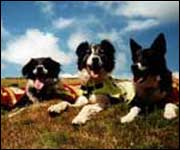 | SARDA dogs use airborne scent to
search large areas quickly |
The DRG can only be called out by the Police and, while mainly used for search and rescue on the moors, is regularly asked to help in "off moor" searches in rural areas.
Being a charity, the DRG is reliant on grants and donations to fund its operations. Many hundreds of man hours are spent by team members and supporters raising funds at specially organised events.
Sometimes organisations "adopt" the DRG for fundraising over a period of time and we are most grateful for their support.
The Dartmoor Rescue Group can be contacted for non-emergency purposes through its General Secretary: info@dartmoor-rescue.org
|