| The day the country went to town | |
| 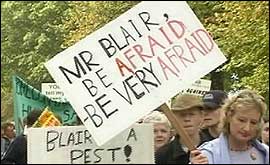 | | One of the messages for the Prime Minister. Around half a million people were in London to join the march. |
| | On Sunday 22nd September 2002, tens of thousands of people from across the South West travelled to London to take part in the March for Liberty and Livelihood. Their aim to encourage the government to take action on a range of problems facing rural communities. |
| | | It was an early start for many leaving Devon in order to get to the start of the march at 10am. Those travelling by train arrived on time, some who went by road were not so lucky.
One coach party from the county found the traffic so bad that, even though they left around 6am, they didn't arrive until almost five and a half hours after the first marchers had begun the route.
 | Noel Edmonds said the march was not purely about hunting |
Still the South West was strongly represented at the march. The Countryside Alliance says more than 40,000 people travelled from the region to join a total they estimate at half a million.
Television personality Noel Edmonds, who lives in Jacobstowe, was among them: "I think what we've got to do is respect our rural communities," he said.
"We've got to support them and this government is not doing enough. This is not purely about hunting - this is about the post offices and the pubs and the problems we've got in the South West."
The operation to get the region's marchers to London was extensive. A chartered train took 700. Among them, the Stoneman family from Witheridge in North Devon. They say they like things how they are at the moment, and do not think the government is listening to what the country people want.
On one of the 250 coaches that travelled from the South West was the Hext family from St Neot, near Bodmin. They went up to London primarily to support hunting and the hunting issue. "We think it should continue and we'd like to see the middle ground from Mr Blair and for him to concentrate on more important rural issues, like what's happening with the countryside."
The march was to highlight a range of rural issues - the lack of affordable housing; poor public transport; the closure of village shops, pubs and post offices; and the depression in farming.
The focus was the threat to hunting, and the coming House of Commons vote on the issue.
In the past, similar demonstrations have had little impact on the large majority of MPs who want a ban on hunting.
The Metropolitan Police say there were isolated incidents of minor disorder, but the march was otherwise peaceful.
Our Rural Affairs Correspondent, Simon Hall, was in London. Read his personal account of the day. | | | |
|
|