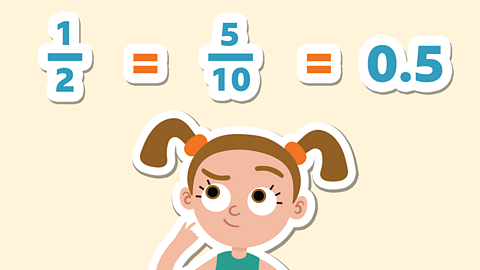
What are unit, non-unit and mixed fractions?
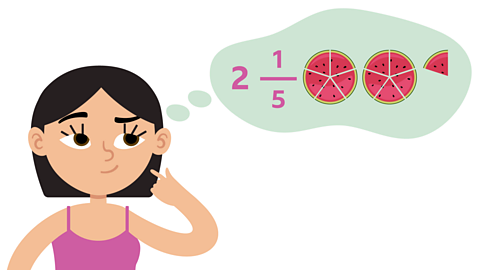
A unit fraction is any fraction where the numerator is 1, for example \(\frac{1}{4}\).
A non-unit fraction is a fraction where the numerator is not 1, for example \(\frac{4}{5}\).
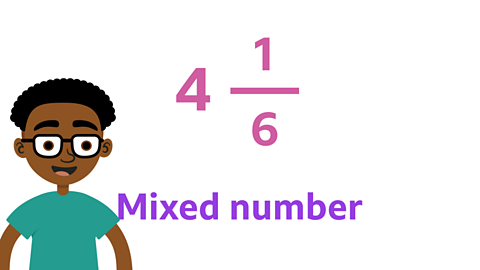
Mixed fractions are a mix of whole numbers and a fraction together, for example 1 \(\frac{1}{4}\).
Sometimes you need to change how fractions are written to make them more useful.
Activity: Unit, non-unit and mixed fractions
Complete this interactive activity to learn how to understand unit, non-unit and mixed fractions. Then put your knowledge to the test.
Converting between top heavy fractions and mixed numbers
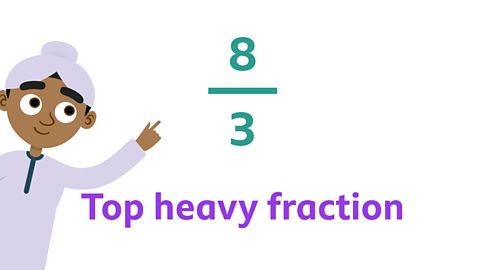
Take a look at the slideshow below to recap unit fractions, non-unit fractions and mixed numbers.
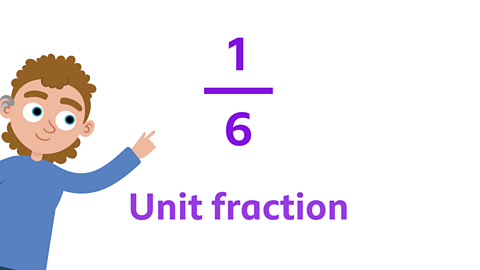
Image caption, A unit fraction always has the numerator 1.
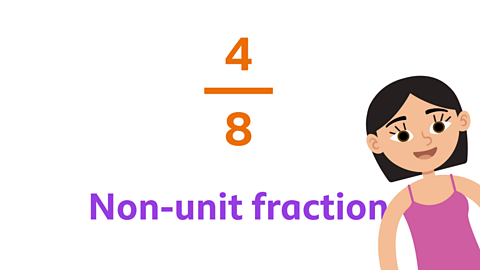
1 of 4
To change a top heavy fraction into a mixed number, work out how many wholes you can make and then add on the remaining parts.
So if you have \(\frac{5}{4}\), you can make 1 whole part of \(\frac{4}{4}\) and you have \(\frac{1}{4}\) remaining.
This means that \(\frac{5}{4}\) is the same as 1 \(\frac{1}{4}\).
To change a mixed number into a top heavy fraction, change the whole numbers into fractions and then add up how many parts you have in total.
If you have 2 \(\frac{1}{3}\), each of the whole numbers becomes \(\frac{3}{3}\), so here you have:
\(\frac{3}{3}\) + \(\frac{3}{3}\) + \(\frac{1}{3}\) = \(\frac{7}{3}\)
This means 2 \(\frac{1}{3}\) as a top heavy fraction is \(\frac{7}{3}\).
Example 1
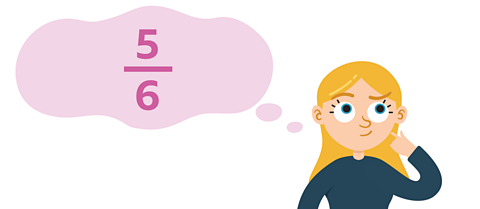
Is \(\frac{5}{6}\) a unit or non-unit fraction?
✓ \(\frac{5}{6}\) is a non-unit fraction as the numerator is not one.
Example 2

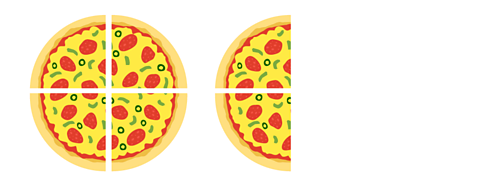
Is \(\frac{6}{4}\) bigger than 1?
✓ \(\frac{6}{4}\) is bigger than 1.
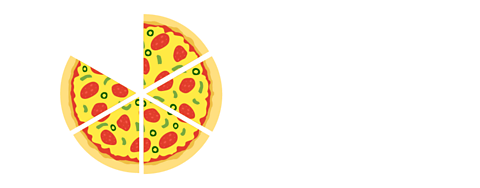
There are 4 slices in each pizza. Each slice represents one quarter.
If you eat 4 of these quarters of pizza you have eaten \(\frac{4}{4}\), or a whole pizza.
So \(\frac{6}{4}\) is bigger than one whole.
Example 3
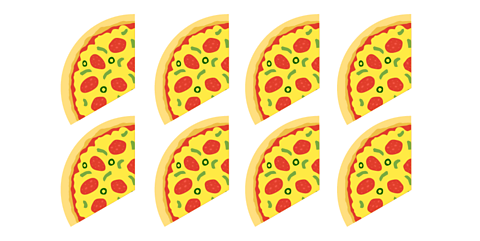
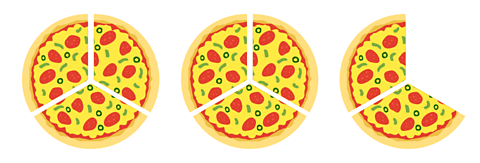
Is \(\frac{8}{3}\) the same as 2 \(\frac{1}{3}\)?
✓ \(\frac{8}{3}\) is not the same as 2 \(\frac{1}{3}\).
If a whole pizza is 3 slices, you can make 2 whole pizzas with 2 slices left.
This means that you have 2 whole pizzas and \(\frac{2}{3}\), which is not the same as 2 \(\frac{1}{3}\).
Primary maths teaching resources
Visit BBC Bitesize for Teachers to see videos, activities and more resources to use in maths classes for KS1 and KS2.

More on Fractions
Find out more by working through a topic
- count2 of 4
- count3 of 4
- count4 of 4