What was the Indus Valley?
The Indus Valley was home to one of the world's first large civilisations, where people lived together with their own cities, culture and ways of life.
It began nearly 5,000 years ago in an area of modern-day Pakistan and Northern India.
There were more than 1,400 towns and cities in the Indus Valley.
The biggest were Harappa and Mohenjo-Daro, these names were given to the cities in later times.
Altogether, around 80,000 people lived there.
We do not know what the Indus people called their cities, because nobody has been able to translate their ancient language into another language to understand it.
Important words
Important words on who the Indus people were.
| Keyword | Definition |
|---|---|
| Citadel | A well-protected part of a city, usually built on higher ground to defend against attackers or protect it from flooding. |
| Civilisation | A group of people living together with their own cities, culture and ways of life. |
| Irrigation | Bringing water to crops to help them grow. |
| Translate | To change one language into another so that it can be understood. |
Watch: Life in the Indus Valley
Watch the video to learn more about life in the Indus Valley.
Narrator: Hello, future people of the UK. I’d like to show you what it’s like to live in the ancient Indus Valley, one of the earliest civilisations, so we’re a long way back in time.
Back before the Vikings… before the Romans and keep going back, back, back until Stonehenge is being built 4,500 years ago.Head south-east over Europe and you’ll see us, just before India.
You can’t miss us – we’re about four times the size of Britain! Aha, you made it! Hi, I’m Suri.
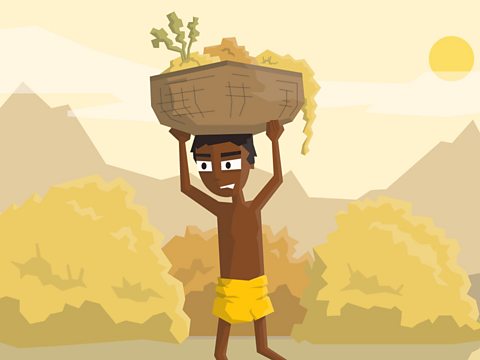
I can’t wait to show you around our village. We’re farmers, by the way, and like all Indus people, we survive from what we can sell.So today Mum has made a special trip to sell our grain in the big city.
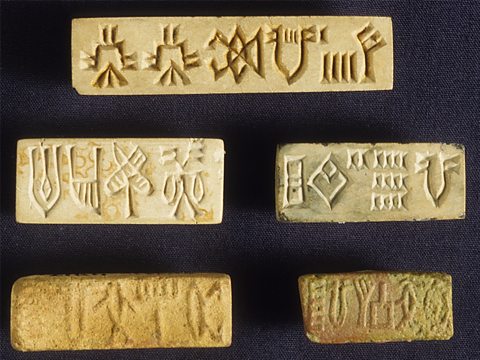
Hang on! But she won’t sell anything without these! These are Mum’s seals – I’ll explain later, but they’re really important.So I need to get them to her pronto.
Never mind the village – you’re getting the city tour instead.
Don’t be intimidated by the walls – they’re not to keep invaders out, they’re to keep water out.
We’re called Indus Valley people because we live – surprise, surprise – in the Indus valley river.
It brings all sorts of benefits, like farming, irrigation and travel, but it can be a bit of a bad neighbour and occasionally tries to wash us away. And wait til you see inside.
Some cities are higgledy-piggledy – not ours.
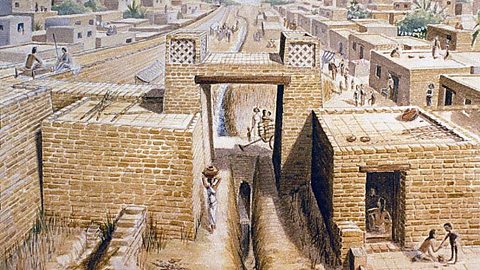
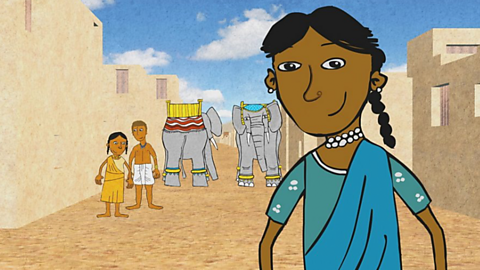
We built some of the first planned cities ever, so the sewers, the roads and the buildings all fit together in a grid system. And down the middle is a big, wide, straight street, just wide enough, in fact, for two elephants to pass side-by-side.
ELEPHANTS TRUMPET
You’d call it a ‘high street’ – we were using the same idea 4,500 years before you.
HORNS BEEP
She’s got to be around here somewhere. Hang on – that looks like my uncle. He’s a builder, can’t you tell?
We don’t have stones around here so, just like you, we use bricks, all baked from clay.
They’re very durable, lasting for thousands of years, which is how your historians will find out about us.
So as you know, our houses have all the mod cons, including personal wells and flushing toilets.
We’re actually one of the first people in the world to have those.
Uncle, any idea where I can find Mum?
Second right, first left – got it.
Check this out! We’re really big gamers in the Indus Valley, and this one is so addictive that I bet you’ll still be playing it in your time.At last the market – I love it here. They’ve got clothes, toys. And just look at this necklace.
In fact, all our products are so great that people come from miles away just to buy them, but money hasn’t been invented yet - we just trade things instead.
It’s just like swapping things, but once the swap is made, it’s made for good. But people don’t like to buy anything without one of these seals.
Don’t worry if you can’t read it. No-one from your time has figured out what it says yet. They tell the buyer who made the goods, so they’re a bit like logos.
Would you ever buy a pair of trainers without the right logo?
Without our seals, Mum wouldn’t be able to sell our grain. So, yikes! Now, which way was I supposed to be going again?
Phew! I’m back on main street. Thank heavens for the grid system. Let’s try again – second right, first left.
Yes! There she is.
I think you’ll be needing these. Ah, shucks, don’t mention it! Wow, thanks, Mum. Pocket money!
COCK CROWS
Well, that’s about it. Our way of life is still a bit of mystery in your time. But, needless to say, it didn’t last forever.
The river here dried up and we were forced to move away. And all this? Well, it’ll be history.
Where was the Indus Valley?
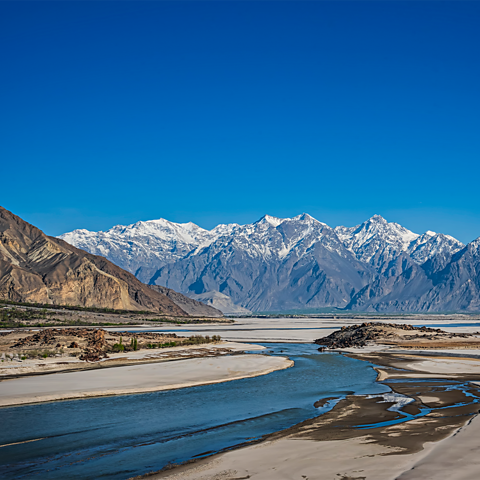
The Indus people lived on the banks of the Indus River, the longest river in Pakistan.
The Indus River begins high up in the Himalayas, the tallest mountain range in the world. From there it flows nearly 2,000 miles to the Arabian Sea.
As the river moves downstream it carves out a valley, this is where the Indus people settled.
The first farmers liked living near the river because it kept the land green and fertile for growing crops.
These farmers lived together in villages.
The villages grew over time into large ancient cities, such as Harappa and Mohenjo-Daro.
The Indus people needed river water to drink and to wash. They also used it to irrigate their fields, which means bringing water to crops to help them grow.
They may also have used water in religious ceremonies.
To the Indus people, their river was ‘The King River’.
Watch: What can the cities of the Indus civilisation tell us?
Explore the cities of the Indus civilisation.
Cities in the Indus Valley, in what is now Pakistan and northern India, were built to last. Four thousand years later, people are still studying them to find out what life was like.
In cities like Mohenjo-daro and Harappa, streets were laid out in straight lines, like a grid. Houses in cities looked alike, showing that plans for how to build them might have been shared.
The cities were carefully organised. Each one had a citadel – a raised, walled area for important buildings – and each had a lower town where most people lived.
Clean water was important. Many houses had their own wells, and cities had special systems to collect and store rainwater. As well as finding ways to collect water, they had covered drains to take their dirty water away.
These features helped keep people healthier – even though people didn't know about germs. Some historians believe that many people in the Indus Valley lived as equals, because everyone could use these features.
Organised, clean and fair, the cities of the Indus Valley show us how people lived and looked after each other.
What happened in the Indus Valley?
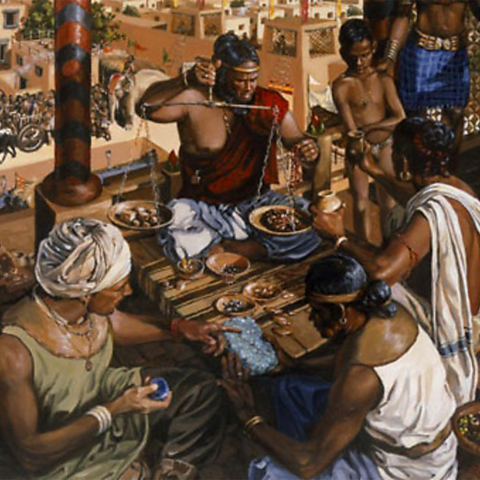
The Indus civilisation seems to have been a peaceful one, the cities were built with strong walls and gateways, which usually means they needed protection.
However few weapons have been found and there is no evidence of an army.
Ancient writings can tell historians about civilisations, but no one has been able to translate the Indus writings.
Archaeologists have to look for other clues.
Sometimes they can find evidence of changes in ruins that indicate wars or battles, but the Indus Valley seems to have stayed the same for hundreds of years.
However, archaeologists have found some skeletons that suggest that the Indus Valley might not have been such a peaceful place after all.
When they looked closely at the skeletons, they saw that they might have died in a nasty way - by being hit with a heavy club.
Slideshow: The ruins of Mohenjo-Daro
Click through the slideshow to learn more about the Indus city of Mohenjo-Daro.
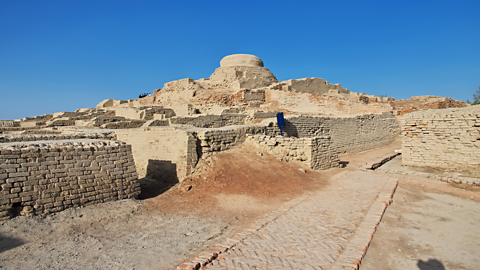
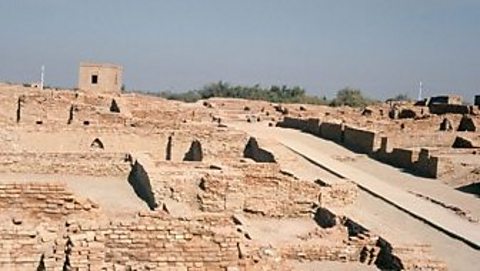
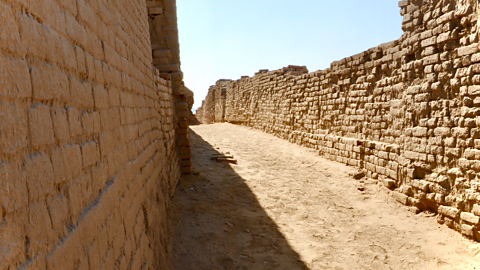
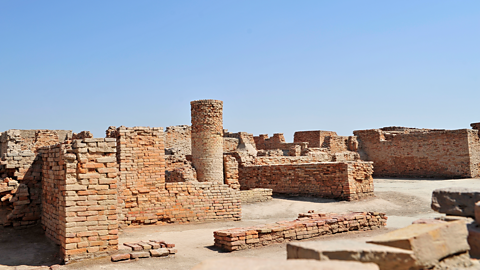
Image caption, The citadel of Mohenjo-Daro. It was were built on a raised mound of earth to protect from flooding from the Indus River. The most important people in Indus society might have lived in the citadel.
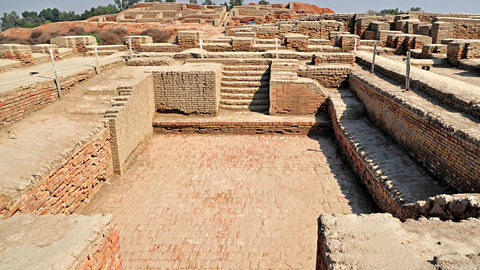
1 of 4
Town planning

The Indus cities were neatly planned, they had straight roads which criss-crossed in a grid pattern to form city blocks.
The main streets were almost 10 metres wide - wide enough for two bullock carts or elephants to pass each other.
Drains ran along the edge of the streets to carry rubbish away and wells were dug for clean water.
Some cities, like Mohenjo-Daro, had high walls. These walls had gateways so people could come and go.
Some city parts of the city were raised up on mounds of earth. The highest mound was known as the citadel. This well-protected part of a city, was usually built on this higher ground to defend it against attackers or protect it from flooding. It might have been where the priests or rulers lived.
Most Indus buildings were made from mud bricks.
Over time, people built new houses on top of old ones, so, over hundreds of years, the cities grew higher and higher.
Some houses were seven metres above the old houses at the bottom!
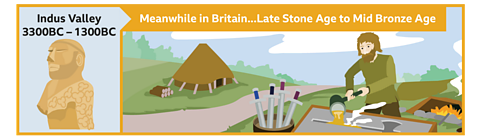
What was happening in Britain?
Think like a historian

Have a look at the thinking points below and think about your answer to the questions. You could even write it down on a piece of paper or discuss it with somebody else if you want to.
What do the sizes of some of the cities of the Indus Valley tell us about them as a civilisation?
Why might translating their language be a key focus for historians and archaeologists?
Why are the Indus Valley's seals so significant to historians and archaeologists?
Perhaps you thought about the number of people in the cities. If there were tens of thousands of people living in these cities, it tells us that they must have had enough resources to survive and grow. It also tells us that they must have been organised to keep all of those people in one place.
Did you think about the fact that we still don’t know everything about the Indus Valley because we haven't been able to translate their language? By translating their language, we would be able to understand many more details about their daily lives. We could discover more things about their ideas, beliefs and the important events they wanted to remember.
Maybe you thought about the pictures and writing on the seals. The seals help show us their language and the animals that they interacted with. Finding the same or similar seals in different places might be a useful clue. It might help us identify a person or place that was linked with the seal – seeing the same seal on different pots might tell us that that person either made or sold pots and decorations.
Activities
Activity 1: Indus cities
Click on the labels below to find out more about the cities in the Indus Valley.
Activity 2: Quiz – Who were the Indus people?
Let's find out what you know about the Indus people.
Grown-ups corner
Are you a parent, carer or teacher?
Take a look at some of the links below on KS2 History which are packed full of knowledge, videos, quizzes and activities.
KS2 History: Introduction to the Indus Valley
BBC Bitesize for Teachers
KS2 History: Non-European Societies
BBC Bitesize for Teachers
KS2 History: Introducing Ancient Sumer
BBC Bitesize for Teachers
Horrible Histories: Raid and Trade game! game
Play Horrible Histories: Raid and Trade KS2 History
More on Indus Valley
Find out more by working through a topic
- count4 of 4