Overview of The Bonnie Earl o’ Moray
- The Bonnie Earl o’ Moray is a traditional Scottish A traditional form of narrative poem, that tells a story about dramatic events including war, love, betrayal, long journeys and even magical events. A ballad normally features repetition, regular rhyme scheme and rhythm. Ballads were traditionally written to be sung or read aloud. by an unknown writer.
- It commemorates a true story: the murder of Scottish nobleman, James Stewart.
- There are many versions of this ballad and it had a significant impact, influencing Scottish politics for some time after the events.
The poem explores themes of:
- heroism and reputation
- betrayal, injustice, and defying social rules
- politics
- loss and mourning
Looking for some quick revision? Try an interactive quiz for National 5 English.
You can read The Bonnie Earl o’ Moray on the Scottish Poetry Library website.
Who was the ‘Bonnie Earl o’ Moray’?
James Stewart was a handsome young noble who lived between 1565 and 1592. He held the titles of 2nd Earl of Moray and Lord of Doune Castle. He was murdered by another nobleman, George Gordon (1562–1636), also known as the Earl of Huntly.
Learn more about the history of James Stewart, the 'Bonnie Earl o' Moray'
- James Stewart, the A character whose name is in the title of a book or play. ‘Bonnie Earl o’ Moray’ had supported a rebellion in 1591. He sided with the 4th Earl of Bothwell in an uprising against King James VI.
- The man who killed him, the Earl of Huntly, was asked by the king to round up everyone who had supported the Earl of Bothwell, but he used his power and influence to take his own revenge.
- He had a grudge against the Earl of Moray, though the reasons for this rivalry have been lost to history. It is believed that the two were rivals, both for territory and to gain the favour of the king.
- Huntly was keen to prove that Moray was plotting against the king and was told to bring Moray in for trial.
- However, Huntly used the power given to him by the king to finally resolve this feud and kill his rival, who had been staying at his mother’s home, Donibristle Castle in Fife.
- He set the building on fire and, as Moray escaped, the tassel on his hat caught fire and betrayed his location.
- When he was captured and lying on the ground, Huntly slashed him across the face. It is said that Moray, as he lay dying, was defiant to the end, and said:
Ye hae spilt a better face than yer ain
- This means "You have spoiled a better face than your own", asserting his famous good looks and taunting his rival even until the end. He was, after all, the ‘Bonnie Earl’.
- The Earl of Moray’s mother, Margaret Campbell, called for justice for this attack.
- The Earl of Huntly was never held responsible for the murder, and this caused widespread outrage. He was held for a very short time on house arrest before being allowed to go about his business as usual.
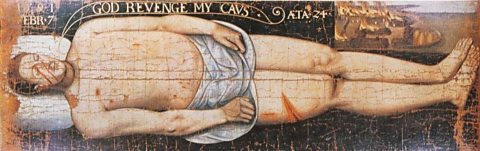
- Moray’s mother had a painting made of her son's dead body, showing his many wounds, with the comment: "God Revenge My Caus" written on it and campaigned to show this in public in Edinburgh to highlight the wrong that was done to her and her family, but the King did not give permission.
- Rather gruesomely, she instead displayed his dead body for a long time, until ordered to have it buried. Campbell blamed the King and considered him complicit in this horrible event.
Oral tradition and politics
There are many versions of this ballad, reflecting the oral tradition of the time, when people were largely illiterate and received their news from visiting singers who recounted tales of current events.
It is thought that this ballad was written as a result of the widespread outrage about the Earl's death, the lack of punishment and the suggestion of royal involvement in the crime.
It was popular and widespread, expressing a rage that may have influenced Scottish politics for some time after the events. It had a significant political impact, extending beyond simple storytelling.
Form and structure of The Bonnie Earl o' Moray
What is a ballad?
A ballad is a A narrative poem tells a story. Narrative poems do not have to follow rhythmic patterns.. It is more often used for emotional impact than for historical or factual accuracy and covers themes of love, tragedy, adventure and supernatural encounters. The stories told in ballads frequently begin When a narrative jumps right "into the middle of things". The story opens with events already in progress.. To create a sense of drama, to build anticipation and to immediately capture your listener, ballads often begin partway through the story, at the most dramatic point, rather than at the beginning.
Ballads have been recorded all over Scotland, from very ancient times right up to the modern day. They focused on real events and places, coving rural, coastal and urban settings and stories. Audiences were invited join in with the songs, which created a sense of community and shared identity. As literacy grew, ballads began to appear in print too.
As ballads were passed along orally, being sung to entertain and inform, the language was usually rhythmic and straightforward, using formulaic language to help people remember the songs and stories.
The balladeer, the singer of the song, usually adopts an impersonal narrative point of view, appearing to be detached from the events. Although these songs were often highly biased, the narrative voice seems to be retelling events without personal commentary. However, ballads often feature the use of direct speech, seeming to quote those involved in the events depicted. This adds realism and creates drama and tension for the audience.
Watch a video about the conventions of ballads, their purpose, rhyme schemes and some examples of ballads: What is a ballad?
Form
Most ballads are written in A stanza of a poem made up of four lines.. This ballad has two stanzas, containing 12 lines each.
- The first stanza focuses on the Earl of Moray, presenting him as a hero.
- The second stanza introduces the villain, Huntly, who has never been punished for his crime.
Each stanza is composed of three quatrains and uses the ABCB rhyme scheme. This form of verse is called a ballad stanza.
Rhyme
The A repeated pattern of rhymes, usually written with letters ABAB would mean lines 1 and 3 rhyme; and lines 2 and 4 rhyme also rhyme but differently. is used to create emotional impact or to add twists to the narrative. The shorter second and fourth lines are often where the key moments happen, reinforced by rhyme and rhythm.
Now wae be to ye, Huntly,
And wherefore did ye sae?
I bade ye bring him wi’ ye,
And forbade ye him to slay.
In this case, we have the King’s voice reported, chastising Huntly for killing Moray instead of bringing him to the King.
Rhythm
Each line of the poem has a regular rhythm. Each line contains three strongly stressed syllables, then a A pause that breaks up a line of verse by using punctuation, particularly a full stop. creates a pause at the end of each line. It also had a practical application: rhythm and patterns help people memorise songs – important in the oral tradition.
Repetition
Ballads regularly use repetition. These A short phrase or verse of a song or poem that is repeated at recurring intervals, especially at the end of each stanza. often highlight key moments or help emotional moments hit harder.
Both stanzas end with the same reference to the Earl’s widow, creating a sense of mournfulness:
O lang will his lady
Lok frae the Castle Doune
Ere she see the Earl o’ Moray
Come soundin’ through the toun.
The way this idea is repeated builds up a sense of sadness and inevitability. It is a A formal expression of sorrow or mourning, especially in verse or song. for a terrible crime.
Refrains can also be seen when lines are repeated, but with a slight difference. In each stanza of the poem, we have repeated lines that start with the same phrase but are paired with different endings:
| Repeated line | Stanza one | Stanza two |
|---|---|---|
| “He was a braw gallant” | “and he rade at the ring” | “and he played at the glove” |
| “And the bonny Earl o’Moray” | “He might hae been a king” | “He was the Queen’s true love” |
Almost like the chorus in a song, this repetition returns the focus of the listener to the many noble qualities of our hero, allowing us to regret his murder all the more.
Stanza one
The Bonnie Earl o' Moray starts off with a technique called A direct address to an inanimate object, abstract concept, a god, or a person who has died. It is similar to personification, as it involves treating an inanimate object or idea as if it was a human capable of understanding. (and not in the punctuation sense). In this context, apostrophe means ‘direct address’. The speaker is talking to the landscape (“Hielands” and “Lowlands”) as if it were a person:
Ye Hielands and ye Lowlands,
O, whaur hae ye been?
It seems like the speaker is crying loudly to the whole of Scotland to pay attention to the terrible deed that has been done.
The ballad also starts When a narrative jumps right "into the middle of things". The story opens with events already in progress. – finding out the Earl is dead before we know what has brought this about. It asks “whaur hae you been?” – if you haven’t heard about this, you must have been somewhere else, given how notorious this event has been.
They hae slain the Earl o’ Moray,
And laid him on the green.
The word choice of “slain” indicates the brutality of the crime.
The reference to “the green” could mean that he has been placed on grass or open land, often after death. This was most often used to refer to a death in battle, suggesting that this death perhaps should be honoured in the same way as someone who has died in noble combat. It may simply be another way to suggest burial, especially in a tragic ballad like this one or it could suggest that, after he was killed, the murderers just left his body out in the open.
This stanza establishes the Earl of Moray as the hero of the ballad. It is likely that this ballad was written, therefore by one of his own supporters. A “braw gallant” is someone who is handsome and noble – a romantic hero. These qualities are emphasised throughout whenever we hear the Earl discussed.
He was a braw gallant,
And he rade at the ring,
And the bonny Earl o’ Moray,
He might hae been a king.
“Riding at the ring” indicates his physical prowess. He is a strong horseman, an athletic figure who was able to take part in sports - in this case, one like jousting, but where the rider aims his lance is aimed at a ring instead of an opponent. This paints a picture of wasted youth and vigour; the wasted potential of a life which had much to give.
The statement that “He might hae been a king” is probably not to be taken literally. It is more likely the balladeer is using Over-the-top exaggeration for effect. to convey the Earl’s noble qualities; that he had the potential to make an excellent king. It is not likely that Moray would have had any chance of actually becoming the King. Although his father-in-law had been regent, the Earl of Moray had no real claim on the throne.
In the first of the two main A short phrase or verse of a song or poem that is repeated at recurring intervals, especially at the end of each stanza., we hear about the mourning widow who will have a long time to wait if she hopes to see her husband again:
O lang will his lady
Lok frae the Castle Doune
Ere she see the Earl o’ Moray
Come soundin’ through the toun
It could perhaps be When the reader knows more than the character about what is going on in the story. that those listening to the ballad already know that the Earl will never come home, but his wife perhaps does not. She will never again hear him “come soundin through the toun”, being heralded by a trumpet or by the welcome of the townspeople as he came home. She will never hear him again and she will never see him again and this creates sympathy in the listener: the image of a woman, waiting forever for her lost love is a poignant one. We are left to mourn with her.
Stanza two
The next speaker, presumably the King, condemns what Huntly has done (even though, in reality, he did nothing of the sort).
Now wae be to ye, Huntly,
And wherefore did ye sae?
I bade ye bring him wi’ ye,
And forbade ye him to slay.
The King’s “woe be to you” is an indication of his disapproval of Huntly’s rash actions. The King demands answers: “wherefore did ye sae?” meaning “why did you do so?” and he repeats what he had instructed Huntly to do: bring Moray with him and not to kill him.
The word choice of “forbade” indicates that the balladeer wishes the King to be absolved of blame – it wasn’t a good idea to criticise the King in those days. We see that Huntly has gone against what the King wanted. Kings were considered to be appointed by God, and if Moray were supposed to be such a good man, it would follow that it would go against God's will to kill him so brazenly. Therefore, by disobeying the King, Huntly disobeys God. This casts Huntly into the role of the villain.
The second quatrain of this stanza is a partial refrain of the second quatrain in stanza one. It features almost like a chorus, emphasising the many noble and courtly qualities of the slain Earl of Moray.
He was a braw gallant,
And he played at the glove;
And the bonny Earl o’ Moray,
He was the Queen’s true love.
While the first stanza referred to the Earl's horsemanship, here he takes part in the noble sport of falconry. The first stanza suggested the Earl had the qualities to be a king; here the reference to royalty is about the Queen's feelings for the Earl. This reference is interesting as it could imply that the Queen was in love with Moray. Given his good looks and sporty physique, it could be presumed that almost everyone drawn to him, and would possibly even fall in love with him.
The question is, was this an illicit love affair being hinted at? Could the King have been jealous of either an affair or his wife’s love for another man? Or was Moray such a good man that the Queen saw him as an equal to the King, and loved his noble qualities? Whatever the meaning here, it adds to the suggestion that the Earl of Moray was a romantic, dashing, heroic figure.
The final quatrain returns to the refrain at the end of stanza one.
O lang will his lady
Lok frae the Castle Doune
Ere she see the Earl o’ Moray
Come soundin’ through the toun.
We are reminded, once again, of the bitter sadness that his family will feel; the utter loneliness and emptiness that comes with the loss of so good a man. His wife, and all those who loved him, will mourn him forever. The audience is encouraged to feel this loss and to mourn too.
Video - What is word choice?
It is important to analyse the words a writer chooses, and what they are telling us. For example:
- the word choice of “slain” in stanza one tells the reader how brutal the crime was
- the use of “forbade” in stanza two suggests that the speaker doesn't want the King to be blamed for the crime
Brush up on your understanding of word choice with this short National 5 English revision video.
What is word choice? Why is it important?
Word choice can have a massive impact on your writing.
Words are like ingredients: even a small change in the recipe can affect the finished dish.
"They had a warm laugh"
But what if "they had a hearty laugh"?
Even though these sentences pretty much tell us the same thing, the words have different effects.
‘Warm’ suggests the laugh is friendly.
‘Hearty’ suggests it is wholesome, passionate and sincere.
When you choose a word you need to think about its denotation.
That's what it literally means.
But you should also think about its connotations - ideas or feelings that the word might suggest or hint at.
"Feeling dizzy, she slid her hand along her head"
This just tells us what happened. But what if:
"Feeling dizzy, she slid her hand along her skull”
The skull is the bone structure in your head. This is the denotation - what it definitely is.
But the connotations of skull are fear, mortality and even death.
These connotations suggest that the dizziness she is experiencing is serious.
In the poem 'The Circle’, Don Patterson watches his son painting the planets in the solar system.
“He draws around his upturned cup, his hand shakes, and he screws it up.”
Patterson could have easily written “he messes it up” but “screws it up” is a far more interesting choice.
These words are really informal compared to his word choice in the rest of the poem.
This helps him capture the reality and rawness of a young boy’s frustration.
At the same time, “screw” suggests a circular motion, another reference to circular shapes within the poem.
It also suggests scrunching up paper and throwing it away.
Word choice is a really important part of writing.
It’s an invaluable part of writing.
It’s crucial!
Themes and comparisons with other poems in the collection
Heroism and reputation
The Earl of Moray is described as “bonnie”, meaning he is not only physically attractive but also morally upright and cherished. The word is affectionately used in Scots to suggest goodness, charm, or spirit. In The Bonnie Earl o’ Moray, it elevates the man to a heroic and idealised status.
The word “bonnie” is linked to pride in Scottish identity. It evokes beauty, belonging, and emotional connection. Its use also indicates the man’s virtue; he is admired for his character. Because he was “bonnie”, his death becomes more poignant: he was loved, and his future held promise, cut short by a brutal crime. The contrast between “bonnie” and the brutality of his death heightens the sense of injustice.
The ballad portrays Moray as a “gallant” Earl, immortalising him as a hero to be mourned. The repeated description of Moray as a “braw gallant” (brave and fine gentleman) highlights how charismatic and strong he was. He was handsome and skilled at noble sports such as “the ring” (tilting) and “the glove” (falconry).
He was the Queen’s true love
This phrase adds more complexity - was he romantically loved by royalty, or A symbol is an object, person, image or event used to represent something bigger. For example, doves are often used as a symbol of peace. beloved because of his many qualities?
The themes of heroism and reputation are also shown in the other poems:
| Lochinvar | The title character is well known for his romantic qualities and his ability to fight. |
| The Twa Corbies | In this poem, heroism and reputation are irrelevant in the face of death. |
| A Red, Red Rose | The speaker is romantic and constant in his affections, like a knight was supposed to be. |
| Little Girls | Heroism is shown through survival against the harm society causes women and girls. |
| Auntie | The aunt is a hero to the speaker because of her quiet, yet impactful, presence in her life. There is no public celebration of the aunt, but she has left a legacy of affection and connection. |
Betrayal, injustice, and defying social rules
The Bonnie Earl o’ Moray focuses on Moray's unjust murder by Huntly, aiming to evoke justice from the King. Its composition served as campaigning, informing the public, stirring anger, and supporting his mother Margaret Campbell's pursuit of justice. It begins with:
Ye Highlands and ye Lowlands / Oh whaur hae ye been?
This signals loss and injustice.
The opening line reveals the injustice – a murder with political implications.
They hae slain the Earl o’ Moray
The death of James Stewart, Earl of Moray, killed when under order for arrest King James VI, reflects the unsettled nature of Scottish politics in the late 16th century. Loyalty was fragile, and ambition could be deadly.
In the second stanza, a speaker, likely the King, criticises Huntly, arguing the murder was unjust and should have been tried rather than executed. Moray's death challenges societal loyalty and royal protection, especially since Moray was a Queen's favourite, hinting at corruption and abuse of power. Killing Moray may have betrayed the King.
I bade ye bring him wi’ ye, / And forbade ye him to slay
This line shows Huntly defied the King’s order and risked implicating him in the crime.
He might have been a king
This hints that Moray was a potential rival for the King, and could be seen as raising questions about James VI's suitability for the role, as well as suggesting motive for his involvement in the killing, or his inaction after it.
The ballad states Moray was "the Queen's true love," giving motive for the King’s possible involvement: did the Queen betray him with Moray; was the King jealous that his wife admired another man more than him? It also shows Moray's qualities (popularity, skill, charm) that make his unjust downfall more poignant. The ballad emphasises how wrong it is to take someone so deserving in their prime.
The themes of betrayal, injustice and defying social rules are also shown in the other poems:
| Lochinvar | His murder is a betrayal; he does not get to face justice or get justice for the murder. His relationship with the queen potentially defies social rules. |
| The Twa Corbies | The knight is betrayed by those who should mourn him and is unjustly killed and left to rot. |
| Little Girls | Systemic misogyny, victim-blaming, and the silencing of girls and women is a key theme, but in the end, they scream in rebellion. |
Politics
The anonymous ballad does more than retell the specifics of the event. It reflects what people thought at the time, and also influences those opinions by emphasising specific themes.
Although it very much suggests that the King was angry that Huntly disobeyed him, the ballad would cast suspicion on the King's role in the murder. Despite that explicit command, Moray was killed. The public at the time would also know that there was virtually no punishment for murder or for disobeying the King. This would subtly and cleverly raise the public's suspicion of the King due to his inaction after the event.
The theme of politics is also shown in the other poems:
| Lochinvar | As a Scottish knight crosses the border to steal away the daughter of an English nobleman; part of the historic border conflicts. |
| The Twa Corbies | The breakdown of the feudal loyalty system is highlighted. |
| Little Girls | Systemic misogyny, victim-blaming, and the silencing of girls and women is a key theme. |
Loss and mourning
The poem is, in effect, a A speech or piece of writing delivered that pays tribute to and memorialises the life of a person who has died., mourning the death of a noble man, admired for his beauty, skill and many virtues.
The opening line calls on all of Scotland, uniting disparate regions in shared sorrow.
Ye Hielands and ye Lowlands
This clearly shows that the speaker believes this is a national tragedy. The ballad becomes a national lament, going beyond local areas, clans or classes.
The phrase “He was the Queen’s love” suggests both that the Queen had a personal affection and that Moray had political favour. He was worthy of admiration from the most noble lady in the land, deepening the sense of tragedy.
His own lady, of course, mourns him even more. Repetition of:
O lang will his lady / Lok frae the Castle Doune
This creates a lingering sense of grief and highlights the futility of her vigil and her suspended hope. This A short phrase or verse of a song or poem that is repeated at recurring intervals, especially at the end of each stanza. emphasises the hidden cost of political violence – her futile wait becomes a A symbol is an object, person, image or event used to represent something bigger. For example, doves are often used as a symbol of peace. of national mourning.
The themes of loss and mourning are also shown in the other poems:
| Lochinvar | Rather than mourning a lost love, Lochinvar takes control and takes her back. |
| The Twa Corbies | The lack of mourning the loss of the knight is striking about this poem. |
| A Red, Red Rose | The speaker sees loss of his love as a temporary thing that he will return to as soon as he can. |
| Little Girls | Mourns the lost voices of little girls and the loss of innocence they experience. |
| Auntie | Mourns the absence of her aunt who she fondly remembers. It is not clear whether the aunt is dead or the speaker is separated from the aunt who lives in her own country |
Revise The Bonnie Earl o' Moray by anonymous
Revise The Bonnie Earl o'Moray by Anonymous with this interactive quiz for National 5 English.
More on Scottish poetry collection
Find out more by working through a topic
- count3 of 8

- count4 of 8

- count5 of 8
- count6 of 8