Why did the Shang need a powerful army?
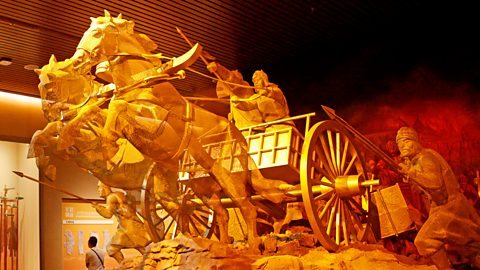
Life in Ancient China involved many battles between different groups.
The Shang Dynasty began by winning a battle and ended because they lost a battle.
They needed a powerful army because they had to protect their lands from people trying to conquer them, which means to take control of their land using force. At the same time, they also wanted to conquer new lands from other people.
Important words
Important words on how the Shang army won battles.
| Keyword | Definition |
|---|---|
| Conquer | To take control of someone or something by using force. |
| Garrison | A group of soldiers who are based in a town or city to defend it. |
| Nobility | Very powerful people who belong to the highest social class. |
| Nomadic | When a person or group of people move from place to place instead of living in a permanent home. |
| Prisoner | Someone who has been captured and is not allowed to leave. |
Watch: The Shang army
Watch the video to learn more about The Shang army.
Narrator: The Shang military was a powerful highly organised machine.
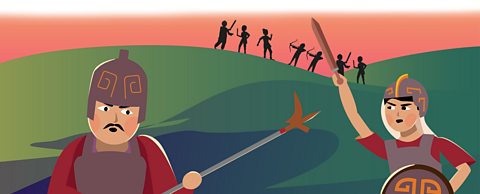
Most of the warriors were foot soldiers armed with bronze weapons such as daggers, spears and ji, a long stick with a bronze spear on the end.
Warrior: Charge!
Narrator: Next came the archers who could attack their enemies from a great distance.
Archer: Ready, aim, fire!
Narrator: They were an important part of any battle and would probably have stood behind the foot soldiers who would protect them.
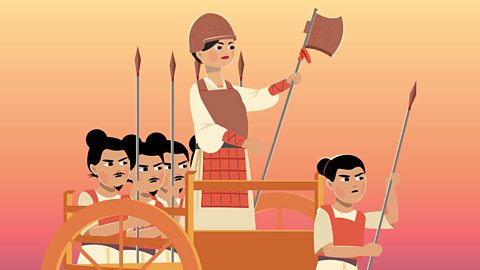
Most deadly of all were the war chariots.
Fast and powerful, these were the most advanced of all the Shang military equipment.
Warrior: Faster, faster!
Narrator: Pulled by horses, they would have a driver to steer, a soldier to attack at close range and an archer.
Battles would be terrifying. There were almost no rules and hardly any medical treatment available to the wounded.
King: We’ve won, take the survivors as prisoners.
Narrator: The Shang people fought others dynasties competing for territory, resources and glory.
What were important battles?
The Shang Dynasty came to power by victory in battle and were eventually defeated in battle.
Shang troops (soldiers) fought frequent wars with neighbouring settlements and with some nomadic herdsmen, who were people that moved from place to place and lived on the large grasslands to the north and west of China.
Battles decided the fate of some of the kings.
At the Battle of Mingtiao, the strong Shang Dynasty began under Cheng Tang, the first Shang king.
The last Shang king, Di Xin, was defeated at the Battle of Muye, by Wu of Zhou after a large part of his army turned against him and either joined the opposing side or refused to fight.
The following Zhou Dynasty lasted for the next 800 years.
Slideshow: What kinds of weapons did the Shang army make?
Click through the slideshow to learn more about what kinds of weapons the Shang Dynasty made.
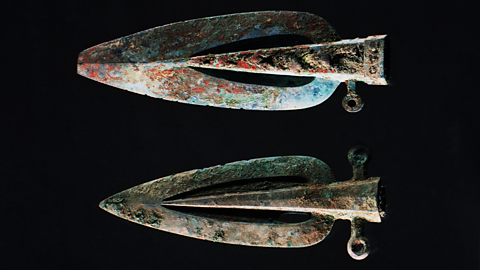
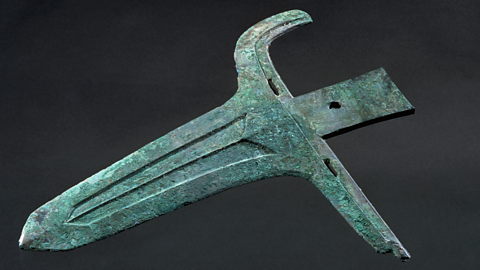
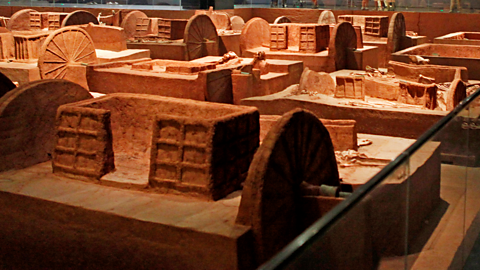
Image caption, These are spear heads from the Shang Dynasty. Shang soldiers were armed with stone and bronze weapons, these included: máo (spears).
1 of 3
Who fought in the Shang armies?
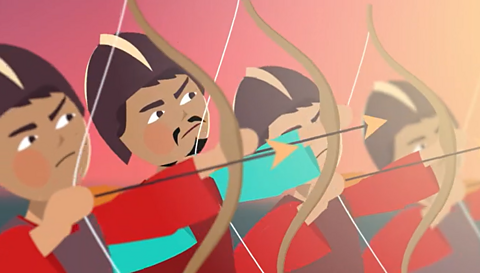
The Shang king kept a force of about a thousand troops at his capital and would personally lead them into battle.
Shang armies were made up of the nobility, as well as town-dwellers and countryside labourers.
The nobility and other state rulers had to provide their local garrisons (groups of soldiers that are based in a town or city to defend it) with all the equipment, armour, and weapons they needed.
Armies ranged in size from 3,000 soldiers to 13,000.
What happened at the Battle of Muye?
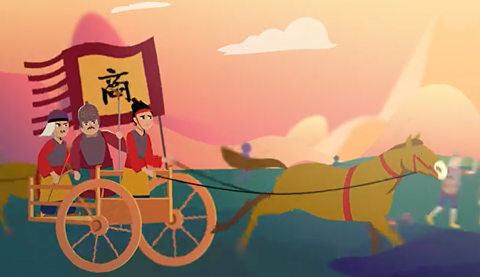
The last Shang king, Di Xin, was defeated at the Battle of Muye, by Wu of Zhou, after being betrayed by his army.
King Wu of Zhou led an army of around 50,000 but Di Xin had 170,000 soldiers in the capital city of Yin.
At the start of the battle, many of Di’s soldiers refused to fight for him, showing this by holding their spears upside down.
Some of them joined Wu but others chose to fight for Di Xin.
Wu’s soldiers were better armed and loyal, and broke the Shang soldiers in a chariot charge, forcing Di Xin to retreat to his palace.
He shortly died.
It was the end of the Shang Dynasty.
Think like a historian

Have a look at the thinking point below and think about your answer to each question. You could even write them down on a piece of paper or discuss them with somebody else if you want to.
- In a battle why would it be a good idea for an army to place its archers behind its foot soldiers?
- Did you think about how the different members of the army fought? Perhaps you knew that archers could fire their arrows over the heads of the foot soldiers and hit their enemies. Maybe you remembered that foot soldiers could also protect the archers from soldiers travelling in chariots, stopping them from reaching the archers.
Activities
Activity 1: Name the Shang warriors
Click through the interactive to sort the Shang soldiers.
Activity 2: Shang army quiz
Let's find out what you know about the Shang army.
Grown-ups corner
Are you a parent, carer or teacher?
Take a look at some of the links below on KS2 History which are packed full of knowledge, videos, quizzes and activities.
History KS2: The Story of China - The Rise and Fall of the Shang
BBC Bitesize for Teachers

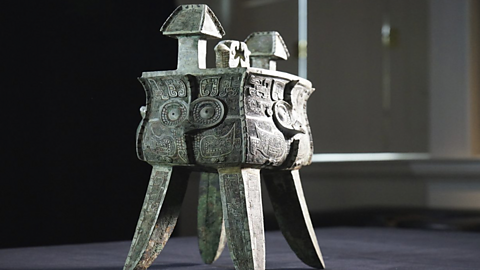
History KS2: The Story of China - How the Early Chinese Made Bronzes
BBC Bitesize for Teachers
History KS2: The Story of China - How King Yu Controlled the Flood
BBC Bitesize for Teachers
Horrible Histories: Raid and Trade game! game
Play Horrible Histories: Raid and Trade KS2 History
More on Shang Dynasty
Find out more by working through a topic
- count4 of 15

- count5 of 15
- count6 of 15
- count7 of 15