What are oceans?

Oceans are vast areas of salt water that cover around 70 per cent of the planet.
They are home to a wide variety of animals, such as whales, sharks and sea turtles - and other life such as coral, seagrasses and algae.
There are five oceans in the world.
All five oceans are connected to each other, and water flows between them.
Watch – Explore the oceans
Watch this video to learn more about why the oceans are so amazing!
Jump aboard and explore the oceans of the world with Patrick and Omi.
PATRICK: I never knew how amazing oceans were until I went to the seaside with my friend Omi. She really loves oceans.
OMI: You've got to see for yourself. Put these on.
The ocean’s packed with life. So it's really important that we look after it.
There are tonnes of different fish, plus mammals and other creatures like crabs and worms.
Some are so tiny, you can barely even see them. And there's the largest mammal alive, the blue whale.
In some places, oceans are so deep that there are parts that have never been explored, and creatures that have never been discovered.
PATRICK: Ahh! Can we go back up now?
Ah, this is much better.
OMI: People travel on seas and oceans every day.
Some people do it for sport. Some do it for work.
Some people even travel with their cars.
Look! You can park your car on a ferry and it will take you from one place to another.
PATRICK: They must be the biggest boats in the world.
OMI: Not nearly – look over there.
PATRICK: What's that?
OMI: A container ship. They take toys, cars, computers, all sorts of stuff from one country to another.
They’re so big that each one of the little boxes on its back is actually the size of a lorry.
PATRICK: But if one ship’s that big, how big are the oceans themselves?
OMI: So big and so powerful!
They cover more than two thirds of the whole world!
PATRICK: You're right Omi. Oceans are truly amazing.
OMI: Yes, and what's even better is that's where the narwhals live. I really, really love narwhals!
Geography

Although the oceans are all connected, they are very different from each other.
This is because ocean currents flow around the planet, moving warm and cold water with them, and changing the climate and weather as they go.
Take a look at the information, videos and activities below to learn about each of the five oceans.
The world's oceans
The five oceans of the world are:
the Pacific Ocean
the Atlantic Ocean
the Indian Ocean
the Southern Ocean
the Arctic Ocean
This slideshow shows the Earth from space. It has been changed so that we can see all of the Earth’s surface in one picture. Have a look to learn some interesting facts about each ocean.

Image caption, Pacific Ocean
The Pacific Ocean is the world’s largest ocean. It has the deepest place on Earth, called the Mariana Trench. The trench is almost 11,000 metres deep - that’s deeper than the word's tallest mountain, Mount Everest, is tall!


1 of 5
Oceans and the water cycle
Water never leaves the Earth and its atmosphere. It simply moves around in what is called the water cycle.
The ocean plays a vital role in this cycle.
The water cycle is the continuous journey of water from oceans and lakes, to clouds, to rain, to streams, to rivers and back into the ocean again.
Have a look at this slideshow to see how the water cycle works.

Image caption, Evaporation
When the Sun shines, it causes water to warm up, turning it into water vapour, which rises into the air. This process is called evaporation.


1 of 4
Activity - Race Across the Continents game
Fly across the continents and oceans in this fun Geography game.
Race Across The Continents. game
KS2 Geography game
Discover more on KS2 Geography
Have a look at these articles to learn more about the oceans and the water cycle.

Science

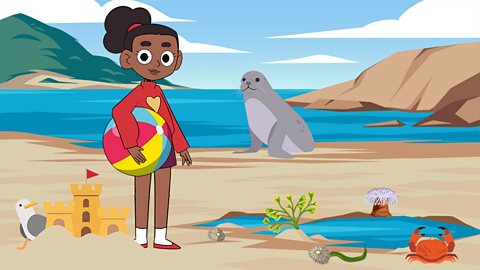
A day at the beach, paddling in the sea or exploring rock pools can be lots of fun.
But oceans play an even more important role - they keep us alive. They not only provide us with food, such as fish, they produce around half of the world's oxygen which is vital for us to breathe.
Have a look at the information, videos and activities below to learn more about why oceans are so important.
Why are our oceans important?
Whether you live on the coast, or live miles away from the beach, the ocean is always with you.
The water you drink and the air you breathe both come to you from the ocean.
Watch this video to learn more about what the oceans do to keep our planet healthy.
Narrator: The five oceans on Earth play a huge part in keeping our planet healthy.
They produce half of the world's oxygen and absorb half of all man-made carbon dioxide. The waters are constantly moving around in patterns called currents, which cycle water from one place to another, over and over again.
This is important in regulating the Earths climate and weather. But water doesn't move around just in the oceans. It also moves around through the air. The sun heats up the water in the oceans, rivers, lakes and seas, turning it into tiny droplets called water vapour.
These tiny water vapour droplets rise into the air and gather together to from clouds. The rain that falls on land, washes into the lakes and rivers. Which eventually makes its way back to the sea. This happens over and over which is why it's called the water cycle.
The oceans are home to millions of species, with more being discovered every day. But our actions are putting the health of our oceans at risk. Air pollution and poisonous waste from things like pesticides, sewage, plastics and metals, end up in the oceans and coastal waters.
With the oceans doing so much for our planet and billions of people rely on them for food and jobs, we need to return the favour and do some thing for our oceans.

Ocean habitats
Oceans provide the perfect habitat for thousands of different species of marine plants and animals.
They are home to plankton and seagrass which play an important role in the health of the oceans.
They help to keep carbon, oxygen and other gases in the air balanced. This important work creates an environment that humans, other animals and plants can survive in.
There are two types of plankton - phytoplankton and zooplankton.
You can learn more about these and seagrass in this slideshow.

Image caption, Phytoplankton
Phytoplankton are the smallest type of plankton. They are so tiny, you need a microscope to see them. Like plants on land, phytoplankton take in carbon dioxide and produce oxygen. This is very important for humans as we need oxygen to survive.


1 of 3
Watch - What is the most intelligent animal in our oceans?
During the summer months the seas off the coast of Wales are home to lots of groups of dolphins.
Many experts believe that these amazing creatures are amongst the cleverest animals on Earth. Watch this video to learn more.
NARRATOR:
Off the coast of west Wales, the warm sea brings in huge groups of small fish called shoals, which is dinner for one of the cleverest animals on Earth.
Dolphins.
They live in family groups called pods, which can sometimes include as many as 50 individuals.
Dolphins hunt fish, like this shoal of sardines, by working together as a team.
They swallow the fish whole, head-first, so that the spines don't get caught in their throats.
Dolphins are highly social creatures with their own individual personalities. They feel many different emotions, just like we do. And have very advanced ways of communicating with each other.
This pod of bottlenose dolphins in Cardigan Bay is made up of mothers and their young.
Dolphins are mammals like us, and usually give birth to a single baby. The youngsters called calves, will stay with their mothers for several years to learn how to catch fish.
The group are constantly chatting to one another by using very high pitch whistles, clicks and squeaks.
We started learning about the ways dolphins communicate with each other back in the 1960s. Scientists worked with dolphins in tanks on separate sides of a lab, and linked them up with microphones.
They would then listen to all the complex conversations the dolphins were having, through these different clicks and whistles.
But over 60 years on, we still haven't cracked the code of dolphin language.
So, for the most part, we know very little about what all these clicks and whistles actually mean.
One person trying to understand more about dolphin communication, is marine biologist, Dr Sarah Perry, from the Cardigan Bay Marine Wildlife Centre.
Sarah, along with many other scientists, has noticed that every dolphin has its own whistle, which they use as their names.
DR SARAH PERRY:
Bottlenose dolphins all have their own unique signature whistles. So it's essentially like them calling their own name, so that they can let those around them know who's here. So it would be like me shouting out my name, "Hi, Sarah. I'm Sarah. I'm Sarah. I'm here."
NARRATOR:
Incredibly, scientists like Sarah are learning that this pod of bottlenose dolphins in Cardigan Bay talk to each other at a higher pitch than any other group of dolphins anywhere in the world.
It's like they're speaking with their own Welsh accent.
So, even though they might look very different, dolphins are actually quite a lot like us. Which is why they love to interact with humans.
Sometimes they turn up when you're least expecting them. They're one of the few animals that play into adulthood.
So, next time you're by the sea, remember, beneath the surface, you can find extraordinary creatures, who, just like us, chat to one another, teach each other things, play and even dream when they fall asleep.
Discover more on KS2 Science
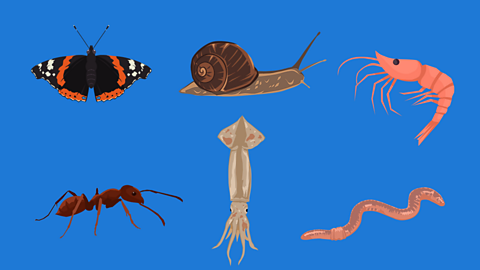
You can learn more about animals and different types of habitats with these articles.
Citizenship

With so much of the Earth covered in water, it is important to protect our ocean wildlife and keep the oceans clean.
There are lots of things we can all do to make less waste and help our oceans.
Learn more about the problem of ocean pollution and what we can do to help with the information and activities below.

Ocean pollution
Plastic waste can last for hundreds of years. When it gets into the sea, it can be a huge threat to marine life.
Sea creatures like green sea turtles can confuse colourful plastics with a tasty meal, or even get trapped in plastic waste.
Even though we can’t always see it, plastic is sadly polluting our oceans all over the world.

What can we do to help keep our oceans clean?
There are many ways we can help to reduce plastic waste and help to keep our oceans clean.
Lots of people volunteer to clean up beaches by organising litter picks. These events can help to get rid of some of the plastic waste that has washed up on the beach and can prevent it from going back into the sea.
If you don't live by the beach, you could go on an organised litter pick in your local area or park.
What else can we do to help?

One of the best ways to stop ocean pollution is to reduce the amount of single-use plastics we use.
There are lots of ways you can do this and make a big difference to the planet. Here are some of the ways:
- Recycle - lots of household waste and plastic can be recycled. This can help to prevent items ending up in the bin or landfill.
- Reuse - waste items can be reused instead of being thrown away. For example, metal cans and glass jars can be used as small plant pots.
- Rehome - old or unwanted clothes and toys can be donated to charity shops, so other people can enjoy them.
Activity - Helping our oceans colouring sheet
Oceans colouring activity sheet. activity
Topic packs

Discover more on KS2 Citizenship
Learn more about the world around us with these articles.
Helping others
KS2 Citizenship

Resources and sustainability
KS2 Citizenship

What is a citizen?
KS2 Citizenship

Oceans quiz
Test yourself to see how much you know about the world's oceans.
The Regenerators
Check out these articles from The Regenerators to learn more about our oceans and how you can help to protect them.
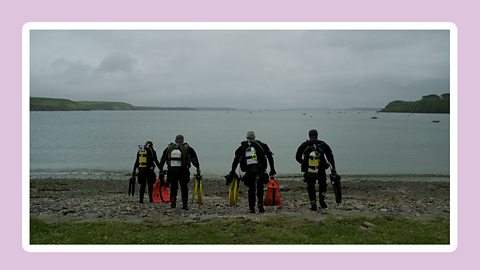
How can we clean up ocean plastics?
The Regenerators
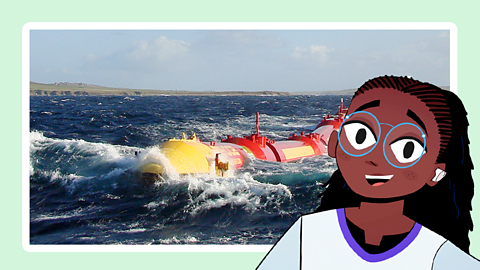
How can we generate electricity from the sea?
The Regenerators
What is the largest mammal that comes to our shores?
The Regenerators
More resources from Bitesize for Teachers
You can find many more amazing resources about oceans from Bitesize for teachers.
World Oceans Day assembly
Bitesize for Teachers
Blue Planet live lesson
Bitesize for Teachers

Planet Create classroom challenges
Bitesize for Teachers

Where next?
Play Bitesize Primary games. game
Fun and educational primary games in science, maths, English, history, geography, art and design, computing and modern languages.