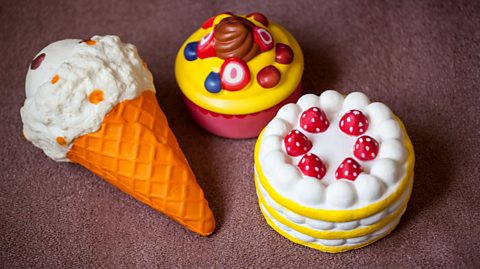
They squish them here. They squish them there. They’re squishing squishies everywhere.
Squishies, as they’re called, are the very squeezable rubber toys that can be squashed into different shapes in our hands, and eventually return to their original shape.
They’re what is called a ‘fidget toy’ - like fidget cubes and fidget spinners which are still popular. Spinners were originally created to help children with conditions such as autism, as explained in this Newsround report from 2017 as it can help them feel calm. Scientific research has also shown that squishies can help people relax and concentrate on the task they are doing as playing with them can activate a part of our brain that makes us focus on a job.
Why do we like playing with squishies?
They also fall into the category of things people find ‘oddly satisfying’, either by playing with the squishies or watching videos of them.
It’s linked to something called ASMR (or Auto-Sensory Meridian Response to give it its posh name) where videos of people squashing squishies, or even cleaning something can make us feel calm - especially if they want to relax before bed. That doesn’t mean everyone will react in the same way - research has shown that, in the case of squishies, not everyone enjoys the feel of them. One study found that, even from an early age, some people find more satisfaction from a crunchy texture than a soft one.
Why are squishies so popular?
Whatever the reason behind people buying them, squishies are certainly popular right now. There are more than 100k TikTok posts - and over half a million on Insta - tagged #squishies. The most popular official brand - NeeDoh - is the subject of more than 300k TikTok videos.
As well as the play element, when something becomes popular it also gains what psychologists call social proof - when we see somebody doing something that gives them enjoyment, we’re likely to want to copy them. If enough of us want to copy other people, it can help products like squishies go viral. When you see videos featuring popular products, always be sure to check if they’re labelled as an advert. If so, it can mean that someone has been paid to talk about it so they’re unlikely to say anything negative and you don't get a truly honest opinion.
Squishies have become such a must-have that it is becoming more and more difficult to buy the official versions in the UK and the USA. The company behind them said in one interview that in early 2025 they sold their entire year’s worth of stock in just nine weeks. Some toy shops in the USA have announced they won't sell them again until the trend is over, due to some customers being aggressive and jumping queues to buy a specific squishie. There have also been safety concerns raised following a craze on socials to squishies in the microwave to make them even stretchier - this is NOT a good idea as some people have been burnt by the liquid inside bursting through the rubber casing.
How can I tell if my squishie is a fake?
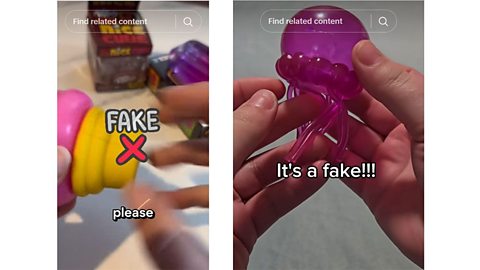
When products become popular or difficult to find, it’s not uncommon for poorer quality fake versions to go on sale - the same thing happened with Labubu dolls in 2025. These aren’t always a good alternative, especially with something like a squishie which is filled with a thick liquid to make it squash in your hands more easily.
People on TikTok have shared their examples of the fake squishies, showing how ones they have ordered online don’t look exactly like the advertised image - or how sections of them can be separated. These can be an example of scams and it's important to keep an eye out for them so you don't get caught out.
BBC Bitesize Other Side of the Story contacted the Chartered Trading Standards Institute, a government service which makes sure that, among other things, products on sale to the public are safe to use (or play with, in the case of squishies). They have teams across the UK, who have been sending out warnings, through local councils, about the hazards of fake - also known as counterfeit - squishies.
Some of their local teams have expressed concerns that fake squishies have not had the same safety tests that the official products have to complete before going on sale. This could mean that the materials inside the fake products are hazardous, with the risk of burning or choking people.
They offered this general advice to anyone who is unsure of whether the squishie they are buying is fake or genuine.
- Beware of prices that "seem too good to be true"
- Buy from reputable retailers, and avoid unfamiliar online sellers or third-party sellers on online marketplace listings
- Check for spelling mistakes or other red flags which means it’s not an official product
- The product's labelling should:
- Be written in English
- Have a product identifier (for example, a model number that can be used as a reference)
- Have a UK identifiable person and address listed
- Have a UKCA or CE mark - this means it has been safety-checked
- Contain appropriate safety warnings, such as whether it is a choking hazard or contains toxic ingredients
- If anyone is concerned or would like advice, contact the Citizens Advice Consumer Helpline on 0808 223 1133 (England and Wales). In Scotland, contact Advice Direct Scotland on 0808 164 6000, or for Northern Ireland call Consumerline on 0300 123 6262
This article was published in May 2026

Not sure if the news you’re seeing on social media is true or false? Can you always tell if the things you see online are real or fake? Learn how to get the other side of the story with our quizzes, videos and explainers.
Do we feel happier when the sun's out?
What is SAD and does daylight really affect our mood?