All about biscuits
You can nibble them, you can dunk them, you can even arrange them nicely on a plate for guests if you're feeling fancy.
We're talking about biscuits, of course. But when you're tucking in to one of your favourite buttery treats, have you ever thought about the history behind them?
BBC Bitesize sat down with food historian and author Lizzie Collingham to unwrap the stories behind some of our favourites.
1. What do custard creams have to do with ferns?
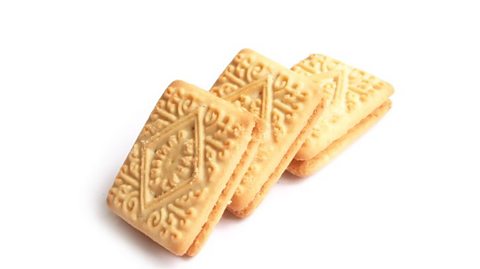
If you’re not too peckish, next time you have a custard cream, take a good look at it before taking your first bite. There’s a good chance you’ll spot an intricate design of straight lines and swirls.
It's very pretty, but it's not there by accident. Custard creams feature patterns in the shape of ferns, which are leafy green plants that don't grow flowers.
Lizzie said: “Ferns were very fashionable in Victorian England.
“People would have little glass cases and grow ferns in them, sometimes in the shape of churches - it was a terribly fashionable pastime for ladies.“
The design on top of the custard cream is perhaps a reflection of this trend, known as pteridomania. Ferns were a familiar motif by the early 20th century.
But Lizzie thinks it also represents a key moment in industrialisation, which had taken hold in Britain by this time. The humble custard cream reflected both the rise of mass factory production and chemically-engineered food, with the now-famous Bird's custard powder used for the filling - the height of manufacturing at the time.
Chemist Alfred Bird invented the powder because his wife was allergic to eggs.
Lizzie continued: “It was seen as a modern, exciting thing to make a food.
“Biscuits were the first industrial food, the first foodstuff to be produced by a machine - mixing, kneading, rolling out, cutting out, baking - it could all be done with minimal intervention from people.
“To put custard powder in a biscuit … it brought together two things which represented industrial progress.“
While the exact date for the invention of the custard cream is unclear - some sources say 1908, others 1913 - we know they appeared after the Victorian era ended in 1901.
Either way, the biscuit was popular, with an advertisement for manufacturer Peek Freans in 1920 stating they were ”far and away the most popular of all the cream sandwich biscuits.”
2. Garibaldi biscuits and the fight for Italian freedom

Sometimes called a ‘squashed fly’ biscuit, these dried fruit favourites date all the way back to 1861, the year that also saw the unification of Italy. Before this, the territory was made up of a series of independent states, kingdoms and duchies.
One of the heroes of this time in Italian history was Giuseppe Garibaldi, who - together with his army, known as the Red Shirts due to their distinctive clothes - conquered Sicily and Naples. This helped to achieve the unification of his homeland.
When Garibaldi came to Britain in 1864, he was treated as a hero. Lizzie said: “He was popular with the working classes as he believed everybody should have the vote.
“He was also popular with the middle and upper classes for standing up to the Bourbon and Habsburg households [two royal families based in mainland Europe].”
Garibaldi was so loved that, when Nottingham Forest football club formed in 1865, they played in the same shade of red worn by his men. It's less clear where the name of the biscuit comes from.
Theories suggest it was a tribute to the way the Red Shirts ate bread and berries when their supplies ran low, or that the biscuit's inventor gave his creation the name of a popular man in a clever marketing move.
3. Does a digestive a day keep the doctor away?

In her research, Lizzie discovered a cookery book containing a biscuit recipe from 1492. It was a translation from an Italian book that saw food as being close to medicine, with the body needing to balance out the four humours.
At the court of Naples, small biscuits that could be dipped into wine were served to aid digestion. The tradition moved over to the British royal court, where the caraway seed was a popular ingredient in biscuits as a remedy for 'windy cholic' - trapped gas or flatulence. They even get a mention in The Pickwick Papers by Charles Dickens in 1836.
In 1892, Alexander Grant developed a recipe for a digestive biscuit for the McVities company in Scotland. Although there had been other digestive biscuits before, this is the one that still sells in its millions today.
It contained a relatively new invention - bicarbonate of soda. It was advertised as being good for digestion and helpful to people who weren’t feeling so well.
Bicarbonate of soda is one of the elements of the digestive juice produced by the pancreas. It is an alkali, so it reduces the acidity of the stomach acid that has been mixing in with food.
Although the original biscuit was advertised as having health benefits - and the exact McVities recipe remains a secret to this day - by 1925, the digestive had also become something of a treat. That was the year a layer of chocolate appeared on the biscuit for the first time.
But is it on the top of the digestive, or the bottom? The debate continues…
This article was first published in May 2022 and updated in September 2026.
