How To Get Your TV Script Made - Part Four: Post Production and Broadcast
The final part of your script's journey to the TV screen.
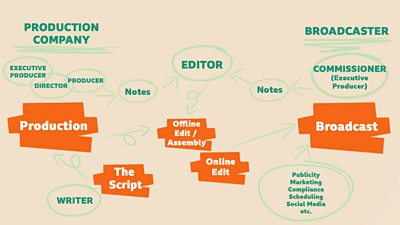

This is the final part in a series of four blog posts for screenwriters who are interested in understanding some of the practicalities of their script making it to the screen.
Previous posts have covered:
Part One: From Your Idea to Commissioner
Part Two: The TV Drama Commissioning Slate
Part Three: From Commissioning Greenlight through Production
This final post will be a whistle stop tour through the post-production, delivery and release of your TV drama, outlining the different stages and the writer’s potential involvement in each of them.
Congratulations! Your TV Drama has made it further than over 99% of others. The shooting script has been wrangled into shape by you as the writer, working with a script editor (and probably dealing with a plethora of notes from multiple interested parties). A director has come on board; locations have been found; a crew and cast have been assembled; and (in perhaps the biggest achievement of all), a budget has been raised to enable it to be filmed. This budget may have come from one broadcaster, but more likely considering the size of TV drama budgets it will be a co-production with several companies contributing funds and taking rights for broadcast in different territories and/or streaming platforms across the world.
The shoot itself may have taken several weeks or months and ranged across internal and external locations including studio space. The number of people involved could have reached the hundreds – with your script providing their vital reference document at the core of thousands of hours of work and millions of pounds of expenditure. (See Part Three: Greenlight through Production)
At the end of the shoot, potentially hundreds of hours of footage have been filmed, with the same sections of script recorded from multiple takes: from one character’s point of view or the return shot from another; as close-up or wide shots; and with variations in the actors’ delivery of lines or other subtle differences reflecting the director’s and actors’ interpretation of your script. These variations are known as ‘coverage’ (not to be confused with script coverage) and provide different options in the edit. Throughout, your script has remained a living document, evolving to fit changing circumstances.
As explained in the previous posts in this series, your involvement as a writer during the production will have varied widely depending on the type of drama and your experience. Your status in the production will have been stipulated by your contract that was drawn up by the Commissioning department, following a greenlight for the show. A more established writer (or more specifically their Agent) will often ask for an Executive Producer credit which includes them in some of the myriad decisions that go into creating a TV show - raising finance, casting actors, selecting a director, selecting heads of departments (DOP, Production Design, Costume, Hair and Make-up etc), reviewing daily rushes (footage that has just been shot) and trouble-shooting in all its forms. A less experienced writer is unlikely to be granted that level of input or control, or to be directly involved during the shoot (other than maybe a visit to the set) but can still be called on to resolve script issues during production.
With the footage ‘in the can’, now the show enters Post-Production (although as Owen O’Sullivan explains below, the Editor’s work begins earlier in the process).
An often-repeated mantra (attributed to Robert Bresson) is that “a film is written three times”, meaning in the Writing, the Shooting and finally the Editing – and this phase carries equal weight in how your story will ultimately be delivered to its audience.
We spoke to Editor Owen O’Sullivan about his career, how he works with scripts, and his work on the recently released BBC drama Mint, written and directed by Charlotte Regan.
Owen O’Sullivan (Editor)
How did you become an editor for TV Drama?
I’ve worked in short form and commercials for over 15 years. Starting, as many do, as a runner and then working my way up through the ranks to Editor. The brilliant thing about short form projects is getting to connect and work with lot of amazing creatives, and one of those people for me was Charlotte Regan (Director/ Writer of Mint). Our first job together was a music video for Manic Street Preachers and since then we’ve cut a variety of commercials and short films together. In the last few years, I’ve been able to jump across into more long form projects, Mint being the latest one.
At what point do you first become involved with a production?
Generally, it’s a few months before they start shooting. I’ll get sent the script for my episodes and will chat to the Director and Producer about the process and I’ll offer my thoughts on how to approach the edit. Then when the production starts shooting, if I’m assembling the episode I’ll start working on a day-to-day basis, putting together scenes as they come in.
What are the stages that you go through when editing a TV drama?
I’ll assume you don’t mean emotional stages, I’d need more than a couple of paragraphs to explain all of that…
As I mentioned above, if I’m involved in the assembly editing, the job starts when production starts filming. This is supposed to be a rough(ish) edit, in line with the script to make sure the scene is working properly. I will flag if I think there is something else that might need shooting, so production can try to pick it up before leaving or striking a set/location.
Once the shoot is wrapped and I have all the footage, I’ll move on to the rough cut, which is usually an over-length but more refined version of your assembly edit. Then I’ll most likely work through edits with the Director of the episode or Producer/ Showrunner. As was the case with Mint, many of these roles were wrapped into one person - Charlotte Regan - but it’s often a fluid and collaborative process with Producers/Directors chiming in at different times throughout.
Once the Director(s), Producers and show runners are happy, a cut is sent to the broadcaster (hello BBC) to feedback on. I might do a few rounds of notes with the broadcaster, again collaborating with the Director and Producers each time, building my way through the fine cut to eventually end up at picture lock.
This is, of course, only in theory. Locked episodes or scenes are often unlocked or in some cases locked early, so that, for example, the VFX team can get started on a tricky sequence.
Do you read the script beforehand? How do you work with the script during the editing process? How would you define the relationship between the writer/script and the editor?
Yeah, I absolutely read the scripts before - I make sure I know them inside and out, right from the get-go. Not just my episode, but the whole series. Until I have a rough cut, the script is my bible.
Moving through the process the initial script becomes obviously less relevant. Scenes and episodes evolve into their own entities as storylines and performances emerge. New lines (added in ADR) and whole new scenes may need to be added to an episode. This happens in collaboration with the Writer, Director and Editor. It’s so useful to be able to ask the Writer for help with an ADR line. Often, I’ll attempt to write out a line of ADR, thinking I’ve nailed it, only for a writer to come in and dramatically improve the line.
Who works with you during the edit?
On Mint we had two fantastic Assistant Editors, Tine and Qianlin. They help enormously, from breaking down rushes to finding sound effects and everything in between. Then there are the Post Producers, who keep us to schedule and co-ordinate between all the postproduction departments. Depending on the job and the post facilities there might be some runners around too, but unfortunately that isn’t always the case.
What are some of the common issues that you come across and how do you resolve them? What are some of the common elements that end up on the cutting room floor? (Eg Superfluous scenes? Unnecessary dialogue?)
It’s often the case that something that might work in the script, doesn’t work in the edit. It’s the same on set too, something might read well on paper, but when it comes to performing the lines, something feels off or it just won’t work. The story evolves at every stage of the process, and it’s my job as an Editor to figure out when it’s something that can be solved or cleverly hidden.
It’s often the inverse situation too. Lots of times I’ve looked at a cutaway or insert shot for the first time and thought “well, I’m never going to use that”, only for it to become absolutely crucial to the scene or another scene even, later on in the process.
From your experience in editing what advice would you offer to someone who is interested in writing TV Drama? Are there things writers consistently overlook that affect how well a scene cuts together?
There are lots of parallels between the writing and editing process - shaping emotion, pace and rhythm. I’m not sure there’s a single thing that writers consistently overlook but having an understanding of how far your script might change, before it reaches the screen, is a smart way to save yourself some pain during the filmmaking process.
What’s the editorial equivalent of ‘good writing’ - ie when you’re watching something what makes you think “that was well edited”?
For me this falls into two categories:
The first being that an edit is good, because I didn’t even think about the edit. The film was constructed so seamlessly that I forgot about the actual cuts and allowed myself to be drawn by the story and performances. You probably wouldn’t say that the film was well edited, just that you enjoyed the film.
The second is that an edit is strong because the pace and rhythm of the cuts and the visual proficiency required to put together the images, made you sit up and really experience the edit. I’m reminded of montages in Trainspotting or Requiem for a Dream, where you ‘feel’ the cuts, but still allow yourself to be immersed by the film.
In practical terms there are several phases to the Edit and as the writer there are some jargon terms that you may hear bandied about.
Offline Edit (Assembly)
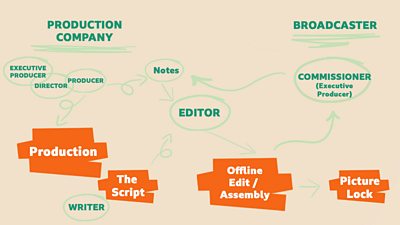
Because of the massive file size associated with full resolution video – especially at 4k resolution – the initial phase of the edit (known as the Assembly Phase) is carried out by the editor with lower-resolution copies of the footage. The original footage is left unchanged by the edit in what is known as ‘non-destructive’ editing. This is done to enable speedy working by minimising delays caused by computer processing. During this phase all useable footage will be arranged according to the script into a first assembly. It may include multiple versions of the same scenes and can run as much as double the length of the final edit. It’s at this point that the vital work is done on ensuring that the story is working. Offline editors often move on to become directors themselves and if, as a writer, you ever get the chance to shadow an offline edit then you should jump at it, as it is an invaluable opportunity to find out how stories are put together for the screen.
The emphasis at this point is on the coherence of the story, without concern for tidy transitions, music, special effects or mis-matched colouring from footage shot on different cameras.
Once the offline editor has created this first assembly, the director (and producer as guardian of the story/script) will work with them to pull together a first rough cut by re-ordering footage and selecting preferred takes. Depending on your status as writer and the type of drama being created (and whether you have an Executive Producer involvement) you may also be consulted, but this is far from guaranteed. In the Continuing Drama (Soap) world for example, you won’t be involved at all at this time. As a newer television writer this can feel disempowering and is the stage where you may feel the most alienated from the story that you have created, but it’s important to remember that everyone is working to ensure that the edit remains the best representation of your script while balancing the audience’s need for a coherent, engaging and entertaining story that will keep them hooked. The producer in particular works as your advocate during the edit and should keep you updated as it proceeds or notify you of any substantial deviations from the script.
Although multiple ever-evolving cuts will be put together in the editing suite, in general only two or three cuts of each episode will be sent by the producer to the broadcaster’s Commissioner/Executive Producer for notes.
The notes that come back will be very similar to those that you will be familiar with from the script development stage. Does the story work? The pacing? Can shots be changed? (ie coverage requests – usually the answer is No!) Is the tone consistent? Do the characters behave in the way they were created? Who am I with as a viewer? Whose story is this? Can we ramp up the emotion?
There will also be notes related to compliance – for example around the use of language or violence or imitative behaviour.
These notes will be reflected in further edits before a final version of the picture edit is created which all parties agree is the best visual representation of the story and to which no further changes are required. This is known as the ‘Picture Lock’ and is an important milestone in the completion of your show.
The initial offline edit may have also identified problems with the audio recording quality of the actors’ dialogue. Lines may have become obscured by other external sounds or have been accidentally mumbled or otherwise missed, rendering them inaudible. These lines are re-recorded as audio only by the actors as Additional Dialogue Recording (ADR). If the actor is going to be in vision when the lines are spoken then the audio must synchronise exactly with the visuals, however if the actor is out of vision, then this offers a final chance to tweak the dialogue – to clarify any story points which may have been missed.
Online Edit
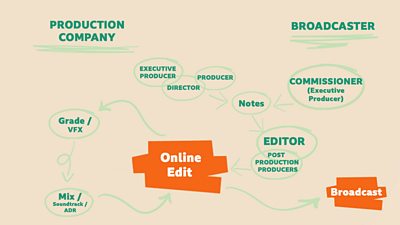
The edit then moves to an Online Edit as the edit decisions are applied to the full resolution copy of the footage.
There are normally two rounds of Grade where the balancing and colour across the footage filmed by different cameras under different lighting conditions is given consistency and any visual styling that is specific to the drama is applied. Any VFX (visual effects) will also be added including Computer Generated Imagery (CGI), elements like smoke, rain, fire or explosions or text overlays like text messages that the audience see on screen.
The edit also goes into approximately two rounds of Sound Mix – where the audio is finalised by balancing dialogue, sound effects and adding music (‘laying track’ is a term you may hear used). The incidental music score is often fundamental to conveying the mood of the drama as a whole or specific moments within it. It can be specially composed; ‘library’ music (generic mood-based music which already exists and is bought from an online library); or existing commercial tracks. It’s worth bearing in mind when writing your script that you may be thinking of a specific track to accompany a scene or for the characters to be hearing within the story world (‘diagetic’ music) but these tracks have to be cleared (the rights have to be paid for) which can be prohibitively expensive for very well-known music. In other words, you may not be able to include your favourite Beatles/Beyonce/Benson Boone track, even if it was the one that was playing in your head when you were writing your script or that you think would be the one that your character would be listening to.
The Commissioning team will also review the show during the Grade and Mix process and feedback with further notes to be addressed.
And then finally your TV Drama is finished!
Once the final edit is ready the programme must go through various compliance processes ahead of broadcast. These include Editorial Compliance where issues like use of strong, offensive or sexual language or content, violence, adult themes, imitative behaviour, drug use etc must be documented as these require continuity announcements, playback warnings and a parental guidance lock on streaming services.
Other compliance checks include for sound quality/audibility of dialogue and for flashing or strobing images.
Subtitles and Audio Description are also applied for accessibility.
So, your drama is finished – it could have cost several million pounds to make, and it’s now important to tell people about it!
When your drama was greenlit the publicity team will have kicked into action – and likely included an announcement in a press release, possibly alongside other new productions that were also commissioned around the same time.
Following that initial announcement there have probably been further press releases with casting announcements (around the time that filming began) and with ‘First Look’ images from the production – all to build anticipation for its release.
The picture publicity team will have been brought in to manage the collection of publicity images during the shoot. They may also create a bespoke visual identity (or ‘Key Art’) for the show which can be rolled out across publicity and marketing. The still imagery including a main ‘brand image’ is extremely important for attracting viewers to your show – as a huge amount of the audience will come from streaming via BBC iPlayer (or other streaming services who have invested in its production). At this point your Logline also really comes into its own too – as these one or two sentences summarising your show will be used as a description on streaming services and in publicity and listings and may be the deciding factor in whether people choose to watch it.
The Marketing team will work on promotion of your show through in-home (eg a trailer which is played between other programmes and released on YouTube etc.) If budgets and resources are available there may also be out-of-home promotion (eg posters, billboards, digital advertising space) although this is only for the most high-profile shows.
Writer and Director Charlotte Regan's first original TV drama Mint was recently released on BBC iPlayer. Hear from her below.
What surprised me the most about the release of Mint was probably how quickly it happens. I guess with film you spend a year trying to get into festivals and then months getting distribution and there’s such a big lead up to the release whereas with TV it all happens insanely quickly. For the good and the bad! For sure it helped me to feel less anxious, but it also feels in a weird way like less conclusive somehow.
I don’t really know what I wish I’d known. Probably wish I’d not redownloaded Instagram for the release because you get pretty obsessive reading the comments and people's thoughts. But at the same time you want to give the show the best chance possible and it’s wicked engaging with people who have watched this thing that you and your collaborators have made.
People taking ownership of something that you’ve sat with for years is strange but incredible. Reading comments and finding out what people think the show is. That’s all the same as a film release and me and the team felt excited about that.
Other than that it was a great time.
The release date of your show will be determined by the broadcaster’s scheduling team and will also involve agreement from any other broadcasters or streamers who have invested in the production from other territories outside the UK. As the release approaches then publicity and marketing will ramp up and as the writer you may be asked to contribute to this with an interview for a media pack and possibly other press and media with newspapers, magazines, websites, blogs, reviews shows etc. Your show may also have a screening (‘red carpet’) event with a press ‘junket’ and/or live Q&A event.
And finally, and increasingly vitally the social media presence of the show can be a key factor in its success with clips, behind the scenes footage and interviews with the stars, reviews from influencers and other content playing a huge part in building anticipation. These also extend the life of the show beyond its initial broadcast/launch on streaming services so that hopefully it will become a ‘word of mouth’ hit with viewing increasing over time and culminating in being nominated and winning awards!
Related Links
- How to Get Your TV Script MadePart One: From Your Idea to Commissioner
- How to Get Your TV Script MadePart Two: The TV Drama Commissioning Slate
- How to Get Your TV Script MadePart Three: From Commissioning Greenlight through Production
- Explore more Resources to support your writingIncluding our Scriptwriting Glossary, Be Inspired interviews and Script Essentials videos.
- Script LibraryOver 1000 scripts from BBC TV Drama, Comedy, Film, Radio and Childrens productions
- Watch Mint On BBC iPlayer
Latest blog posts
More blog postsSearch by Tag:
- Tagged with BlogBlog
- Tagged with 20262026
- Tagged with Script to BroadcastScript to Broadcast
- Tagged with Script to ScreenScript to Screen
