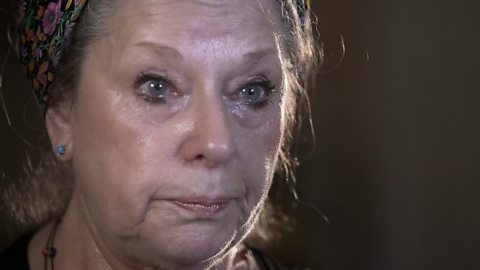
Ruth Rogoff:
The liberation of Belsen had been put on general release in every cinema and people were asked to go and see that.VO: There was no question of me being too young to see that sort of thing. And I was totally and absolutely horrified as everyone was watching it.
And I just felt terribly emotionally disturbed and the feeling was overwhelming. I just couldn’t believe that these sort of things had happened and that my family had disappeared in that terrible way.
I have never got over what I have learned about the Holocaust, and what I’ve read. I mean, if you look around this house, you’ll see I’ve got a huge section in the next room of Holocaust Literature (people who have written about the Holocaust) and everything I do, I believe has an element that relates to it.
Not voluntarily, it’s something I can’t help myself. For example, if I’m peeling potatoes as I throw the potato peel away, I think about the girls in Auschwitz who looked for a bit of potato peel because they were starving.
Another thing that’s been left with me and my children and grandchildren always laugh about it. I’m terrified of being without food. In my car I always have something to eat. Now I don’t eat a great deal myself, but I always have water and I always have something to eat. And that is definitely a throwback to the fear of hunger.
However much you can learn about history, and of course it is important to learn and to think you’re not going to make the same mistakes again, the fact is we do, as human beings, as parents we make mistakes that we promise ourselves we will never do. I think human beings can’t help it, the frailty of the human being is such that we do repeat mistakes.
But I think, whatever people say about young people today, I think they are more tolerant. So maybe there is hope. I think humanity is getting better. Hopefully I’m right.
Video summary
Ruth discusses her memories of the Holocaust and details the horrors of watching footage from concentration camp Bergen-Belsen at her local cinema.
She talks about how the footage made her feel and how it made her reflect upon the tragedy of how her own family ‘disappeared’.
Ruth also reflects on how the Holocaust has affected everything she does each day.
This short film contain scenes which viewers may find upsetting – teacher review is recommended prior to watching with your pupils.
Teacher Notes
Your pupils could discuss what they think life within a concentration camp might have been like for people and how people were later liberated.
Pupils could research the social, legal and emotional status of the survivors and find out about organisations helped them during the time.
This topic appears in history at KS3 and KS4 / GCSE in AQA, OCR A, OCR B, EDEXCEL, EDUQAS and WJEC GCSE in England and Wales, and CCEA GCSE in Northern Ireland.
It is also on the curriculum for 2nd, 3rd and 4th Level, National 4 and 5, and Higher in Scotland. It also appears in PSHE and PDE at KS3 and KS4.
Ruth's Story - Escaping the Nazis as war began. video
Jewish girl Ruth Rogoff escaped from Germany and arrived in Britain on 3 September 1939. She relates her childhood experiences and talks of her mother’s remarkable courage.
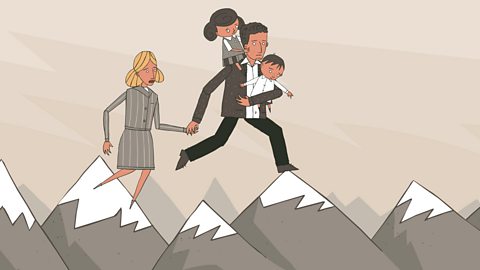
Arek’s Story - Survival in Auschwitz-Birkena. video
Arek Hersh recounts his experience as a prisoner, at the age of only 14, in the notorious death camp at Auschwitz-Birkenau.
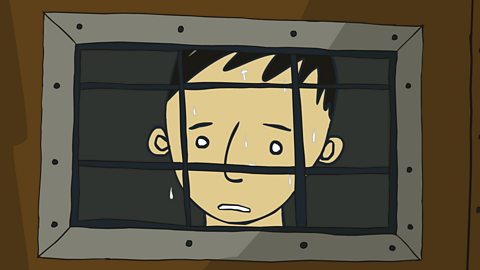
Interview with Holocaust survivor Arek Hersh. video
Arek Hersh, an 85-year-old concentration camp survivor expresses his anger for what the Nazis did to him. He talks about why it’s important for him to tell his story to others.
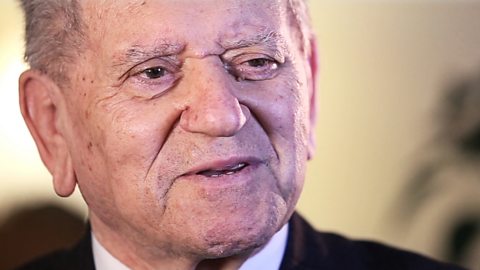
Heinz’s Story - Kristallnacht and escape to Britain. video
Holocaust survivor Heinz Skyte on life in Nazi Germany and his escape to Leeds in the UK.
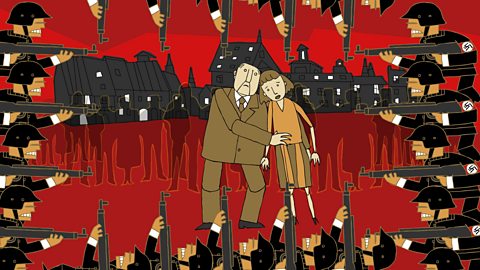
Interview with Holocaust survivor Heinz Skyte. video
Heinz, a Holocaust survivor, reflects on his childhood experiences in Nazi Germany.
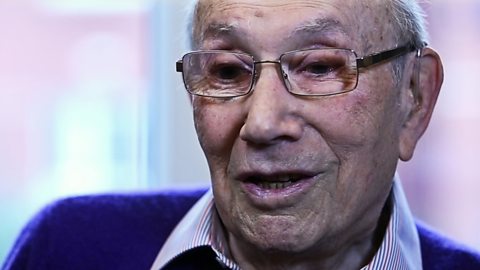
Martin's Story - Interrupted childhood experiences of a young Holocaust survivor. video
Martin Kapel, a survivor of the Nazi Polenaktion ("Poland Action") in October 1938, relates his childhood that included expulsion, escape and bombing.
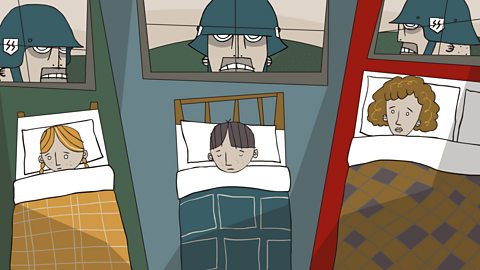
Interview with Holocaust survivor Martin Kapel. video
Martin Kapel came to the UK via the Kindertransport, following the Nazi Poland Action in October 1938. He reflects on the importance of studying history in order to learn from the past.
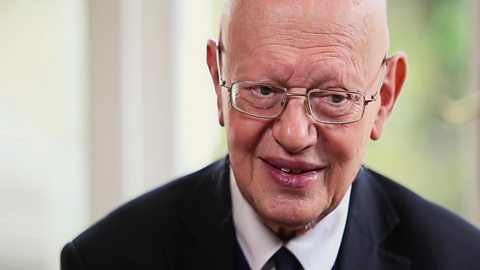
Trude’s Story - Escaping from Nazi occupied Czechoslovakia. video
In this animation, Trude Silman describes her experience as a young Jewish girl living in Nazi occupied Czechoslovakia, and escaping to Britain in 1939.

Interview with Holocaust survivor Trude Silman. video
Trude Silman, a Holocaust survivor who escaped to the UK, reflects on the impact of her experiences and how it has shaped her subsequent beliefs.
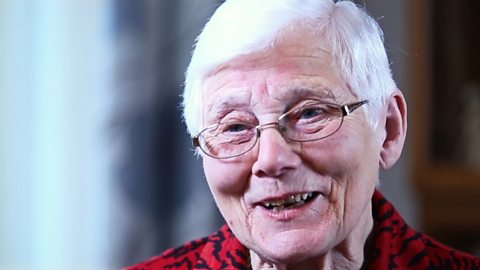
Suzanne’s Story - Hiding from the Nazis in occupied France. video
Suzanne Ripton’s story of living in hiding, as a Jewish child in Nazi-occupied France.
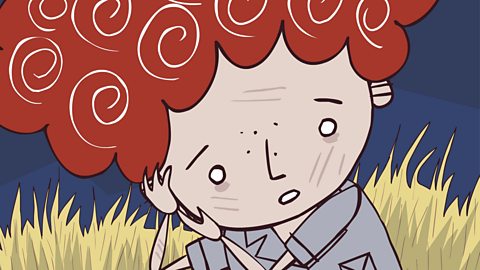
Interview with Holocaust survivor Suzanne Ripton. video
Suzanne Ripton, a Holocaust survivor who now lives in the UK, discusses the traumatic after effects of her experiences, her hatred of the Nazis and why we should remember the Holocaust.