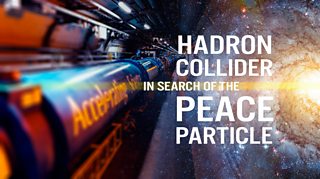
Curiosity, Collaboration and the Peace Particle
Theoretical physicist John Ellis has spent decades at the heart of CERN, helping to shape our understanding of the universe and championing global collaboration in particle physics.
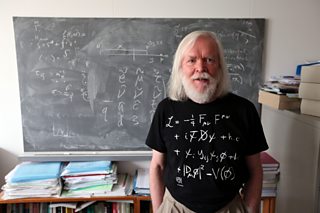
In The Hadron Collider: In Search of the Peace Particle, available to watch on iPlayer now, he appears as one of the voices bringing the human side of CERN to life.
Here, Ellis reflects on the awe of discovery, the importance of international cooperation, and the questions that continue to drive his curiosity.
The film shows CERN as a place full of personality as well as physics. What do you wish people understood about the human side of the scientists who work there?
Indeed, as the home from home of many thousands of people of all ages from over a hundred countries, there are plenty of personalities, giving CERN a unique character.
The members of the CERN community are united by a desire to understand better the way the universe works, but they approach this aim from many different directions and are diverse in almost all other aspects of their personalities.
Is there a moment (scientific or personal) that still gives you a sense of awe around what you and your colleagues at CERN are trying to uncover?
Whenever some new discovery is announced or some new measurement improves on the past by a significant margin.
CERN has always been a place built on collaboration across borders. What does this kind of collaboration make possible that might not happen otherwise?
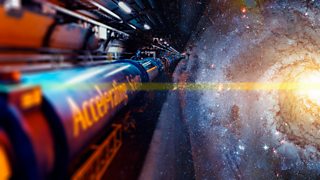
The work at CERN requires inspirations and skills that cannot be found in a single country or region, as well as the diversity of approaches that international collaboration provides. Not to mention the requisite financial resources.
After decades in the field, what’s the big questions or mystery that still drives your curiosity? Or a question you’d like to see answered in your lifetime?
What is the nature of dark matter?
What is the quantum theory of gravity?
What is the origin of the vast range of mass and energy scales we encounter in fundamental physics?
What would you most like viewers to take away with them after watching Hadron Collider: In Search of the Peace Particle?
Despite what sometimes divides us, we are all human and ask the same fundamental questions about the universe and our place within it, and we can work together to seek the answers.
6. CERN was founded on the idea that science should help build peace after a period of global conflict. When you look at CERN today, how do you see that mission playing out in real terms, and why does it still matter?
We have had Indians working with Pakistanis, Americans working with Iranians, Israelis working with Palestinians, Russians working with Ukrainians, even British working with French.
Some of these collaborations currently experience difficulties, but I hope they will be overcome.
In the meantime, I hope that everybody can be inspired by humanity's achievements when its differences are set aside.