Summary

  • Andy Burnham is due to be named leader of the Labour Party, before he becomes prime minister on Monday - key timings to know

  • The Makerfield MP will be confirmed as Keir Starmer's successor at a special party conference in central London

  • In a speech, Burnham's expected to say his government will be "focused on driving growth in every postcode and returning power to communities"

  • His argument today will be one he's been rehearsing for months, writes the BBC's Chris Mason

  • Burnham, who returned to Parliament in June after nine years, has already announced plans to have a new Downing Street team based in Manchester - calling it "No 10 North"

  • Meanwhile, speculation is rife about who will be appointed to the new cabinet - our political correspondent says there are "live discussions" about Home Secretary Shabana Mahmood becoming chancellor

  1. What's on the agenda at special Labour conference?published at 10:09 BST
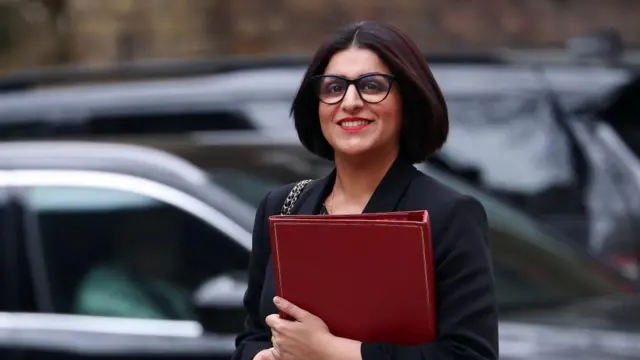
    Shabana Mahmood walking with her red binder in hand and smilingImage source, EPA/ Shutterstock

    Andy Burnham will officially be coronated as Labour's leader at a party conference at about midday. We've gotten a peek at what's on the agenda.

    These timings, as ever, are subject to change - but here's what we're expecting to see.

    At 12:00 BST, we'll hear from Labour's deputy leader, Lucy Powell.

    At about 12:04, Hollie Ridley, the party's general secretary, will make remarks.

    Ridley will be followed a few minutes later by Shabana Mahmood - chair of the National Executive Committee - at 12:06. Speculation is swirling that Mahmood is in line for No 11 - we have more on that in this post.

    Then we'll hear from the man of the hour - PM-in-waiting Andy Burnham - at about 12:08. His speech is expected to set out his vision for the country, arguing for an approach to governing that "unashamedly Labour" - our political correspondent has more about what we might hear.

    We'll carry the key moments in this page, and you'll able to watch live above from about midday.

  2. BBC Verify

    Burnham likely to face pressure to find £9bn a year for defencepublished at 09:59 BST

    By Ben Chu, policy and analysis correspondent

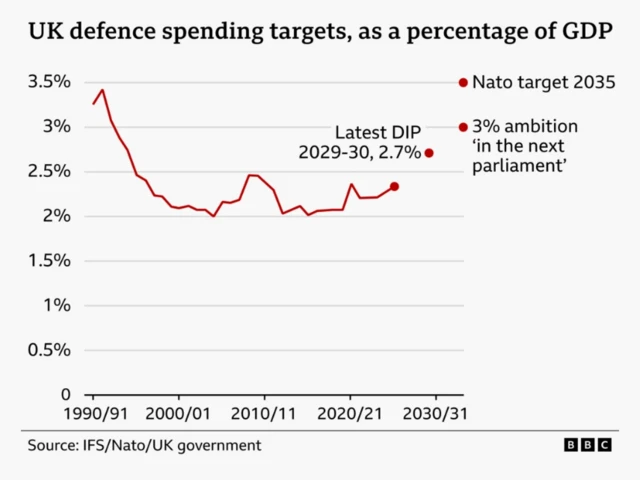
    The government’s much-delayed Defence Investment Plan in June led to an outcry in some quarters because it only took military spending to 2.7% of GDP by 2030.

    And it was not fully funded, requiring savings from other government departments.

    Andy Burnham will likely face similar pressure to Keir Starmer to lift defence spending to 3% of GDP by 2030, but this would cost an additional £9bn a year.

    Another challenge is the new Nato target of raising defence spending to 3.5% by 2035, which would cost an extra £24bn annually compared with the current plan.

    Line chart titled “UK defence spending targets, as a percentage of GDP”. Defence spending falls from about 3.4% of GDP in 1991 to around 2.1% by the early 2000s, then fluctuates mostly between 2.0% and 2.5% through the 2000s and 2010s. Spending rises slightly after 2020 and reaches about 2.3% in the mid-2020s. A labelled projection in the latest Defence Investment Plan shows spending at 2.7% in 2029/30. Two additional target markers appear at 3.0% ("ambition in the next parliament") and 3.5% (Nato target for 2035). Source: IFS, Nato and UK government.

    Some have suggested this could be paid for by the Treasury issuing special “war bonds” to avoid tax rises or spending cuts, but Starmer recently said this would simply be more borrowing at a time of painfully high interest costs for the government.

    Another challenge for Burnham if he does spend more on defence is reforming how military equipment is bought and developed, which has historically been wasteful.

    In 2025, only three out of 47 major defence projects were classed as “green” - meaning likely to be successfully delivered on time and at the right quality - by a government infrastructure watchdog.

  3. What we know about the incoming PM's policiespublished at 09:40 BST

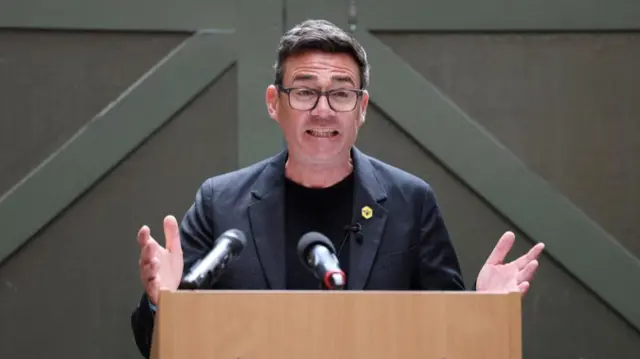
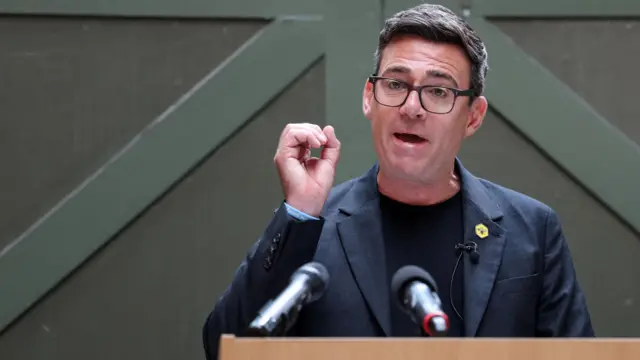
    Andy Burnham stands behind a lectern, wearing a dark coloured blazer and a black t-shirt underneath.Image source, Reuters
    Image caption,

    Burnham set out his intentions for the country during a speech at the People's History Museum in Manchester in June

    Andy Burnham is now closing in on becoming the UK's next prime minister - here's a closer look at some of his key policies:

    Devolution: Burnham has promised the biggest-ever "rebalancing of power" away from Whitehall, with regional authorities and mayors to be handed more power, and a No 10 "North" to be set up in Manchester.

    Water and energy: He says he wants all parts of the UK taking "greater public control" of the water and energy sectors, having advocated for public ownership of Thames Water.

    Housing: The former Greater Manchester mayor has pledged to establish the biggest council house building programme "since the post-War period".

    Immigration: Burnham has said net migration "needs to fall further", though he has not yet set a specific target.

    Welfare and employment: He also wants to see a "fair and lasting" reduction to the UK's welfare bill - but specific funding plans are yet to be set out.

    Tax and spend: Burnham has promised to stick to Labour's pledge to avoid raising income tax, VAT or National Insurance, but says there is "some room" within the manifesto for tax changes. He has also promised to stick to Labour's fiscal rules.

    You can read more about Burnham's policies in our news story.

  4. Analysis

    Burnham has wanted the top job for decadespublished at 09:22 BST

    Henry Zeffman
    Chief political correspondent

    Today marks the fulfillment of a decades-held ambition for Andy Burnham.

    He first tried to become Labour leader in 2010, finishing fourth behind Ed Miliband (and David Miliband and Ed Balls).

    He then tried again in 2015, a contest he began as the favourite but ended up losing by some distance to Jeremy Corbyn.

    Third time lucky, and then some. Today is the culmination of a period of almost a month, for most of which it has been apparent that Burnham would become Labour leader.

    From what we know of it, Burnham’s speech will focus on the Labour Party, saying it must be “authentically Labour”, “unashamedly Labour” and “distinctively Labour”.

    What does that mean? One clue may be in his argument that Britain “took a series of wrong turns in the 1980s”.

    The implication of that is that the direction was not adequately corrected in the 1990s and 2000s, New Labour governments in which Burnham served, nor perhaps even in the two years since Keir Starmer took office.

  5. Liverpool City Region mayor: Burnham wants to shake things uppublished at 09:10 BST

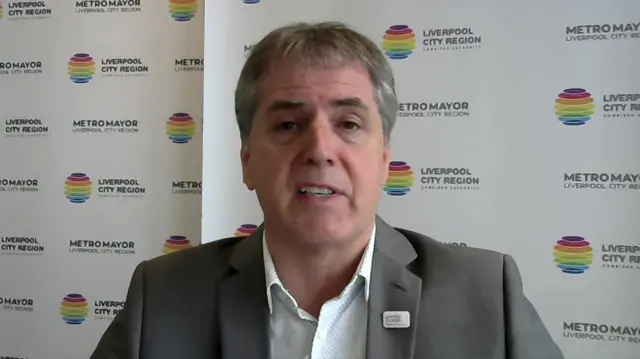
    Steve Rotheram speaks to the BBC in front of a backdrop saying "Liverpool City Region"

    Andy Burnham has wanted to become prime minister for 16 years but has "used the opportunity in between" to "see Parliament from the outside", according to Liverpool City Region Metro Mayor Steve Rotheram.

    Speaking to BBC Breakfast, Rotheram says: "If people believe that Andy Burnham is being made the prime minister so that he can communicate the same message just in a better way or a better form, then they're absolutely deluded."

    "Andy wants to go in there and he wants to shake things up."

    On the possibility of tax rises, Rotheram says both he and Burnham introduced an additional tax as mayors, saying the "small increase" in Manchester has improved public transport.

    "Nobody really complains about a small increase that allows you to do something that’s popular," he says.

    It's put to him on BBC Radio 4’s Today programme that some are concerned Burnham does not have a plan, which Rotheram rejects.

    He says "there's been a plan being worked on for many weeks and months now", but adds that "you don’t put everything out there in one go".

  6. Burnham to promise new path for UK that is 'unashamedly Labour'published at 08:47 BST

    Nick Eardley
    Political correspondent

    Andy Burnham stands in front of a wooden podium and microphones as he delivers a speech at the People's History Museum in ManchesterImage source, Reuters

    Andy Burnham will promise a new path for the UK as he becomes Labour leader today.

    In his speech at a special party conference in central London, Burnham will argue "Britain took a series of wrong turns in the 1980s" when "political power was centralised and economic power privatised".

    As is usual for big set-piece speeches, his team has briefed the media on some of what he will say.

    He will say the country needs a "new path to the one we’ve been on for the last 40 years".

    Ahead of becoming PM next week, he will pledge to lead a government with the "courage to fix the big things that politics has neglected" and the "conviction to argue for our plans".

    Burnham will also promise a "distinctively Labour" approach - with more economic renewal, public control and "reindustrialisation".

    He will say his government will be "unashamedly Labour in our priorities and in the decisions we take, putting people and places at the heart of everything we do".

    He is also expected to pay tribute to Keir Starmer for taking Labour "from its worst electoral defeat in a century to one of the largest election victories in our history".

    He will highlight areas including stronger workers' rights, investment in public services and the Hillsborough Law.

  7. The new occupant in No 10 is decided - but what about No 11?published at 08:41 BST

    Iain Watson
    Political correspondent

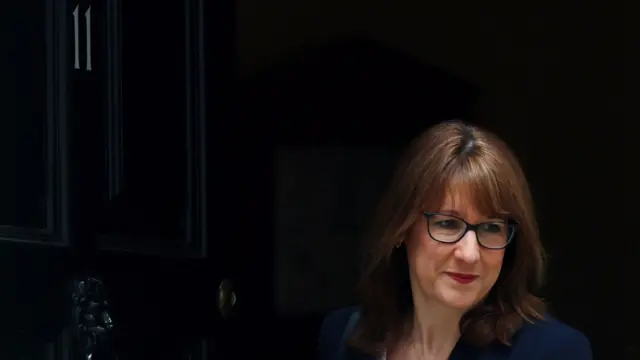
    British Chancellor of the Exchequer Rachel Reeves walking out of the door at 11 Downing StreetImage source, EPA/Shutterstock

    Andy Burnham is moving into No 10 on Monday.

    But the beneath-the-radar battle for No 11 Downing St is continuing. Whoever Burnham appoints as chancellor - and next-door neighbour in Downing Street - will send a signal of his intent both to politicians and to the bond markets.

    The official line from team Burnham is that no decision has been taken.

    Announcements on cabinet posts are not expected to be made until Monday, when Burnham moves to No 10.

    Discussions have been taking place among a tight group of people - the next No 10 chief of staff James Purnell, Louise Haigh and the former MP who stood aside for Burnham, Josh Simons.

    When Burnham won the subsequent Makerfield by-election the widespread assumption was that the Energy Secretary Ed Miliband would move to the Treasury.

    But there has been both noisy and more subtle attempts to influence Burnham's choice of chancellor - ranging from unions with workers in the oil and gas industry and who distrust Miliband's instincts, to Keir Starmer's unpaid 'cost of living' tsar Lord Walker, the boss of Iceland.

    I've been told there are "live discussions" over installing Home Secretary Shabana Mahmood in Number 11.

    Read more about the jostle for No 11 here.

  8. How party leaders have reacted to Burnham becoming leaderpublished at 08:24 BST

    Kemi BadenochImage source, PA Media

    Kemi Badenoch has accused Andy Burnham of "running scared" of scrutiny and warned Labour MPs during Keir Starmer's final PMQs on Wednesday that changing prime minister was not a "silver bullet". However, she has stopped short of calling for a general election.

    Ed Davey has also stopped short of calling for an election, arguing that the public will want to give Burnham a chance. TheLiberal Democratleader said if Burnham "is serious about changing the way we do politics", then his "door is open".

    Nigel Farage and Reform UK have been highly critical of Burnham and have demanded an immediate general election. Following Burnham's victory in Makerfield last month, the party said the country had "no clue" what he stands for.

    Zack Polanski has suggested the Green Party could work cooperatively with Burnham and has urged him to introduce wealth taxes and rent controls.

    The SNP says it has "no idea" what Burnham's proposed plan for greater devolution entails, First Minister John Swinney said it showed a "lack of knowledge" about Scotland.

    Plaid Cymru's Westminster Leader Liz Saville has urged the next Labour leader to act differently to his predecessors.

  9. A 15-minute conference to leadership ascension - what to expect todaypublished at 08:04 BST

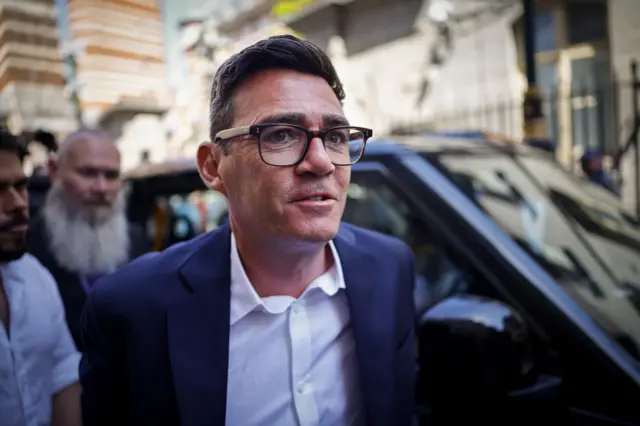
    Andy Burnham pictured in front of a black cab in WestminsterImage source, EPA/Shutterstock

    At midday, Andy Burnham will be announced as the new Labour leader at a special party conference in central London.

    The announcement will come after a short intro by National Executive Committee (NEC) chair and Home Secretary Shabana Mahmood.

    For context: As the governing body of the Labour Party, the National Executive Committee provides strategic direction for the party and is made up of representatives from each section of the Party.

    From that point on, Burnham is Labour leader.

    Keir Starmer will continue to be prime minister, until he goes to see the King on Monday morning to resign. Burnham will then follow him to the Palace to be asked to form a government by the King.

  10. Today's pitch will be one Burnham has rehearsed for monthspublished at 07:53 BST

    Chris Mason
    Political editor

    This is a moment shorn of any real capacity for surprise – and, until Monday at least, its logical consequence as well: Andy Burnham actually becoming prime minister. His argument today will be one he’s been rehearsing since at least his by-election campaign launch in a dusty car park near Wigan in May.

    “Returning power to communities” as he puts it, and a new path from the one he claims the country has been on “for the last forty years” – a period taking in not just the leadership of Margaret Thatcher and John Major, but Tony Blair, Gordon Brown and their successors.

    He’ll say his approach will be “distinctively Labour, unashamedly Labour” – with more “public control” and “reindustrialisation".

    He’ll also argue he’s open to working with other parties on the long term issues the country faces. In a video posted on social media last night, he reflected on his own family’s experience of the social care system in England.

    “If there’s one area where I’m going to expend quite a lot of political capital, it’s going to be social care,” he said.

  11. Burnham to become Labour leader and promise new path for UKpublished at 07:42 BST

    Imogen James
    Live reporter

    Andy BurnhamImage source, Getty Images
    Image caption,

    Andy Burnham returned to Parliament after winning the Makerfield by-election last month

    Today is the day the Labour Party officially gets its new leader in Andy Burnham.

    For the rest of the country, it's one day closer to a new prime minister - on Monday, Burnham will take that position from Keir Starmer, who announced his intention to resign last month.

    It has not been entirely straightforward for Burnham - his first attempt to return to Parliament was blocked by Starmer before he ultimately stood in and won the Makerfield by-election.

    The former mayor of Greater Manchester effectively won the leadership contest before it even got under way, gathering the support of so many Labour MPs that it was mathematically impossible for anyone else to run against him.

    In a speech later, he is expected to set out a new path for the UK with a "distinctively Labour" approach of economic renewal, public control and "reindustrialisation".

    Burnham will say that when he is in Downing Street, the government will be "unashamedly Labour in our priorities" and have the "courage to fix the big things that politics has neglected".

    We'll bring you the key lines and analysis ahead of Burnham being officially declared Labour leader at a special conference in central London at 12:00 BST.