Summary

  1. Zelensky says allies asked Ukraine not to attack Russian energy infrastructure amid global fuel crisispublished at 16:03 BST

    Vitaly Shevchenko
    Chief analyst, BBC Monitoring
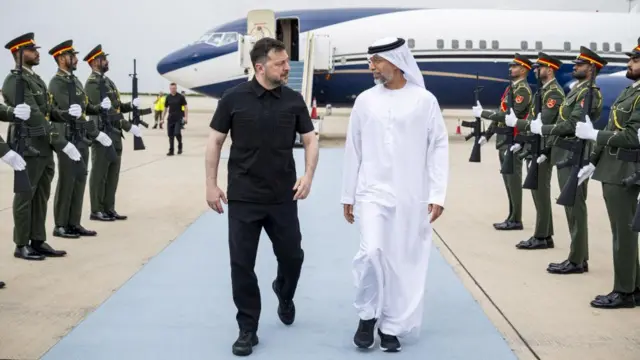
    Suhail bin Mohamed Al Mazrouei, UAE Minister of Energy and Infrastructure, receives Volodymyr Zelenskiy, President of Ukraine, in the United Arab EmiratesImage source, UAE Presidential Court
    Image caption,

    UAE Energy Minister Suhail Al Mazrouei greets Ukrainian President Volodymyr Zelenskiy during Zelensky's Middle East trip in March

    Ukraine's President Volodymyr Zelensky has said that his allies have asked him to halt at least some of the attacks on Russia's energy infrastructure amid the global fuel crisis.

    Speaking after visiting a number of Gulf states, Zelensky said:

    "We have received messages from some of our partners asking about how our response strikes against Russia's oil sector, the energy sector can be reduced."

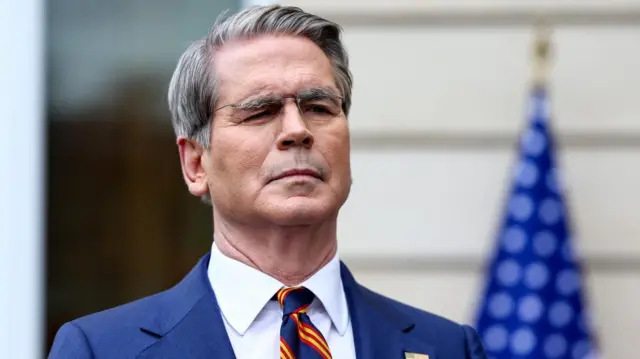
    "If Russia is ready not to strike Ukraine's energy, we'll respond by not attacking theirs," he told journalists in a voice message.

    It is not clear which countries he may be referring to, but the US has eased some of the sanctions imposed on Russian oil in response to surging energy prices triggered by the war in Iran.

    President Zelensky's comments come after a string of long-range strikes by Ukraine against Russia's energy sector, particularly a key oil export terminal at the port of Ust-Luga outside St Petersburg.

    He was speaking after visiting Saudi Arabia, the UAE, Qatar and Jordan. His tour of the Middle East is now over and he is heading back to Kyiv.
  2. Jordan bans air conditioning in government buildings as energy costs risepublished at 15:54 BST

    Jordan is banning the use of air conditioning in government buildings as the war increases economic pressure on Gulf states.

    In a directive reported by the state-run Jordan News Agency today, Prime Minister Jafar Hassan is also restricting the use of government vehicles and putting a two-month hold on international trips for official delegations and committees.

    The government has previously acknowledged the impact that rising fuel and energy costs are having.

  3. In pictures: Destruction caused by strikes in Lebanon, Iran and Israelpublished at 15:46 BST

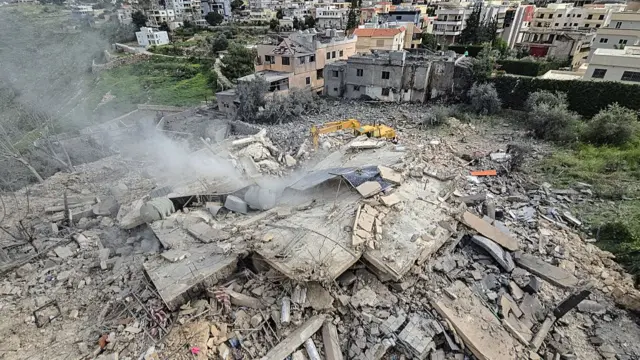
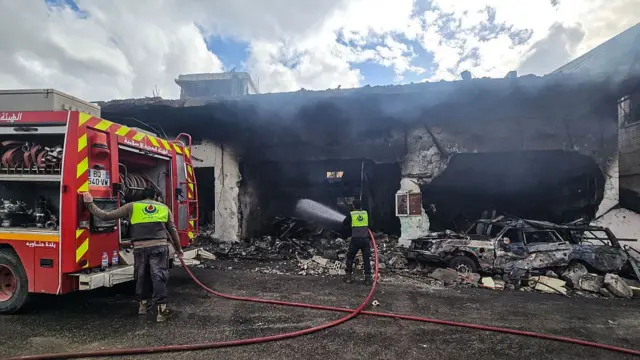
    As Israel continues its attack on Hezbollah in Lebanon, and US-Israeli forces exchange fire with Iran, here are some pictures showing the aftermath of the strikes.

    First responders work on the rubble of a building that has been flattened with smoke blowing out of it after aImage source, Getty Images
    Image caption,

    A building hit by an Israeli air strike in the southern Lebanese village of Hanouiyeh

    Two firefighters can be seen with hoses spraying a building that has been turned black by an Israeli airstrikeImage source, Getty Images
    Image caption,

    Firefighters put out a fire at the same site

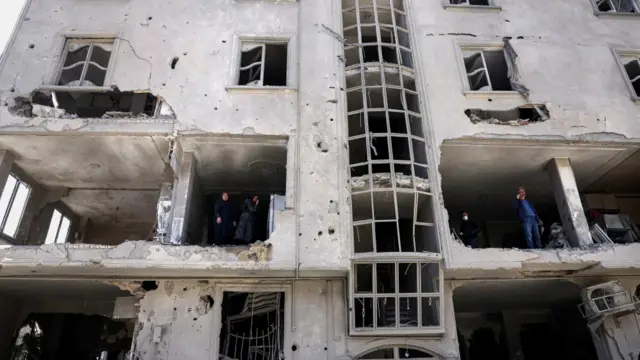
    People inspect damage to a residential building after it was hit by a strikeImage source, Reuters
    Image caption,

    People inspect damage to a residential building after it was hit by a strike in Tehran

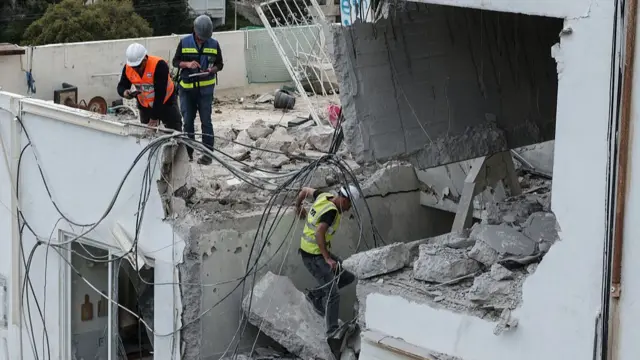
    Workers climb through a building that has been damaged, with some walls crumbling and wires hanging assess damage after an Iranian strike in Haifa, IsraelImage source, Getty Images
    Image caption,

    Workers assess damage after an Iranian strike in Haifa, Israel

  4. More than 6,000 people taken to hospital since start of war, Israel sayspublished at 15:31 BST

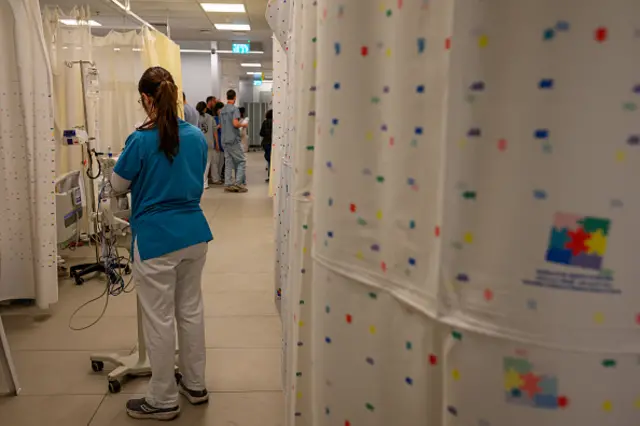
    A nurse checks equipment at Clalit’s Schneider Children's Medical Center underground hospitalImage source, Getty Images

    More than 6,000 people have been taken to hospitals in Israel since the start of the war with Iran, according to the country's Ministry of Health.

    The ministry says 121 patients are still receiving medical treatment - one is in a critical condition and 16 are considered to be serious.

    In the past 24 hours, 232 casualties have arrived at hospitals across the country, the ministry adds.

  5. Iran stays in Nuclear Non-Proliferation Treaty but questions its meaning - spokespersonpublished at 15:20 BST

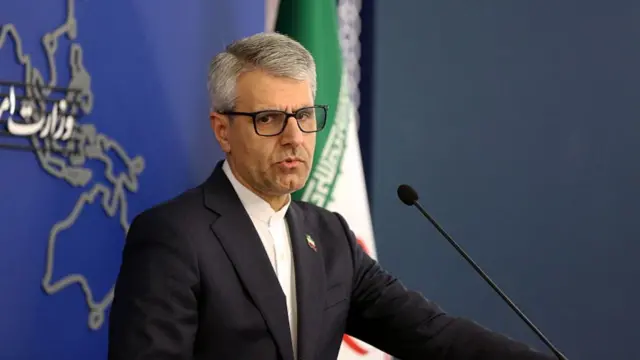
    Iranian Foreign Ministry spokesperson Esmail BaghaeiImage source, Anadolu via Getty Images

    Iran’s Foreign Ministry Spokesperson Esmail Baghaei has repeated that Iran has never sought, and is not seeking, nuclear weapons.

    Speaking at a news briefing today, he says both parliament and the public are concerned about the benefits of being a member of the Nuclear Non-Proliferation Treaty. The treaty, entered into force in 1970, aims to stop the spread of nuclear weapons but allows countries the right to develop and research nuclear energy.

    Baghaei says Iran is still committed to the treaty as it remains a member, but is questioning whether it can enjoy the rights it provides.

    Iran has said it is not seeking to make nuclear weapons, but the US has accused it of doing otherwise.

    Last year, International Atomic Energy Agency’s board of governors declared Iran in breach of its non-proliferation obligations for the first time in 20 years.

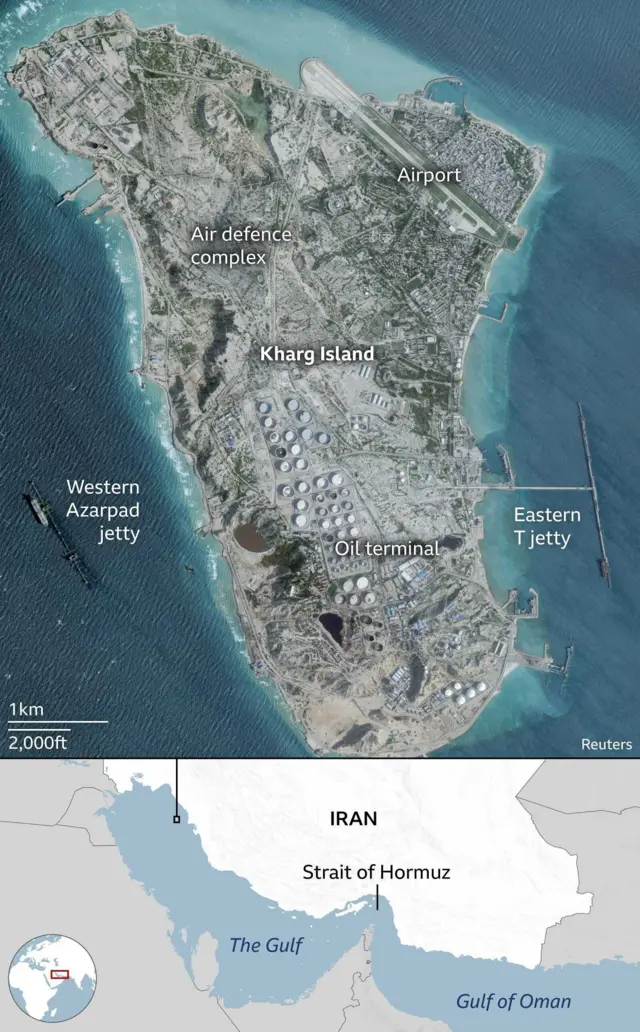
  6. Remind me, what is Kharg Island? Why does Trump want it?published at 15:04 BST

    As we've mentioned, US President Donald Trump has warned that if a deal with Iran isn't reached soon, the US will target locations including Kharg Island.

    But what is Kharg Island?

    It is a small island 15 nautical miles (28km) off the coast of Iran. Ninety per cent of Iran's crude oil passes through a terminal on the island.

    Taking the island would effectively cut the Islamic Revolutionary Guard Corps' economic lifeline, affecting its ability to conduct the war, says security analyst Mikey Kay.

    This move could also choke off Iran's oil exports, give the US military a platform to launch attacks against the mainland, and be used as leverage to pressure Iran to keep the Strait of Hormuz open.

    But a US operation would be difficult. A landing force would have to travel considerable distances, either by naval vessels or as part of an airborne force.

    Iran has reinforced its defences on Kharg Island in recent weeks, including deploying more military personnel and air defences, sources told CNN.

    A graphic showing the location of Kharg Island in the northwest of The Gulf about 25 kilometres off the coast of Iran. A satellite image shows the whole island which is roughly eight kilometres long and four kilometres wide. Shadows indicate that the island has many rocky outcrops but the island has been heavily industrialised. There is an airport in the northeast that extends slightly into the sea and around it appears to be the main accommodation on the island. The oil terminal takes up most of the southern half of the island where more than fifty large, white circular structures are clearly visible. These are the oil containers and they are surrounded by other smaller industrial buildings. The south of the island is flanked by two jetties for oil tankers to dock when loading. In the middle of the island an area is labelled as being an air defence complex.Image source, Reuters/Google
  7. Analysis

    No evidence of 'great progress' in US-Iran talkspublished at 14:50 BST

    Lyse Doucet
    Chief international correspondent

    Wars are unpredictable but there is still no proof of the “great progress” President Trump says the US is making in what is, so far, only indirect messaging with Tehran.

    Iran has not formally replied to the 15-point plan shared with them by Pakistan. But leaked copies underscore it is tantamount to a surrender document.

    Distrust runs very deep after the last two rounds of mainly indirect diplomacy, in February, and June last year, were shattered by US-Israeli air strikes.

    Iran is making it clear it no longer wants to work through that channel, led by Trump’s special envoy Steve Witkoff, which it now sees as subterfuge.

    That's why there's a lot of talk about US Vice-president JD Vance stepping in.

    Official sources in the region say there is still no agreement to hold talks - no movement in closing very wide gaps. Trump’s description of a "new and more reasonable" regime is also belied by a system now militarised and dominated by hardliners who replaced assassinated clerics and commanders.

    As the US moves toward possible escalation, that is Iran's main emphasis too.

  8. Spain says US planes involved in Iran war not allowed in its airspacepublished at 14:39 BST

    Spain's Prime Minister Pedro SánchezImage source, EPA

    Spain's government says its airspace is closed to US planes involved in attacks on Iran.

    Defence Minister Margarita Robles tells reporters the government refused to "authorise either the use of military bases or the use of airspace for actions related to the war".

    The ban on the use of military bases was announced in early March, prompting an angry reaction at the time from US President Donald Trump, who threatened trade retaliation against Spain.

    Spanish Prime Minister Pedro Sánchez has described the US and Israeli attack on Iran as reckless and illegal.

  9. US Navy Seals, Army Rangers and paratroopers now in Middle East - CBSpublished at 14:28 BST

    Hundreds of US Special Forces personnel - including elite Navy Seals and Army Rangers - are now in the Middle East, according to the BBC's US partner CBS News.

    Thousands of US marines and paratroopers are also in the region, CBS reports.

    Sources tell CBS the deployments are intended to give Donald Trump alternative options in Iran, including operations that could involve opening the Strait of Hormuz, taking oil from Kharg Island or seizing Iran's stockpile of enriched uranium.

    US Central Command (Centcom) declined to comment on this development.

    On Saturday, Centcom said 3,500 sailors and marines had arrived aboard USS Tripoli in the Middle East.

  10. US treasury secretary addresses global oil concernspublished at 14:20 BST

    U.S. Treasury Secretary Scott BessentImage source, Reuters

    In an interview with Fox News on Monday, US Treasury Secretary Scott Bessent says the global oil market is well supplied "and we want to get back to the normal".

    "The market is in deficit 10 to 12 million barrels a day, and we're making up for that deficit."

    He says there will be freedom of navigation in the Strait of Hormuz, "whether it is through US escorts or a multinational escort".

    You can see the situation in the Strait of Hormuz in our previous post.

  11. BBC Verify

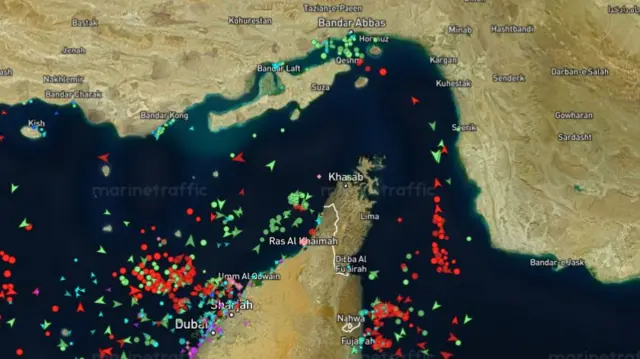
    Hormuz ship transits continue at sluggish pacepublished at 14:07 BST

    A MarineTraffic screengrab showing the Strait of Hormuz with essentially no ships sailing through the narrow channelImage source, MarineTraffic
    Image caption,

    Ship-tracking data shows reduced traffic through the Strait of Hormuz - seen here between Iran and the tip of the Arabian Peninsula

    By Joshua Cheetham

    Just three ships have transited the Strait of Hormuz today, according to maritime intelligence firm Kpler.

    Before the US-Israel war with Iran began, almost 140 commercial ships passed through the strait each day, according to the Joint Maritime Information Centre.

    All three ships broadcast they had "Chinese owner and crew" according to their publicly-available position broadcasts - showing some vessels are signalling their links to China in an attempt to pass safely.

    Two of the vessels seen on tracking sites today are container ships owned by China Shipping Container Lines. The third is a bulk carrier owned by Pole Star Shipping Line.

    The government in Tehran has effectively closed the narrow Strait of Hormuz since the start of the war in Iran, leading to spiking oil prices and concerns over the supply of some commodities.

    On Sunday, US President Donald Trump said that Iran had agreed to allow some ships to sail through the strait. But it’s unclear which ships these are, who owns them, or where their cargoes are heading.

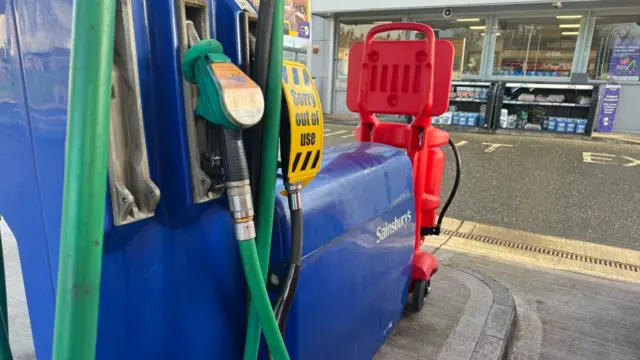
  12. Diesel prices in UK reach highest level in 40 monthspublished at 13:55 BST

    Sainsbury's Dungannon diesel pump

    Diesel prices in the UK have reached their highest level since December 2022, while petrol has also hit a 28-month high.

    Average petrol prices are now 152 pence a litre, with diesel at 181.2 pence.

    RAC policy chief Simon Williams tells the BBC it now costs £10.55 more to fill up a typical petrol family car than it did at the start of the Iran conflict. For diesel cars, owners are paying £21.35 more.

    The war in Iran and the situation in the Strait of Hormuz have pushed global fuel costs up sharply - with some countries bringing in measures to cut usage. Sri Lanka has introduced fuel rationing, while two Australian states have made public transport free to encourage people not to drive.

  13. IDF says it has struck IRGC-affiliated university againpublished at 13:49 BST

    The Israel Defense Forces (IDF) says it has struck the Iranian Imam Hossein University in recent days.

    In an update, the IDF says the university contained Islamic Revolutionary Guard Corps (IRGC) infrastructure, and that research and development for weaponry was carried out there.

    This comes after earlier strikes on the campus - on 7 March, the IDF gave a similar update saying it had struck the university.

    The university is in Tehran and is affiliated with the IRGC.

  14. What do Iranians think of Trump talking about Kharg Island?published at 13:44 BST

    Ghoncheh Habibiazad
    Senior reporter, BBC Persian

    It’s still very difficult to reach people inside Iran because of the government-imposed internet outage. Some manage to connect using Starlink satellites and other methods - but using or even possessing Starlink can lead to up to two years in prison in Iran.

    I’ve been asking some of them what they think about Donald Trump talking about the possibility of seizing Kharg Island.

    A man in his 30s who has visited the island before tells me: “Obviously I will not be happy, but I want to see what the Islamic Republic will do.

    "They have been saying for years that they have a powerful navy, and I am sceptical.

    "I think the US wants to put economic pressure on the regime by doing this.”

    A woman in her 20s who wants the war to end says: “I am very worried and anxious about it. The most important thing is that it is part of Iran’s soil. I think it is going to put a lot of pressure on ordinary people if it happens.”

    • BBC Persian is the Persian language service of BBC News, used by 24 million people around the world - the majority in Iran - despite being blocked and routinely jammed by Iranian authorities
  15. Trump's renewed threat and killing of Iran's naval commander - what's the latest?published at 13:36 BST

    Residents sit amid debris in a residential building that was hit in an airstrike earlier this morning on March 30, 2026 in the west of Tehran, Iran.Image source, Getty Images
    Image caption,

    The war in Iran enters its fifth week

    US

    US President Donald Trump says Washington is in "serious discussions" with a "new and more reasonable [Iranian] regime" to bring an end to military operations in Iran.

    But he also warns that if a deal is not reached soon, the US will target electricity-generating plants, oil wells and Kharg Island.

    Iran

    Four days after Israeli forces said they had targeted Iran's naval commander Alireza Tangsiri, the Islamic Revolutionary Guard Corps (IRGC) has confirmed that Tangsiri was killed.

    Supreme Leader Mojtaba Khamenei called Tangsiri "courageous". His funeral will be held tomorrow morning, according to Iranian state media.

    Lebanon

    Israel has launched air strikes in south Beirut, saying it was targeting Hezbollah's infrastructure. Pictures show destroyed buildings and debris, as rescue workers search for people in the affected area.

    Israel

    An Israel Defense Forces (IDF) soldier was killed while fighting in southern Lebanon on Sunday, the Israeli military says.

    Iran launched missiles at northern Israel. The Israeli fire service says an industrial building and a fuel tanker in Haifa were hit by debris from an intercepted missile aimed at the Bazan oil refinery.

  16. A timeline of Trump's Strait of Hormuz deadlinespublished at 13:26 BST

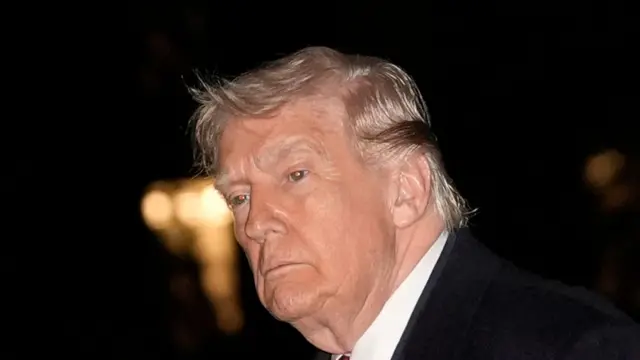
    Picture of Donald Trump taken from the right of his face as he looks diagonally into the distance. He wears a black suit, white shirt and has a serious look on his faceImage source, EPA

    As we've reported, Donald Trump now says that "if the Hormuz Strait is not immediately 'Open for Business'", the US will be "blowing up and completely obliterating" assets including electricity and oil plants.

    This isn't the first time he's posted something similar - the US president has been updating his deadline for Iran to open the Strait of Hormuz in various Truth Social posts. Here's a timeline:

    21 March: Trump said he would "hit and obliterate [Iran's] various power plants, starting with the biggest ones first" if Iran didn't reopen the Strait of Hormuz within 48 hours.

    23 March: He then said the two countries had had "very good and productive conversations". He said he would "postpone any and all military strikes against power plants and energy infrastructure" for five days.

    26 March: Trump said he would extend this pause to 10 days, in response to what he called a request from the Iranian government, bringing the deadline to 6 April.

    Today, he says the US is in "serious discussions" with a new Iranian regime which he says could "end our military operations in Iran". But if a deal is not "shortly reached", Trump says, the US will "conclude our lovely 'stay'".

  17. UAE intercepts nearly 40 missiles and drones in past 24 hours - defence ministrypublished at 13:11 BST

    The UAE says it has intercepted 11 missiles and 27 drones in the past 24 hours, according to its Ministry of Defence.

    The ministry says it has engaged 1,941 drones and 440 missiles since the war began.

    In a statement on social media, it adds that 178 people have been injured in attacks so far, with eight fatalities.

    Meanwhile, Bahrain's Defence Force says it has intercepted eight missiles and seven drones in the past 24 hours - bringing its total to 182 missiles and 398 drones.

    Since the start of the war, Iran has been targeting neighbouring countries where the US has a presence, in retaliation for US and Israeli strikes.

  18. Iran says US demands to end the war ‘excessive and unreasonable’published at 12:52 BST

    Ghoncheh Habibiazad
    Senior reporter, BBC Persian

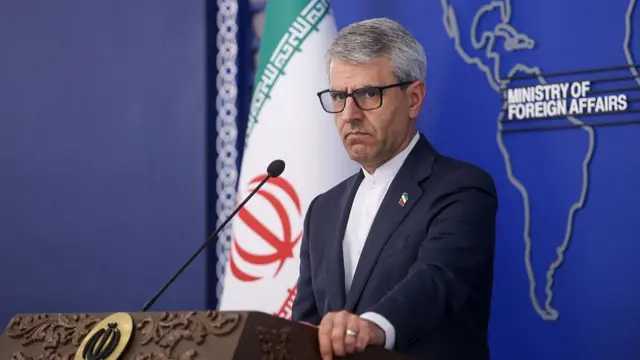
    Esmaeli Baghaei speaking in February, stood at an ornate podium with a global map and the Iranian flag behind him.Image source, Getty Images

    We've just brought you the latest comments from Donald Trump, who says the US is in "serious discussions" with a "new and more reasonable" Iranian regime.

    Earlier today, a spokesperson for Iran's Foreign Ministry said the points conveyed regarding US demands from Iran to end the war have been “excessive and unreasonable”.

    According to the report of his remarks by Iranian outlets, Esmail Baghaei says that Tehran has had “no direct negotiations with the US” and also that what has been discussed so far has been “messages through intermediaries about the US’s intention to negotiate”.

    He says that Pakistan's meetings are within a framework “they themselves have established”, and Iran has “not participated”.

    Baghaei has also accused the US of “constantly” shifting its position. “I do not know how many in the United States take the claim of American diplomacy seriously,” Baghaei said.

  19. Trump: US in 'serious discussions' with 'new and more reasonable' Iranian regime - but repeats energy threatspublished at 12:35 BST
    Breaking

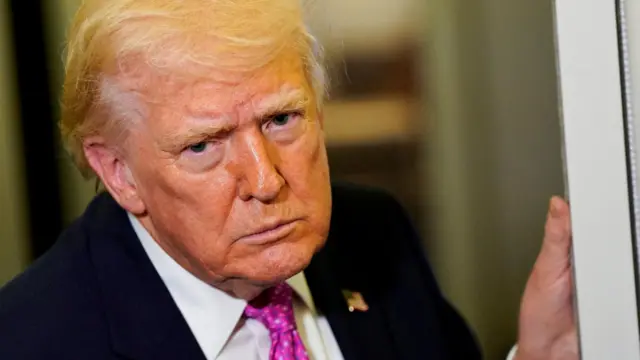
    US President Donald TrumpImage source, Reuters

    Donald Trump says the US is in "serious discussions" with a new Iranian regime which the president says could "end our military operations in Iran".

    In a post on Truth Social, Trump writes: "The United States of America is in serious discussions with A NEW, AND MORE REASONABLE, REGIME to end our Military Operations in Iran.

    "Great progress has been made but, if for any reason a deal is not shortly reached, which it probably will be, and if the Hormuz Strait is not immediately 'Open for Business,' we will conclude our lovely 'stay' in Iran by blowing up and completely obliterating all of their Electric Generating Plants, Oil Wells and Kharg Island (and possibly all desalinization plants!), which we have purposefully not yet 'touched'.

    "This will be in retribution for our many soldiers, and others, that Iran has butchered and killed over the old Regime’s 47 year 'Reign of Terror'."

  20. Analysis

    Kharg Island – is it a bluff?published at 12:20 BST

    Frank Gardner
    Security correspondent

    There has been so much noise made about a possible US ground assault on this island of Iran’s in the northern Gulf that you have to wonder if it’s all part of a cunning deception plan.

    There is no doubting its strategic value to Iran and the Islamic Revolutionary Guard Corps (IRGC). They rely on it for 90% of their oil revenues and although Iran claims it has other means of getting its oil to its customers, losing control of Kharg would be a definite blow.

    But, there are other islands in the Gulf that could also be in America’s sights.

    These include tiny Larak Island, just offshore from the key port of Bandar Abbas, which sits right on the Strait of Hormuz.

    Iran is currently making all tanker traffic pass by this island for checking and reportedly being forced to pay $2m per vessel.

    Then there is Qeshm, a vast island where Iran is suspected of housing underground missile and drone sites.

    And there are three islands, Abu Musa and the Greater and Lesser Tunbs, whose ownership is disputed between Iran and the UAE but all are occupied by Iran.

    Taken together, Iran’s Gulf islands form a protective shield that can threaten shipping and giving it a geographical advantage.