Sally Woodward Gentle and Lee Morris (Executive Producers)
Sally Woodward Gentle and Lee Morris (Executive Producers)
Published: 13 February 2017
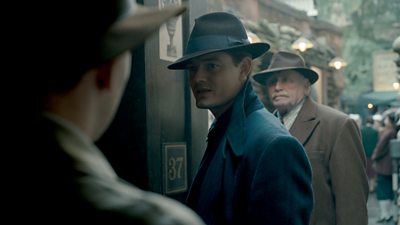
The thing about SS-GB is that it’s a very rich novel and has such a clever central conceit. It doesn’t feel like sci-fi. It feels like real life.
Can you please tell us how this project came about?
SWG: I worked with Len 23 years ago on a documentary called Edward VIII, Traitor King. We stayed mates. I’ve always loved SS-GB and always wanted to make it. When I asked Len, he said: “I think that television is now in a place to achieve a novel's ambition”. The thing about SS-GB is that it’s a very rich novel and has such a clever central conceit. It doesn’t feel like sci-fi. It feels like real life.
SS-GB also has a terrific central character, doesn’t it?
LM: Yes. At the start, Archer is trapped. He doesn’t have much choice about working for the Nazis because of his domestic circumstances and his belief in the importance of stability. As the story unfolds, feelings are aroused within Archer that lain dormant up until that moment. It brings the fight out in him, and prompts the idea that he could make a difference.
SWG: Archer is amazingly compromised and that is fascinating. He is in mourning for his wife who died during the invasion and has a young boy, and yet he has an incredibly responsible job as a detective. He sees the job as something that needs to be done. No matter what, the country needs to be stable to the point where he hopes the occupiers will no longer be there.
When we join him at the start, he doesn’t yet know about the real nature of the occupiers and their global ambition and extremist vision. But he is surrounded by people with a very strong moral code, and he is gradually awakened by that. He knows he has to act. Ultimately, Archer is compelling because he represents us. He is at the moral core of this story.
Can you explain the significance of the murder at the beginning of the story?
LM: When Archer arrives at the murder scene, he’s thinking that it’s a standard black market killing. But he soon begins to think there’s something odd about it. When he gets the call to say that a high-ranking Nazi is coming over to examine the case, that confirms to Archer that this is actually very important. He has unwittingly stumbled on something that is much bigger than he thought.
Does Archer’s growing realisation about the significance of the murder isolate him?
SWG: Yes. He has to carry around a lot of secrets. He can’t confide in anyone. He has to protect all these people, and yet he is party to these extraordinary secrets. He is in a terribly compromised position. That’s when he decides to take a heroic stance.
Why is Sam Riley so right for the role of Archer?
LM: Everyone in the office fancies him! Even I can see why! His performance is superb. He manages to convey things without actually saying them. That’s why it’s such a great performance.
SWG: He’s a brilliant actor and hasn’t done TV before. He lives in Berlin, so the director went for coffee with him. Afterwards, he told us: “Sam’s perfect!”
Tell us about Kate Bosworth’s performance as Barbara.
SWG: Barbara’s a brilliant American journalist, and what is great about Kate’s performance is that you are never quite sure where you stand with her. Kate brings glamour and romance, but at the same time until the very end you don’t know which side she’s on. The chemistry between Kate and Sam is fantastic. You really believe in the relationship between the two of them.
Why did you choose Robert and Neal as the writers?
SWG: They’re both big Len Deighton fans. Len’s knowledge of history is fantastic. He understands that history is often created by the minutiae of people’s lives. He talks about how history can be generated by someone having a row with his wife, late at night. Robert and Neal absolutely get that sense of historical accuracy. They also know how to tell a story with real tension and how to create a good soundbite. In addition, they’re fantastic at developing female characters.
Why is the idea of alternate history so compelling?
LM: It’s a natural thing to be curious about. It goes back to the book and the fact that we very nearly did lose the Battle of Britain. It was very close run thing. If the RAF hadn’t been so skilful and courageous, and the weather had been more favourable, it could have all been so completely different. That’s such an opportunity for a writer. It opens up so many possibilities. It shows that history could go in different directions at any point.
Does SS-GB remain relevant?
SWG: Absolutely. It hasn’t dated at all. The book is still extraordinarily pertinent. Len is incredibly clever. He is always a few steps ahead of everyone in his conspiracy theories. He knows a good story when he sees one, and he based this on documents from the Nazis about what they would do in the event of an invasion of the UK. There was also a handbook which was to be issued to German soldiers, we have copies in the office. They were going to save Blackpool as a playground for the troops.
What Len is really, really good at is dirty politics, and that hasn’t gone out of date at all.
What effect do you hope that SS-GB will have on audiences?
LM: The central question in this drama is: what would you do in that situation? Robert and Neal have framed the drama around that.
We are the generation that is fortunate enough to have grown up between big global conflicts. But SS-GB is a reminder of the fact that Britain was very nearly occupied. It feels fantastical, but who knows how many steps away from that we actually were?
Those storm clouds did gather very quickly. I’m not saying we are about to be plunged into another world war, but we always have to be vigilant. First and foremost, we are making entertainment, but like all the best thrillers, if you sit and think about it, SS-GB gives you plenty of food for thought, too. It’s absorbing and portrays a world that people can become really immersed in.
SWG: It’s a thriller set against the backdrop of what might have happened. But it should also make us ponder. When you see the rushes and step back, it’s really chilling. You realise that we were incredibly lucky that we weren’t occupied.
It really chimes with today’s world. Recent politics have made it feel more pertinent than ever. The message in this drama is that you can never be complacent. It’s not enough to maintain the status quo. You have to stand up and do something.