'Maybe someday, someone will offer their shoulder to me'
Our journalist partners in Ukraine reflect on a war that has gone on nearly as long as World War I
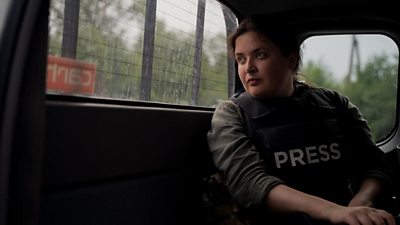
Anastasiia Ivantsiv is a leading war correspondent for Suspilne News, based in Kyiv but reporting from across the country and on the frontlines. Her reporting has been shortlisted for the European Press Prize and the Thomson Foundation Young Journalist Award. BBC Media Action has partnered with Suspilne for over a decade, supporting its newsroom modernisation, journalist mentoring and more. Anastasiia recently spoke at a BBC Media Action event about her work.
Imagine a summer field of sunflowers. Beautiful—stunningly so.
But you are driving through this field in a large armoured vehicle on an evacuation mission. Your task today is to find the body of a fallen soldier somewhere in this beautiful sunflower field, to recover him so his family can give him a proper farewell. Mortar shells are landing around your vehicle. It feels like a naval battle—you keep moving while explosions fall all around. But you have a mission.
My role, and the role of my photographer colleague, is to document this mission—to show the reality of war to our audience. These are just a few hours from the lives of journalists on the front line, but for soldiers, this is daily routine. Day after day.
This story happened to me a year ago at the front. We recovered the body of the fallen soldier, and his family was able to bury him with dignity. But the story did not end there. A year later, I spoke with the wife of this infantryman. Her wound still hurts; time has not healed it, unfortunately. She is very angry at the world for turning this into her reality.
Now the situation has worsened—not only at the front, but also in cities far from it. After the latest Russian strike, my apartment has no electricity, no heating, and no water. This has been going on for several weeks now. My typical workday lately looks like this: I go to work, interview people, film my report in cold buildings and apartments. Then I return to my own cold apartment, still without basic comforts.
I see an utterly exhausted Ukrainian society—and my colleagues in particular. They desperately need support. A friendly shoulder, one that is a little less worn out and still has some strength left.
So why do I keep doing my job? Because I have no choice. For now, I will be that shoulder for my people—for my colleagues, my friends, my parents, for the woman who lost her husband to the war. Maybe someday, when I need it, someone will offer their shoulder to me.
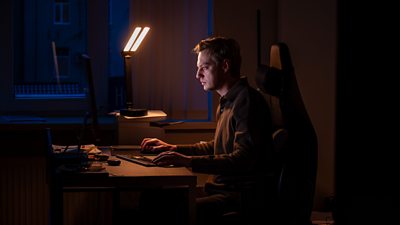
Oleh Dereniuha is the founder and publisher of NikVesti, an online news outlet which is a leading independent voice covering the southern city of Mykolaiv in Ukraine. BBC Media Action has supported training and mentoring for NikVesti's journalists and supported coverage of critical issues including the dangers of unexploded ordnance for local residents. He recently spoke at a BBC Media Action event about his work in the city, which is caught between the frontline and the strategically important port city of Odesa and has seen regular shelling and infrastructure attacks throughout the war.
When blackouts, shelling and uncertainty become normal in Mykolaiv, trusted local media like NikVesti become part of the basic infrastructure of a community. Support for regional journalism in Ukraine is not temporary aid. It is long-term resilience.
Our cooperation with BBC Media Action helped NikVesti strengthen our newsroom and deliver life-saving information about mine risks to communities in Mykolaiv region that face these dangers every day. This kind of partnership has real impact.
Our daily routine now has become one of working in darkness and cold. Our office is lit by single lamps powered by rechargeable power banks; we have electricity for about three hours each day now. The water supply was cut off months ago, and our internet and mobile phone connections are intermittent from the constant attacks on infrastructure.
If we want stability in Europe, we must help frontline communities like Mykolaiv remain informed, connected and confident about their future. Independent local journalism is a key part of that stability.
Frontline cities like Mykolaiv are not only defending territory. They are defending democratic space, open discussion and accountability. Strong local media like NikVesti are essential to keeping that space alive.
Read more about our work in Ukraine
Search by Tag:
- Tagged with UkraineUkraine
- Tagged with Media developmentMedia development
