Talking about periods on radio in Afghanistan
Protecting reproductive health and transforming lives
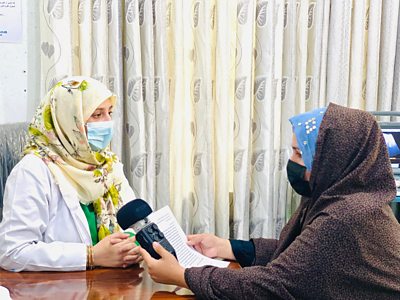
When she first heard about the new Paiwand (Connection) programme on her local Saday-e-Adalat radio, Rahela was skeptical. Radio programming is conservative in Afghanistan and she said she did not expect it to offer anything new.
But as she listened, something changed. She began to hear stories that mirrored her own experiences and real struggles faced by families in her community.
The programme spoke about issues that were rarely discussed, such as girls’ first menstruation and hygiene, offering clear and respectful guidance. That’s when Rahela’s skepticism began to turn into trust.
“I shared it with my family and now we all follow the programme regularly. The programme has truly changed our lives in a positive way,” she said. In a country where practices are shaped by traditional beliefs, and where even subtle differences in language and nuance can carry strong implications, open discussions or knowledge-sharing on sensitive yet important issues like reproductive health remain limited.
Our team in Afghanistan operates with the understanding that meaningful change toward better health doesn’t happen overnight. It begins with curiosity, reflection and connection.
In creating and airing Paiwand (Connection), BBC Media Action Afghanistan partnered with six local radio stations, including Radio Urooj and Saday-e-Adalat, in some of the most remote and least developed provinces like Ghor, Farah and Bamiyan, where access to accurate health information can be very limited. The programme is a means of encouraging conversations, inspiring action and ultimately saving lives.
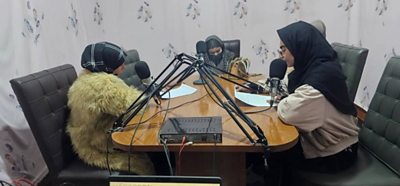
So far 56 episodes have been produced and aired on the BBC Afghan Service in both Pashto and Dari languages as well as on local partner stations. Each local partner also produces follow-up discussion segments so that listeners can share their own experiences and local context. We also work closely with local producers through mentoring and coaching, emphasising both medical accuracy and cultural sensitivity.
For many listeners, Paiwand has been their first trusted source of information on topics that are often considered too sensitive to discuss openly. Both men and women have found a voice that reflects their realities and provides practical guidance. Farah province resident Khaleel’s wife had previously experienced a difficult pregnancy but, like many families, they did not know how to respond to warning signs or seek timely help. Khaleel said that his understanding of pregnancy care was limited and was shaped by traditional beliefs.
One day while listening to the radio he heard that unusual symptoms and signs of complications during pregnancy must be reported quickly and not ignored.
“After my wife’s past difficult experience, now I take her to health centres for examinations on time,” he said.
Khaleel’s story is one of many small but significant shifts where awareness leads to action, and action leads to safer outcomes.
Paiwand’s thoughtful design includes a strong emphasis on gender balance, ensuring that both women’s and men’s perspectives are represented. Paiwand reaches more than 2.8 million listeners across Afghanistan – becoming more than just a radio programme, but a bridge that connects knowledge with practice, silence with dialogue and tradition with informed choice.
Paiwand is a weekly radio programme produced by BBC Media Action Afghanistan under a Foreign, Commonwealth & Development Office (FCDO)-funded project led by MSI Reproductive Choices. The program aims to reduce morbidity and improve reproductive, maternal, newborn and child health (RMNCH) outcomes in Afghanistan.
Latest news from Afghanistan
Our projects in Afghanistan
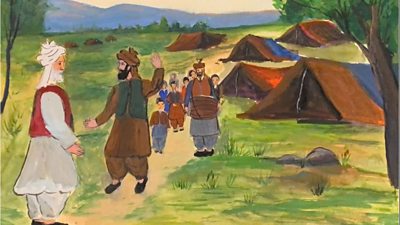
'See it, avoid it, report it' - our work on mine awareness
Young boys are the most frequent casualties of explosive ordnance in Afghanistan - our drama and discussion programmes may help save their lives.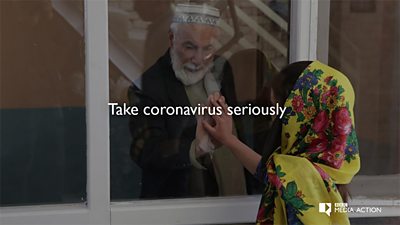
'Hello hope': Why COVID-19 communication is critical in Afghanistan
Learn more about our work with media and communication to help prevent the spread of COVID-19 among nomadic groups in Afghanistan.
Search by Tag:
- Tagged with AfghanistanAfghanistan
- Tagged with AsiaAsia
- Tagged with HealthHealth
- Tagged with Media developmentMedia development
