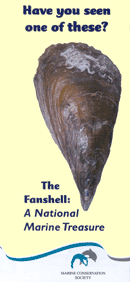
|  | A survey expedition has been mounted by conservationists to confirm the numbers of an extremely rare fanshell discovered in Plymouth Sound.
The live specimens recently spotted by a local diver off West Hoe are the first to be found in the whole of the UK since 2002.
Although they can grow to the size of dinner-plates (up to 48cm long), these mussels have become so rare they have eluded scientists for many years.
The recent discovery of up to 20 live animals in the shallow waters of Plymouth Sound has surprised marine scientists.
In the past Fanshells (Atrina fragilis) were far more common, but are known to be susceptible to damage by fishing trawlers.
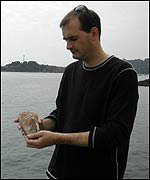 | | Dr Jean-Luc Solandt holding a fanshell. |
As an indication of their rarity, none were found during professional marine life surveys at nearly 9,000 sites around Britain between 1987 and 1998.
"These are the first live specimens to be recorded for at least two years," said Dr. Jean-Luc Solandt, Marine Conservation Society biodiversity policy officer.
"The find in Plymouth is unique because they are very close to the shore.
"They were found in a busy shipping channel just off West Hoe and it's possible this may have helped protect them from anchors and fishing nets."
The expedition is part of a national survey by the MCS, English Nature, the Marine Life Information Network and Seasearch. The MCS aims to involve divers and fishermen in recording where, when and how many fanshells they see.
Other than the recent Plymouth find, only two live specimens have been reported - both from a remote corner of north-western Scotland. "Our fanshell survey is vital to make people aware of, and record this extraordinarily rare marine animal", said Dr. Solandt.
"We rely on the general public, particularly divers and fishermen to record their sightings of fanshells, and report them to MCS.
"We are asking fishermen who find any live to place them in a bucket of seawater, and contact MCS as soon as possible."
 | | The fanshells have been found in a busy shipping lane. |
Seasearch, a national programme designed to involve recreational divers in recording marine life for nature conservation, has also been recording fanshells north and south of the border.
Two dedicated Seasearch trips involving over 50 dives failed to find a single fanshell in locations where animals were previously sighted.
Chris Wood, national Seasearch co-ordinator says of the Plymouth find: "Seasearch divers have been following up possible sightings of these rare shells for nearly two years.
"So far expeditions to sites on the west coast of Scotland and South Wales have failed to find any living specimens.
"This means that those in Plymouth Sound are the only living fanshells in their natural habitat outside Scotland that we can be certain exist, so it does make them very special." The identification of these beautiful creatures was made possible by a marine life identification guide produced by the MarLIN programme at the Marine Biological Association in Plymouth.
The MCS fanshell leaflet includes full colour photos and a recording form so observers can report sightings.
"Recreational divers often spot rare and unusual marine life, said programme director, Dr Keith Hiscock.
"They can help scientists by joining a range of recording initiatives." Free copies of the leaflet can be obtained from the Marine Conservation Society by calling 01989 566017.
First published: 28th July 2004 |