
| How swaling helps Dartmoor's wildlife | |
|  | | We are swaling... |
| | Swaling on Dartmoor is an ancient method of land management - but what is it and why is it done?
We've been to a swaling demonstration to find out what it's all about... |
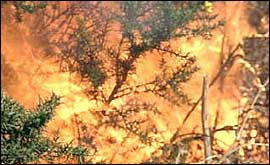
| | | Every year, parts of Dartmoor are deliberately set on fire...but this isn't vandalism - it's a way of improving access for walkers and, crucially, encouraging the moor's huge array of wildlife.
The controlled burning of the moor - or swaling as it is termed - is a traditional land management technique which has been used to control overgrowth on Dartmoor for some 5,000 years.
Swaling is a common sight at particular times of the year - for example, during March. It stops at the end of March, because that's when the bird nesting season starts.
 | | A farmer keeps a close eye on things |
In these health and safety conscious times, water bowsers are used to create firebreaks, beaters are put on standby, and the fire service is alerted whenever swaling takes place.
Farmers even held a demonstration of how to swale safely and effectively at an area near Haytor.
Dartmoor farmer Maurice Retallick explained: "If the gorse isn't controlled, then there may be the instance of having a large unmanagable fire.
"It may be started by vandals or by accident, and it can create a huge amount of damage to the vegetation and the wildlife."
Sue Goodfellow of the Dartmoor National Park Authority said swaling plays an important role in the preservation of the moorland.
 | | Horses carry on grazing |
"It provides a variety of structure. It provides young shoots for birds and insects to eat, it provides older stuff for cover, and it provides taller gorse - and it's that variety we're looking for," she said.
Swaling is good for the creatures which call Dartmoor "home."
Many rare ground nesting birds prefer the shorter, fresher vegetation that grows back after the burn.
The trick is to create a quick sharp fire which kills off plants above ground, but not below. So only small areas are burned, as bigger ones get too hot, killing plant roots.
In addition, windless days are preferred, as a breeze can make the fire too intense.
Swaling also has another positive knock-on effect as it prevents Dartmoor becoming overgrown, giving farmers more open space to graze their animals, and improving access for walkers.
But that's really secondary...the main object of the exercise is to ensure the best possible "living conditions" are provided for the wildlife which helps to make Dartmoor the unique place it is.
| | | |
|
| | Weather |  | | Monthly statistics, features and information. |
| E-cards |  | | Send an e-postcard of glorious Devon to a friend. |
| In Pictures |  | | Browse through our vast selection of photo galleries. |

BBC Devon
Broadcasting House
Seymour Road
Plymouth
PL3 5BD
(+44) 01752 229201
devon.online@bbc.co.uk
|
|


