It was only in January, that she again allowed people onto her farm: "I was still very jumpy right up until after Christmas. We didn't let anybody on, and we were still parking at the top of the lane," she said.
"It was a bit like starting all over again. You had to get out and tell your customers 'We're here, we can now move our stock and we can sell.'
"But the whole of the rural community is fragmented. There's very little cohesion and very little pulling together.
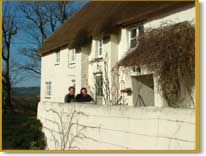 | Paula, with husband Rob |
"There's a bit of a split in communities - the us and them feeling between those who've had foot-and-mouth and those who haven't which is a great shame. There's still a great muddle out there."
Paula currently has a stock of 60 cattle and 40 ewes on her farm. She has been farming for 25 years, and the last 12 of those have been at Lock's Park. She uses traditional English breeds on local grasslands - at Lock's Park, it is Culm grassland.
She now works with a group of farmers using these methods, which she says means they are utilising the land, rather than fighting against it. The welfare of animals and environmental standards are the key considerations.
Paula welcomed the Curry report into the future of farming and food production. She already uses many of the methods recommended in the report, and says that quality is important. She also believes that everyone in the food chain must work much more closely together.
 | "Sky" standing guard over the farm.. |
But she has doubts about whether the Government would be able to better handle any future outbreak. She said: "I'm not sure if lessons have been learned, or if they have a contingency plan.
"I thought, back along, that there may be some issues which would be looked at - like vaccinations, and importing beef from foot-and-mouth countries. But as far as I can see, no very direct action has been taken either here or in Europe.
"Everyone is sitting on the fence, saying 'if it happens again, we might do this.' But there's nothing definite about contingency plans if it happened again."
A year on, and Paula is still receiving letters from viewers of Countryfile - and it is this support from the public which she will always remember most from the events of 2001: "I've had a fantastic response, and I'd like to show my appreciation to everyone who wrote in and telephoned.
"That is my one over-riding memory of foot-and-mouth. They say that bad things do fade into the distance and good things do stand out, and one of the things I will always remember is people's support. I'd like to say thankyou, because it gives you tremendous encouragement, it really does."
There were 173 confirmed cases of foot-and-mouth in Devon, and around 400,000 animals were killed. Devon's first case was at Highampton on February 24th, and the final case was in North Tawton on June 17th.
Click here to return to Farming Index
|











