Devon's foot-and-mouth inquiry has damned the Government's handling of the crisis and come up with its own plan to control any future outbreak.
The 90-page Mercer Report - entitled "Crisis and Opportunity" - lists a range of criticisms and lessons to be learned.
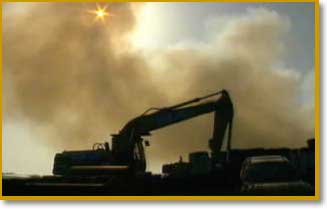
It cites two enduring images of foot-and-mouth. It says new born lambs must never again be trapped in fields by restrictions, as limited animal movements should be possible. And, the report adds, pyres should never again be used for carcass disposal.
 | Another enduring image which the report says should never be seen again... |
Both of these images demonstrate "lamentable" Government mishandling, according to the inquiry - which was organised by Devon County Council.
Chairman of the inquiry panel, Professor Ian Mercer, said: "The word 'lamentable' sprang out because it does try to encapsulate tragedy and the low standard of reaction."
Devon's report says culls on farms neighbouring outbreaks should in future be limited to those which have proven contact with infected animals, and research should be carried out on using vaccination.
The Mercer Report also says that farmers whose stock did not have foot-and-mouth, but still could not move livestock to market, should be compenstated alongside those whose animals were slaughtered.
 | Professor Ian Mercer |
Prof Mercer said:"The Government could, if the will was there, devise a method for providing financial assistance to farmers and their families who were on Form D restrictions."
The 4,500 farmers in Devon alone who were placed under the "Form D" restrictions are described as "the forgotten victims in this whole tragedy" in the report.
Regional director of the National Farmers' Union, Anthony Gibson, supports the view: "Many of them are in severe financial difficulties and the Government's response is wholly inadequate," he said.
"To say 'we don't compensate for consequential loss,' - well, frankly, that's not good enough."
The report says research is needed on how foot-and- mouth spreads, before the countryside is ever again closed down. The policy of sealing off large areas of the countryside devastated not only the farming community, but the tourism industry as well.
 | There were protests against the culling at Knowstone - scene of a bungled cull |
Another recommendation is that the army should coordinate the response to any future outbreak from the start. The inquiry team says that a national contingency plan is needed - but there is currently no sign of one.
In another criticism of the way the crisis was handled in Devon, the report concludes that the "culture of secrecy" at the agriculture ministry made the disaster worse.
And the construction of the £5.6m Ash Moor burial pit, which has never been used, is also condemned.
The Department for the Environment, Food and Rural Affairs (Defra) told the inquiry of its regret over the bungled cull of pedigree cattle at Knowstone, near South Molton. That left some of the herd - suspected of having the disease - roaming around the village.
Recommendations sent to Government
Defra says that new instructions have been issued to ensure that sufficiently skilled marksmen are selected in future.
The report is damning about the Government's handling of foot-and-mouth, but constructive as well. It suggests how such an epidemic could be better handled in future, although it has no power to achieve that.
There are recommendations about how the Government could plan to manage longstanding problems specific to the countryside - such as high house prices, a lack of farm labour, and inadequate training.
The inquiry report was compiled after 380 people and organisations - from Devon and beyond - submitted evidence to the inquiry during its investigations in the late summer and autumn of 2001.
Fifty witnesses gave further evidence at its hearings in public held in Exeter between October 8th and 12th.
Government admits lessons must be learned
In response to the report, the Rural Affairs Minister, Alun Michael, said: "We are taking very seriously the criticism and the recommendations.
"There were a massive number of lessons to be learned from events, which were quite unprecedented in both the scale and speed with which we were hit by events last year.
"There are already major changes which have taken place, and lessons that have been learned, and we are very much looking to the future."
Click here to go to the Farming Index
|