|  | The Government has given the go-ahead for the first commercial planting of genetically modified crops in Britain.
Ministers have given qualified approval to the growing of one variety of GM maize for animal feed after a series of trials.
But they have rejected the growing of GM beet or oil-seed rape.
The Environment Secretary Margaret Beckett told the Commons there would be strict conditions to ensure there was no damage to the environment, while further scientific analysis takes place.
The announcement will trigger vehement protest from anti-GM campaigners, and relief from the biotechnology industry. But legal challenges and unanswered scientific questions still lie ahead.
South Devon farmer Guy Watson, who lost a legal challenge to a GM trial near his organic farm, has predicted widespread contamination of conventional crops.
"The issue now is very different because we are not talking about tiny areas of trial crops," he said.
 | | Organic farmer Guy Watson is concerned about the decision. |
"We are talking about the possibility of quite large areas of GM maize being grown, particularly throughout the West Country because that is where most maize is grown, which I think would really make it impossible to grow a crop of sweetcorn or maize that would not be contaminated to a significant level."
Mr Watson added: "In the States, roughly 50% of supposedly non-GM maize is found to be contaminated to significant levels with GM crops.
"You imagine that in the state of Idaho or something where the fields are huge and compare that to the situation in Devon where we have very small fields, a very mixed system of agriculture, where there are going to be a lot of boundaries between GM and non-GM maize.
"The level of contamination is just bound to be a lot higher than the levels in the States which are already very significant."
Margaret Beckett told MPs the government would oppose the growing anywhere in the European Union of the two other GM crops, beet and oilseed rape, involved in the recent tests.
She said the GM maize licences would expire in October 2006, and anyone wishing to renew them would have to carry out scientific analysis during cultivation.
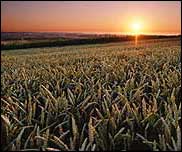 | | Arguments remain over the use of GM crops. Photo courtesy Monsanto |
Mrs Beckett said there was no scientific case for a blanket approval for all uses of GM, but neither was there a scientific case for a blanket ban on the use of GM.
However before any variety can be placed on the UK's approved seed list, the devolved authorities in Scotland and Wales must agree with the UK government in Westminster that this should happen.
Neither is yet certain to give their agreement: the Welsh Assembly voted unanimously in 2000 to keep Wales GM-free.
The Soil Association, which has fought GM crops from the beginning, said it was fearful that if something went wrong, perhaps in 10 to 15 years, it would be "impossible to reverse".
Conservative MP John Whittingdale warned that despite the Government's decision, more than 40 regions in Britain wanted to declare themselves GM-free, including Cornwall, Devon, Somerset and the Lake District.
He asked whether the Government will be providing advice to these authorities on the establishment of voluntary GM-free zones.
Even if Scotland and Wales do agree to support a decision to let the maize be grown, that will not necessarily be the end of the government's problems.
There will still be an opportunity for objectors to appeal against the decision. That could mean a hearing lasting several months and the earliest possible date the maize could be planted is in early 2005.
Tony Juniper, director of Friends of the Earth, said the Government had given the thumbs-up to GM maize and shown two fingers to the British public.
"In demonstrating its pro-GM credentials, the Government has ignored considerable scientific uncertainties, shown contempt to Parliament and utterly disregarded public opinion," said Mr Juniper.
"Moreover, this crop will be fed to cows to make milk that will not be labelled as GM, thereby making a mockery of official claims that policy will preserve consumer choice.
"We will now fight that all the way - through the remaining official approval stages and through the market."
Bob Fiddaman, spokesman for Scimac, a group of industry organisations that support GM crops, said the technology did not carry risk.
"Never has a form of technology been so tested and checked by scientists before it has been allowed to be fully developed," he said.
"There is nothing wrong per se with genetic technology because you're only moving genes within species."
 | previous farming news |  |
|