Wednesday 5th November 2003
Badger culling trial is suspended | |
| 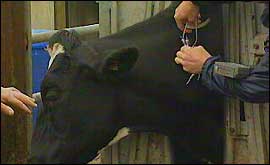 | | TB in cattle is a major problem in the South West |
| |
The Government has suspended one of its badger culling trials - because the culling appeared to INCREASE the number of cases of TB in cattle. |
|  | | The culling of badgers has been suspended by the government after new tests suggested it was counterproductive in the battle against tuberculosis in cattle.
The announcement was made in a written statement to the House of Commons from Exeter MP and animal health and welfare minister Ben Bradshaw.
Mr Bradshaw said culling would be suspended in "reactive treatment areas" with immediate effect.
He said the decision had been taken on the basis of recent scientific findings from the Independent Scientific Group on Cattle Tuberculosis (ISG).
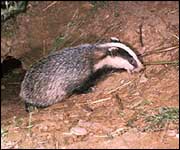 | | Many farmers blame badgers for the spread of bovine TB |
Many farmers are convinced badgers are responsible for spreading bovine tuberculosis among their cattle.
The ISG was appointed by the government in 1998 to design and oversee a large-scale field trial aimed at evaluating badger culling as a way of reducing the incidence of TB in cattle.
The Krebs trials cover 10 areas across the country - five of them in the South West - as well as locations in Herefordshire, Staffordshire and Derbyshire.
The areas are divided into three. In the first, the badgers are culled immediately (proactive culling); in the second, they are killed if there is an outbreak of TB (reactive culling); and in the third zone, the badgers are left alone.
The trials found that killing badgers in reaction to an outbreak of bovine TB led to an increase in the disease - by 27%.
But one Devon farmer - who wants to be known only by his Christian name, Paul, is critical of the suspension.
 | | Paul wants urgent action to stop bovine TB |
Paul is a dairy farmer who has lost 80 of his animals as a result of bovine TB, and the disease has also affected the farm's breeding programme.
"It seems strange that they haven't allowed it to go the full length of the trial. Have they got enough information to take this hasty decision?
"Surely a trial needs to run its full length of time with all its components."
He added: "We need urgent action - this is the third minister I've dealt with on this matter and it's now time for action."
Mr Bradshaw said proactive culling would continue because the data for these areas did not yet yield a statistically significant result.
Ian Johnson, of the National Farmers Union in Devon, said he was "greatly surprised" by the government's move.
"This was the most disrupted part of the trials by the foot and mouth outbreak and it hasn't been going on long enough.
"We can't quite understand on what science this has been based. We will be asking some very urgent questions because this is an intractable problem which is not going to go away."
He said the TB disease was out of control in many parts of the South West.
However, Mr Bradshaw said: "Clearly in those areas where we know that it's making matters worse and that badgers are being killed unnecessarily, it would not be conscienable to continue with those trials.
"I've made the decision to suspend the trials on the basis of these interim results, which I asked for.
"If there are significant results from the proactive trial areas between now and when they're due to end in two to three years time, then I will do the same on that and will take measures accordingly."
The end result is that no-one seems happy with matters as they stand at the moment. Farmers believe he's been hasty in suspending the trial, while badger groups want a complete end to all the culling.
Mr Bradshaw says the most important thing is to develop a vaccine against the disease: "Vaccination is the holy grail - if we could get vaccination, that would solve a lot of our problems."
 | other farming news |  |
| | | |
|
|