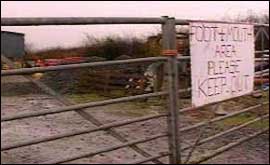
|  | The Government's handling of the 2001 foot-and-mouth crisis has been slammed by the Public Accounts Committee.
The influential committee - made up of MPs - says that the absence of planning to deal with the effects on tourism cost the South West economy around £100m.
In Devon, there were 173 confirmed cases of foot-and-mouth, and 400,000 animals were culled - many of those were contiguous, rather than confirmed cases.
Pyres of carcasses became a common sight in the Devon countryside, which was deserted for much of 2001, as huge areas were effectively closed off.
 | | Farm equipment had to be disinfected |
The Public Accounts Committee report, published on 14th March, concludes that inexcusable mistakes were made in the Government's handling of the £8bn foot-and-mouth crisis.
And there is a fresh warning from the National Farmers' Union in Devon that the Department of Environment, Food and Rural Affairs (Defra) may not be able to deal effectively with any future crisis.
Ian Johnson, of Devon NFU, said: "I would hesitate, from my perspective, to say that they (the farming ministry) have really learned these lessons.
"So my confidence in Defra is not a lot greater than it was previously."
The county's tourism industry still hasn't recovered from the disastrous year it suffered in 2001, according to Malcolm Bell of South West Tourism.
He says that although the recovery for tourism was faster than expected, businesses are still feeling the effects of the crisis two years on.
Report calls for improved planning:
The MPs' report says that lessons from the 1967 outbreaks had not been learned, in dealing with the 2001 crisis. In the earlier outbreak, the army had been called in much sooner than in 2001.
The MPs go on to claim the Government should not have disposed of carcasses on mass pyres. They also believe that the blanket closure of footpaths for a lengthy period should not have been allowed.
The report calls for better planning for future outbreaks and clear policies on when to start vaccinating livestock.
 | | Some 400,000 animals were culled in Devon during the crisis |
The farming ministry's contingency plans, in line with EU guidance, were based on an assumption there would be no more than 10 infected premises at any one time.
"The department had not considered any other scenarios because it felt that the risks of foot-and-mouth disease were low. This was a serious misjudgment," the MPs commented.
"In the event, at least 57 premises were infected before the outbreak was discovered and 2,000 premises were infected in total."
The committee estimates that the cost to agriculture - and, in turn taxpayers - was £3bn, and up to half of that could have been saved had there been a national ban on livestock movement from the outset of the outbreak.
The MPs also believe that contingency plans focused too much on agriculture, when in fact the most severe damage was suffered by the tourist industry.
Committee chairman, Tory MP Edward Leigh, told the BBC: "Many things were inexcusable and were done wrong. The lessons are very obvious, you have got to act decisively and quickly from day one."
Compensation claims:
The MPs are calling for better planning to avoid spiralling costs of compensation for farmers. Nearly £1,400m was received by farmers in compensation and other payments, with the assessed values of animals tripling during the crisis.
The department, headed at the time by Nick Brown, allowed potential recipients to select and appoint valuers themselves.
It had to pay a premium to get work, such as cleansing farms and construction of disposal sites, the report says.
Some £90m is being withheld from companies where the department has been unable to find out if work claimed for had actually been carried out.
"The department's weak negotiating position resulted in it paying excessively for goods and services," the MPs report. "Cost and financial controls were weak, particularly during the early weeks of the crisis."
A Defra spokesman said: "The committee's very thorough report acknowledges that it was a crisis and decisions had to be taken immediately.
"We were dealing with an outbreak on an unprecedented scale, handling a vast operation, and while we got a great many things right, we accept that there were mistakes and lessons have to be learnt."
The department accepts the need for greater flexibility in contingency planning, better communications and the need for speed in scaling up operations like the response to foot-and-mouth.
 | previous farming news |  |
|