|  | It is difficult to over-emphasize what an impact the arrival of the movies had on the people of Devon.
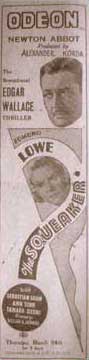 | Odeon advert |
For the first time here was an entertainment that could reach into the most remote villages, bringing flickering visions of worlds previously beyond imagination.
From daily newsreels of the silent era, to the Golden Age of cinema in the 1930s and '40s, the people of Devon came to know the stars of the silver screen whose glamorous lives became the talk of the schoolyard and village square.
Venues ranged from fairground tents in the late 19th and early 20th centuries, to the super multiplex in 1999. Devon, being a large, mainly rural county, saw the rise of many local entrepreneurs, and small circuits were often run as family concerns.
The Prince family in Teignmouth, the Ellis family with cinemas across the county, and the Noyces of Kingsbridge, were typical. In the early days, any building with a long enough throw was used for showing films. Later, purpose-built cinemas appeared, though often former shops or skating rinks were converted into cinemas.
These venues, whether in the city or in a market town, were small to medium in size, seating anything from 150 to 400 patrons.  | Odean Newton Abbott c.1937 |
The 1930s saw the emergence of the picture palace, with the advent of the Odeons, Gaumonts and ABCs. The Regent (later Odeon) in Plymouth, was the largest in the county, with a seating capacity of 3,254. From the start, the majority of picture houses were in the south of the county, which reflected both the geography of Devon, and the growth of tourism. In 1935, there were 45 full-time cinemas south of Chagford, and only 14 to the north. This remains true now, with the first multiplexes being the Warner Village in Plymouth and the Apollo in Paignton. Both opened in 1999.  | The State Cinema, St.Budeaux, c.1936 |
Cinema-going reached a peak in 1946, with some 30 million admissions per week in the UK. In 1939 there were an estimated 5,500 cinemas nationwide, with 75 in Devon. Plymouth lost seven cinemas in World War Two due to bombing, Devonport lost three, and Exeter lost four (two more were damaged but later repaired). Cinema-going declined after 1946 for various reasons, of which television was only one, until an upswing began in 1984.
However, this came too late to save the majority of Devon's cinemas, many of which reversed the earlier pattern and became shops, bingo and snooker halls, or were demolished. The closure of the Torbay Cinema in Paignton in 1999 was particularly tragic, as it was, to that date, the oldest working cinema in Europe.
Devon at the Cinema
by Gordon Chapman
is published by Halsgrove
£19.95
|