|  | It's not often that school children get the chance to work with professional musicians and hear their compositions played by experts.
But that's what's been happening in Plymouth and East Cornwall. Twenty students, aged from 14 to 19, spent their last half term holiday at Buckland Abbey.
They worked with Sewa-education, a company that teaches West African music and dance in schools and community groups.
The students learned about the Mandinka style of African music and were then challenged to each write their own five minute piece for the professional musicians to play.
 | | Beating a drum... |
They had to write for instruments like the bongo, djembe, dunun, balafon, flutes and small percussion.
The Audioworks project has been set up by a partnership of arts organisations and the National Trust.
Music Adviser Derek Kitt says the bulk of the funding has come from the National Foundation for Youth Music.
He says the work the students have come up with is extremely exciting.
"It's a million miles away from what they can do in school," he says. "There they have a limited amount of time for composing. This project gives them a week working with professional musicians.
"And composing for professional musicians means they can write anything. They normally compose music for other students to play, and are limited by their friends' instrumental skills."
The Education Officer at Buckland Abbey, Hannah Jones, says the project has been an amazing experience.
 | | Learning how it's done |
"The music the students have composed is wonderful," she said, "and it's incredible that they'd never played the African instruments before the week started."
And for the students themselves, it's a great experience. Aaron Maia is from Brazil and is studying in Plymouth for a year.
"I've never had experience with African instruments and music. Each instrument has a limit of sounds. So, you think about all you can do with one instrument, then pass to another.
"The music is not about notes, but about rhythm. This is a beautiful place and that really helps. You have the quiet of the place. You have the beauty of the place. It really helps make the composition.
"You have to have a connection with the instrument. Each one depends on the other. You see the other side of music working with other people.
"Maybe I will make some kind of music like this again in the future. I will not just stay on the violin or piano. I want to introduce this to other people."
Another student, Callum Hutchins, added: "It's great work here. You can release your mind. I haven't met anyone here before, but we're together - thinking music and talking the same language. That's really great! "
At the end of each project the students hear their work performed at a concert by the musicians they've been working with. And they're given a professionally recorded CD.
Derek Kitt hopes more teachers will come along to the next events.
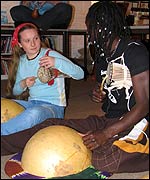 | | Taking advice |
"We'll be running two composition projects during the 2005 February half term. One is on rock music, and the other is on the string quintet."
And for the students themselves this project has a huge impact. One participant in the Buckland Abbey week said in his evaluation:
"I've just found out today that one of the African musicians runs a course in Senegal. I've asked my Mum if I can go."
Whether this Audioworks project will lead to a mass exodus of talented musicians from Devon to West Africa is yet to be seen.
But in the meantime, secondary schools in Plymouth are being invited to send students on any of the composition courses coming up over the next 18 months.
And from Derek Kitt's experience so far, the students have got so much out of the project that their reactions to it have been almost life-changing.
Article first published: November 2004.
|